Stud Bolt Selection Guide
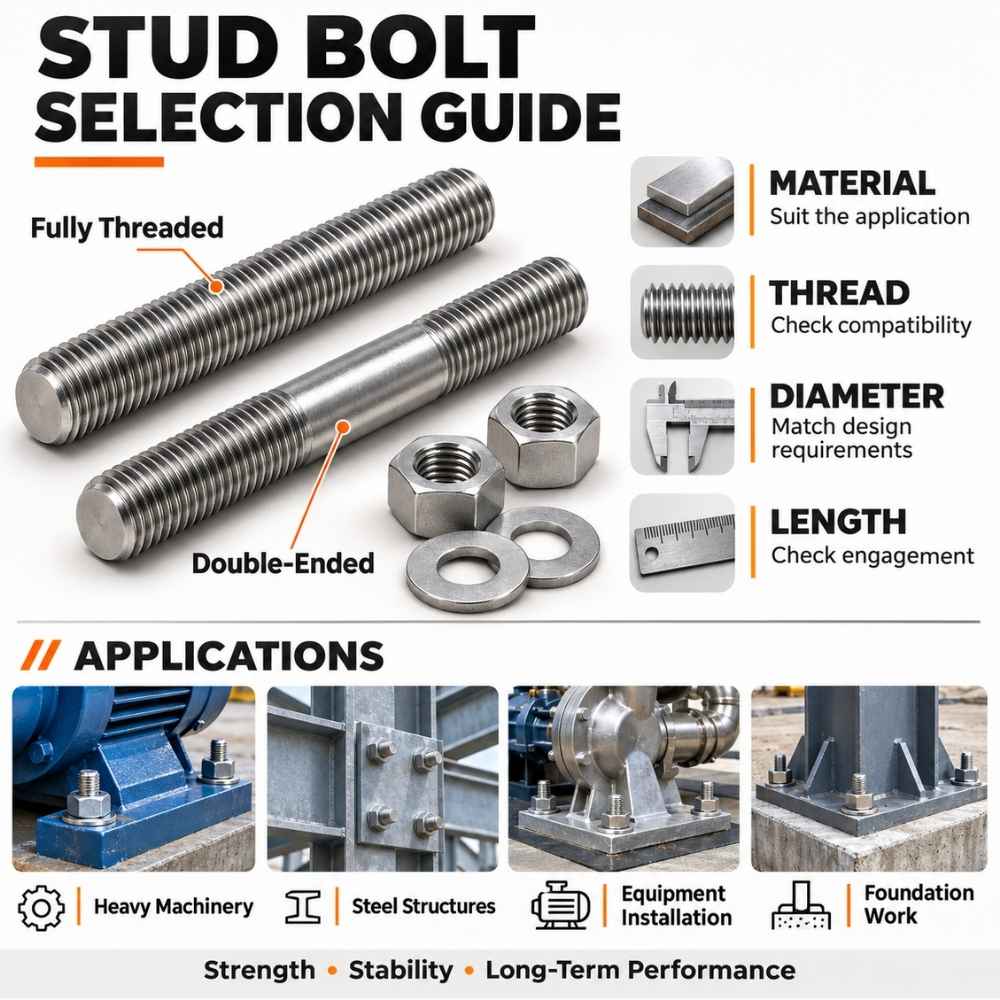
Industrial construction requires fastening solutions that deliver strength, stability, and long-term performance. Whether a project involves heavy machinery, steel structures, equipment installation, or foundation work, selecting the right fastening component plays an important role in overall safety. A Stud Bolt provides a practical solution for creating strong connections between structural components, machinery, and supporting foundations.
Unlike ordinary bolts, stud-type fasteners can offer threaded engagement at one or both ends, depending on their design. This lets engineers select suitable configurations for different installation requirements. The correct material, thread specification, diameter, and length also help maintain reliable connections under demanding working conditions.
For industrial buyers in Ahmedabad and across Gujarat, understanding product specifications is essential. This guide explains stud fastener types, applications, material options, selection factors, and installation considerations to help you make informed purchasing decisions.
What Is a Stud Bolt and Why Does It Matter?
A Stud Bolt is a threaded metal rod without a head, used to join two components or to anchor equipment to a supporting base. Nuts are fitted on the threaded portion to secure the connection, which makes it a dependable choice for industrial fastening. Here are four key points to understand before choosing one.
01. Headless Threaded Design
A Stud Bolt can be fully threaded or threaded at both ends. This design allows nut positions to be adjusted and gives strong threaded engagement in flange joints, machinery assemblies, and structural fastening.
02. Strong Foundation Anchoring
Foundation Bolts and MS Foundation Bolts work on a similar principle. They are embedded in concrete to hold columns, machines, and equipment bases firmly in place, helping keep the structure stable under load.
03. Material and Specification Matter
A weak or incorrectly chosen fastener can lead to loosening, misalignment, or joint failure. Material grade, diameter, length, and thread specification should always match the project’s engineering requirements.
04. Choosing the Right Manufacturer
A reliable Stud Bolt Manufacturer provides accurate dimensions, material test certificates, and consistent quality inspection. This ensures the product performs as expected in demanding industrial conditions.
Types of Stud Bolts Used in Industrial Applications
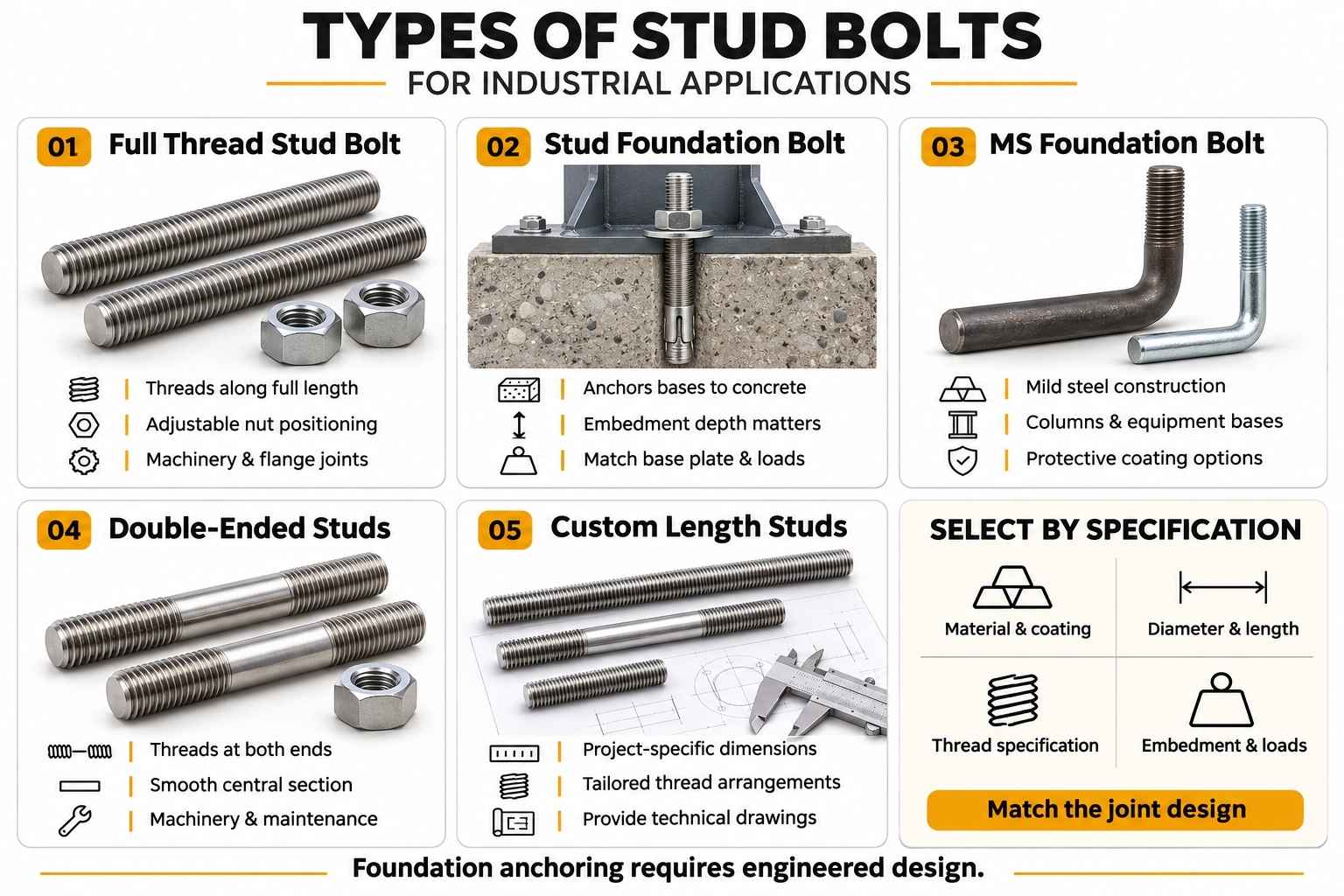
Industrial projects use different stud configurations according to connection requirements. Although these products share a threaded fastening principle, their designs and applications can vary.
01. Full Thread Stud Bolt
A Full Thread Stud Bolt features threads along its entire length. This configuration provides flexibility when installers need adjustable nut positioning or threaded engagement across different sections.
Common applications include:
- Industrial machinery connections
- Pipeline and equipment assemblies
- Flange connections
- Structural fastening arrangements
- Maintenance-related installations
Moreover, full-length threading allows installers to adjust the nut position according to the joint design. However, the selected diameter, material, and thread specification must match the intended application.
02. Stud Foundation Bolt
A Stud Foundation Bolt supports the anchoring of machinery, structural supports, and equipment bases to concrete foundations. Its design depends on the required embedment depth, thread arrangement, and foundation configuration.
Engineers may specify these fasteners when an installation requires a threaded connection between a machine base or support plate and a concrete foundation.
Before selecting one, consider:
- Required anchoring depth
- Threaded projection above concrete
- Concrete foundation dimensions
- Base plate thickness
- Expected loading conditions
Importantly, a foundation anchoring system needs suitable engineering design. Product selection alone cannot replace proper anchoring calculations.
03. MS Foundation Bolt
An MS Foundation Bolt is made from mild steel and is widely used for general-purpose anchoring of columns, machinery, and equipment bases. MS Foundation Bolts are available in different shapes and lengths, so the right choice depends on the foundation design and load requirements. For outdoor or humid locations, consider a protective coating such as hot-dip galvanizing.
04. Double-Ended Studs
Double-ended studs have threads at both ends, often with an unthreaded section between them. One end engages with a tapped component, while the other accepts a nut.
These fasteners commonly support machinery assembly, equipment maintenance, and industrial flange connections.
05. Custom Length Studs
Some projects require non-standard dimensions or specific thread arrangements. In such situations, custom-length products can help meet the installation requirements.
Buyers should provide accurate technical drawings and specifications before requesting custom manufacturing.
Important Factors to Consider When Selecting a Stud Bolt
Choosing a suitable fastener involves more than comparing dimensions or prices. Material properties, loading conditions, environmental exposure, and installation requirements all influence performance.
01. Select the Appropriate Material
Material selection affects strength, durability, corrosion resistance, and service life.
Common material options include:
- Mild Steel: Suitable for many general-purpose industrial fastening applications.
- Alloy Steel: Offers specific mechanical properties for demanding applications when manufactured and heat-treated to the required specification.
- Stainless Steel: Provides improved corrosion resistance in suitable environmental conditions.
A suitable material should meet the project’s engineering requirements rather than simply the lowest purchase cost.
02. Check Diameter and Length
Incorrect dimensions can create installation problems and affect connection performance. Therefore, confirm the required measurements before placing an order.
Important dimensions include:
- Nominal diameter
- Overall length
- Threaded length
- Unthreaded shank length
- Thread pitch
- Nut engagement length
For foundation applications, also consider embedment depth and the required projection above the concrete surface.
03. Understand Strength Grades
Strength grades indicate important mechanical properties of fastening materials. However, the appropriate grade depends on the applicable product standard and service conditions.
For this reason, buyers should check material certificates, specified grades, and relevant manufacturing requirements before approving a product.
04. Consider Surface Finish and Protection
Industrial fasteners may operate in humid, outdoor, chemical, or high-temperature environments. Consequently, surface protection can influence their service life.
Depending on the application, available options may include:
- Plain or self-finish
- Zinc coating
- Hot-dip galvanizing
- Other specified protective coatings
Always confirm coating compatibility with the selected material, dimensions, and operating environment.
05. Match the Fastener to the Load Conditions
Every industrial connection experiences different forces. Some joints mainly experience tension, while others may encounter shear, vibration, or combined loading.
Engineers should assess:
- Tensile loading
- Shear forces
- Vibration exposure
- Temperature conditions
- Corrosion risks
- Fatigue requirements
Proper engineering assessment helps prevent unsuitable product selection.
Industrial Applications of Stud Bolts and Foundation Fasteners
Stud-type fasteners support a wide range of industrial activities because they provide practical threaded connections.
01. Heavy Machinery Installation
Manufacturing facilities use threaded fasteners to secure machine components, mounting assemblies, and supporting structures. Correct dimensions and tightening procedures help maintain stable connections during operation.
02. Construction and Structural Engineering
Steel structures, industrial platforms, and supporting assemblies often require reliable fastening arrangements. Suitable threaded products help connect components according to engineering drawings.
03. Oil, Gas, and Pipeline Equipment
Industrial pipeline systems use stud fasteners in suitable flange and equipment connections. Material selection becomes particularly important when installations involve pressure, temperature variations, or corrosive environments.
04. Power Plants and Industrial Facilities
Power generation facilities contain machinery, equipment supports, and structural assemblies that require dependable fastening components. Proper specifications help support maintenance and operational requirements.
05. Manufacturing and Processing Plants
Production facilities use threaded fasteners in machinery installation, equipment assembly, and maintenance activities. Standardized dimensions also help simplify replacement and inventory management.
How to Choose a Reliable Stud Bolt Manufacturer
Selecting a dependable Stud Bolt Manufacturer is an important part of industrial procurement. A suitable supplier should understand technical requirements and provide products that match the approved specifications.
Before finalizing your purchase, evaluate these factors:
- Manufacturing capability: Check whether the manufacturer can produce the required sizes, materials, and thread configurations.
- Material quality: Ask for relevant material test certificates and traceability documents.
- Dimensional accuracy: Confirm that products meet the approved technical drawings.
- Quality inspection: Review the manufacturer’s inspection and testing procedures.
- Custom requirements: Check whether the supplier can accommodate project-specific dimensions.
- Delivery reliability: Evaluate production capacity and expected delivery schedules.
- Technical communication: Choose a supplier that understands your specifications and responds clearly to technical queries.
Furthermore, request a quotation that clearly mentions material grade, dimensions, coating, applicable standards, and quantity. This approach makes supplier comparisons more accurate.
Stud Bolt Types Compared by Features and Applications
Frequently Asked Questions About Stud Bolts
A Stud Bolt is a headless threaded metal rod used to join two components or anchor equipment to a base. It is threaded along its full length or at both ends, and nuts are fitted on the threaded portions to secure the connection.
A normal bolt has a head on one end, while a Stud Bolt has no head and carries threads at one or both ends. This allows nuts to be fitted on both sides and makes nut positioning more flexible.
A Full Thread Stud Bolt has threads along its entire length. It is commonly used in flange connections, pipeline and equipment assemblies, machinery fastening, and maintenance work where adjustable nut positioning is needed.
A Stud Foundation Bolt anchors machinery, structural supports, and equipment bases to concrete foundations. Its design depends on the embedment depth, thread arrangement, and foundation configuration.
An MS Foundation Bolt is made from mild steel and widely used for general-purpose anchoring of columns, machines, and equipment bases. MS Foundation Bolts come in different shapes and lengths depending on the foundation design.
Common options are mild steel, alloy steel, and stainless steel. Mild steel suits general-purpose use, alloy steel suits demanding applications when heat-treated to specification, and stainless steel offers better corrosion resistance.
No FAQ found.
Check the nominal diameter, overall length, threaded length, thread pitch, and nut engagement length. For foundation applications, also consider the embedment depth and the projection above the concrete surface.
It depends on the environment. Plain or self-finish suits dry indoor use, while zinc coating or hot-dip galvanizing is preferred for humid, outdoor, or corrosive locations. Always confirm the coating is compatible with the material and dimensions.
The right grade depends on the applicable product standard, load conditions, and service environment. Check the material test certificate and specified grade before approving a product, and consult your engineer for critical applications.
Yes, a good Stud Bolt Manufacturer can produce custom lengths and special thread arrangements. Share accurate technical drawings and specifications to avoid errors.
Check the manufacturer’s production capability, material test certificates, inspection procedures, dimensional accuracy, and delivery reliability. Also look for clear technical communication and the ability to handle custom requirements.
Mention the product type, material grade, dimensions, coating, applicable standards, and quantity. Sharing drawings also helps, as it makes supplier comparisons accurate and avoids delays.
No FAQ found.
Final Thoughts on Choosing the Right Stud Bolt
Choosing the right threaded fastener requires careful attention to material quality, dimensions, thread configuration, strength requirements, and operating conditions. From machinery installation to industrial foundation work, suitable fastening products help create dependable mechanical connections.
Whether your project requires a Full Thread Stud Bolt, a Stud Foundation Bolt, or an MS Foundation Bolt, always match the product specifications with the engineering requirements. Work with a manufacturer that maintains dimensional accuracy, material traceability, and consistent quality inspection.
A well-informed purchasing decision can improve installation efficiency, simplify maintenance, and support long-term structural reliability. To discuss your requirements, contact us with your drawings and specifications for a detailed quotation.