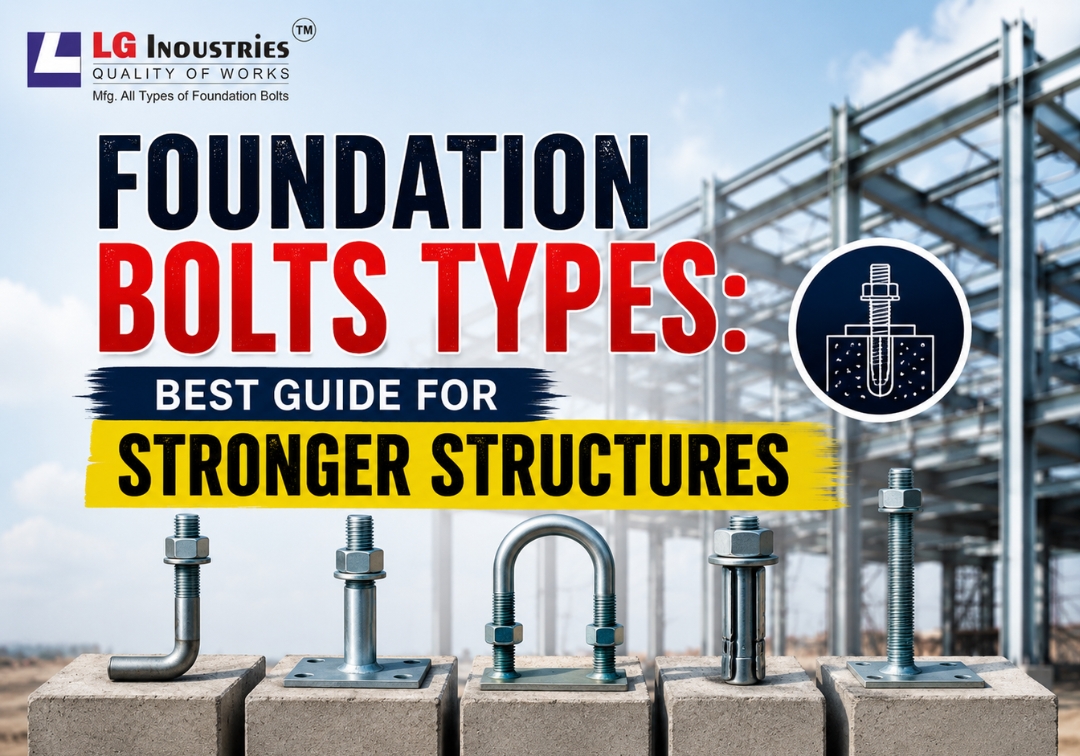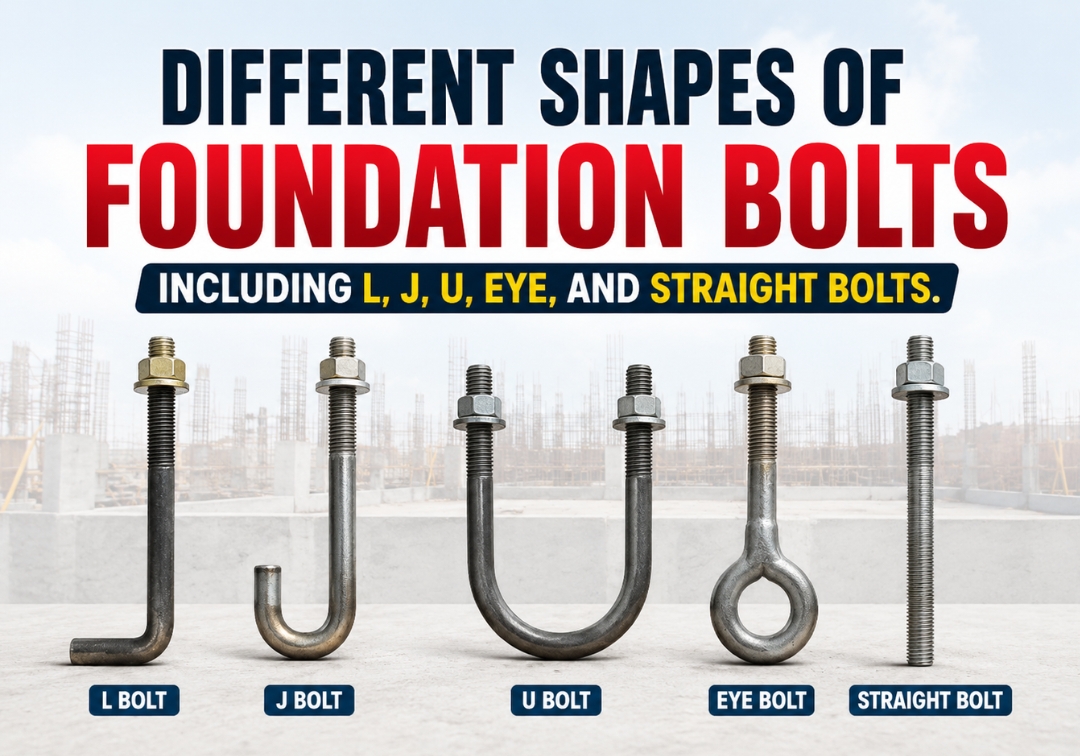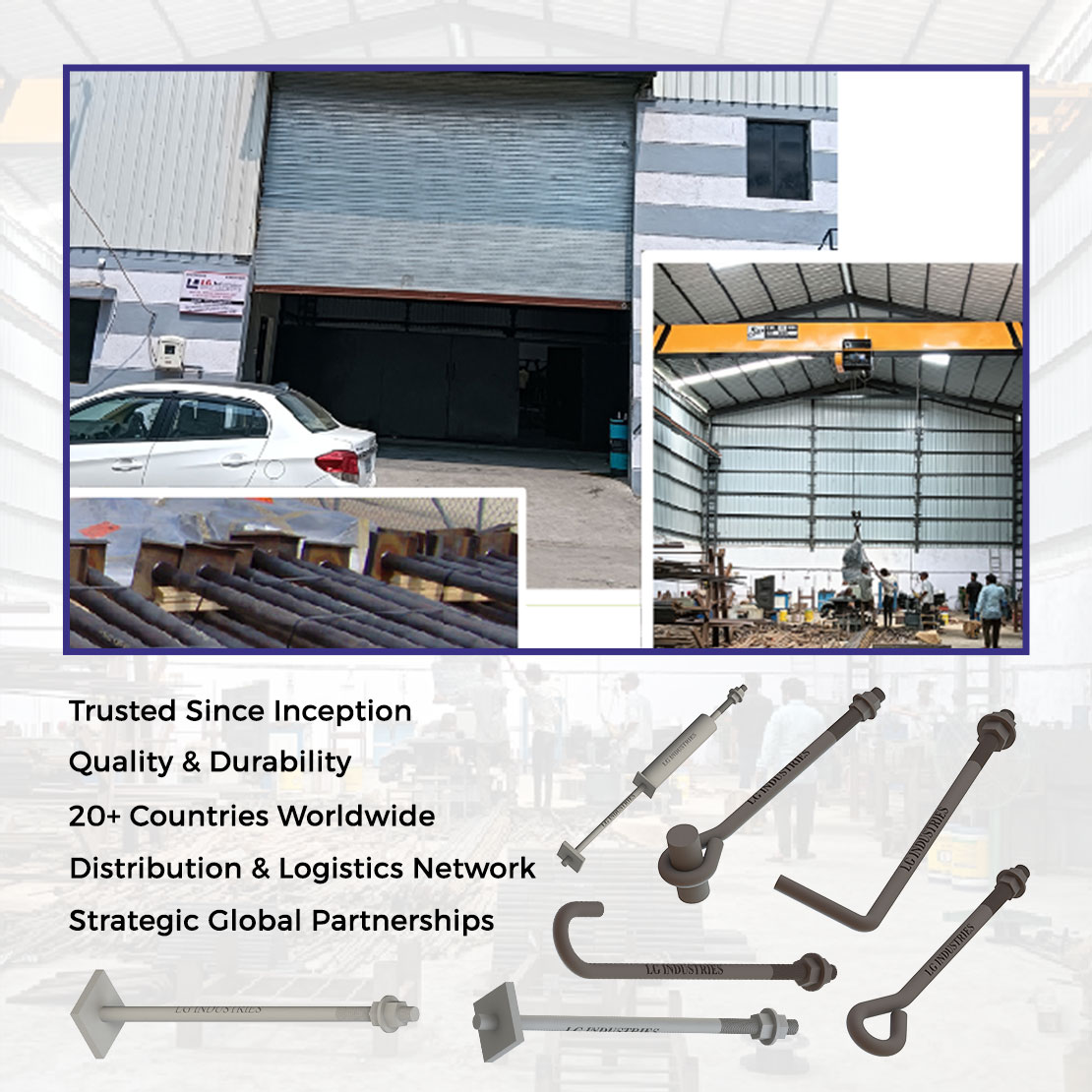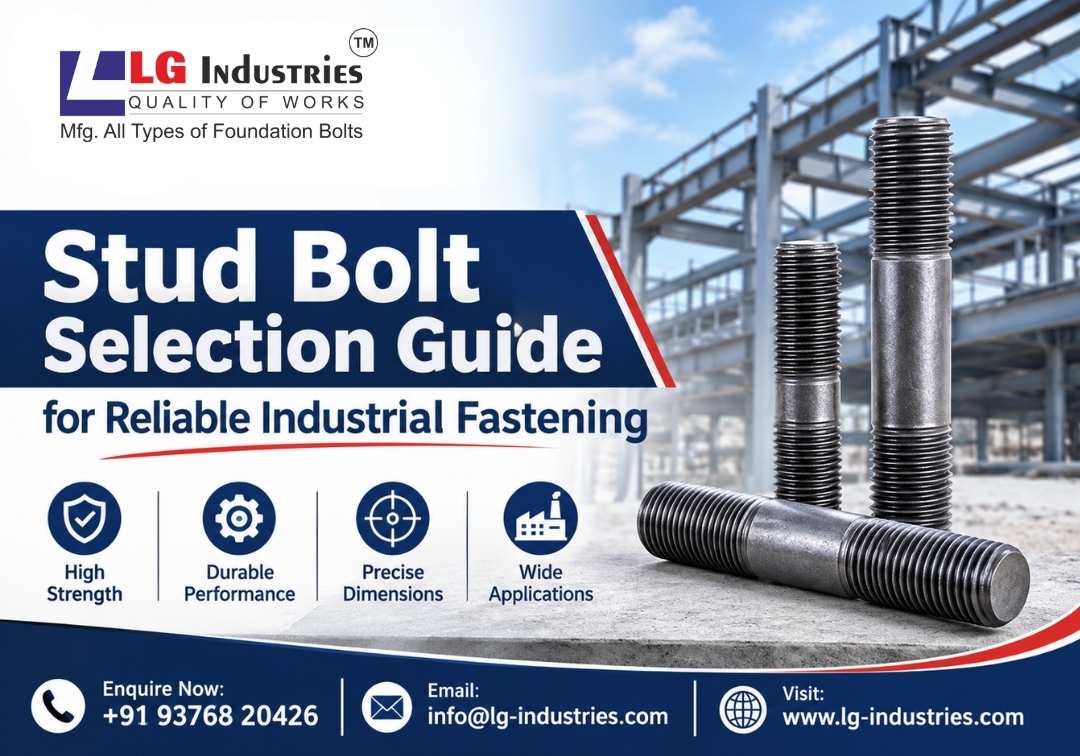
Stud Bolt Selection Guide for Reliable Industrial Fastening - LG Industries

Stud Bolt Selection Guide for Reliable Industrial Fastening

Stud Bolt Selection Guide
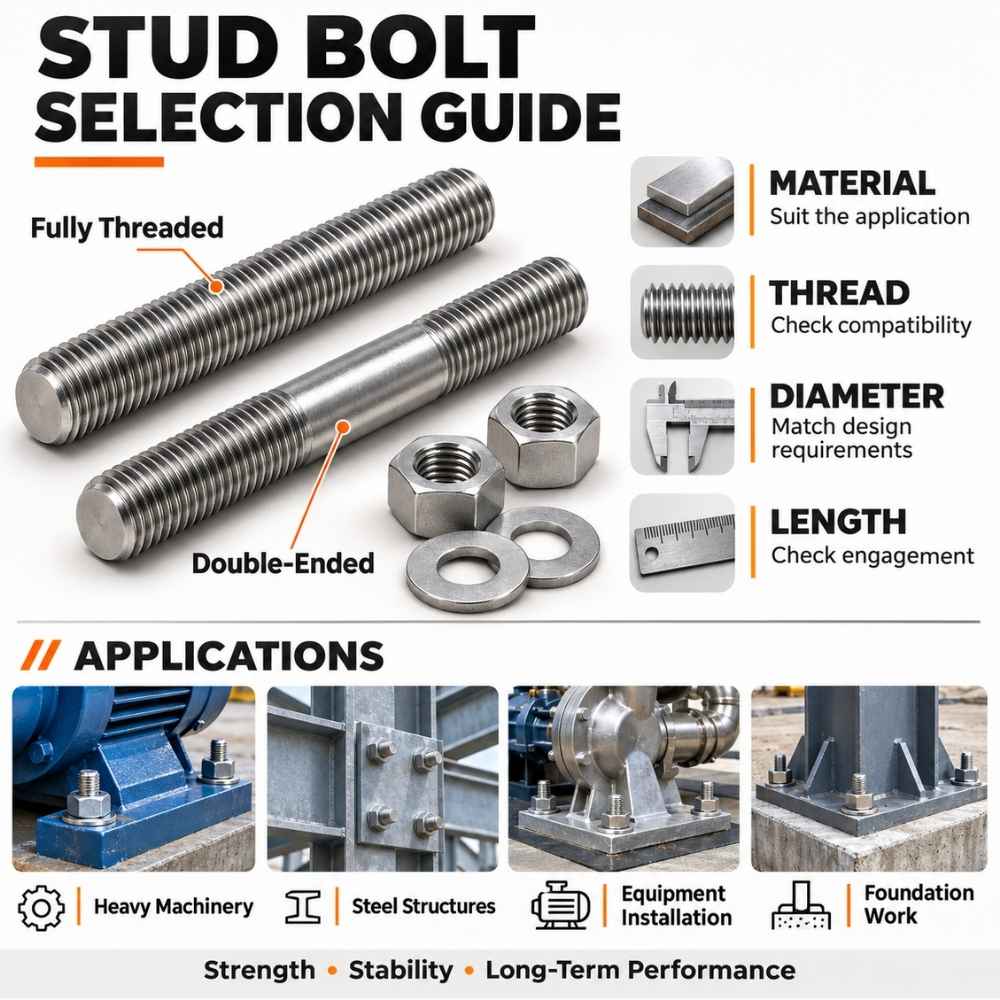
Stud Bolt Selection Guide - LG Industries

Industrial construction requires fastening solutions that deliver strength, stability, and long-term performance. Whether a project involves heavy machinery, steel structures, equipment installation, or foundation work, selecting the right fastening component plays an important role in overall safety. A Stud Bolt provides a practical solution for creating strong connections between structural components, machinery, and supporting foundations.

Unlike ordinary bolts, stud-type fasteners can offer threaded engagement at one or both ends, depending on their design. This lets engineers select suitable configurations for different installation requirements. The correct material, thread specification, diameter, and length also help maintain reliable connections under demanding working conditions.

For industrial buyers in Ahmedabad and across Gujarat, understanding product specifications is essential. This guide explains stud fastener types, applications, material options, selection factors, and installation considerations to help you make informed purchasing decisions.

What Is a Stud Bolt and Why Does It Matter?

A Stud Bolt is a threaded metal rod without a head, used to join two components or to anchor equipment to a supporting base. Nuts are fitted on the threaded portion to secure the connection, which makes it a dependable choice for industrial fastening. Here are four key points to understand before choosing one.

01. Headless Threaded Design

A Stud Bolt can be fully threaded or threaded at both ends. This design allows nut positions to be adjusted and gives strong threaded engagement in flange joints, machinery assemblies, and structural fastening.

02. Strong Foundation Anchoring

Foundation Bolts and MS Foundation Bolts work on a similar principle. They are embedded in concrete to hold columns, machines, and equipment bases firmly in place, helping keep the structure stable under load.

03. Material and Specification Matter

A weak or incorrectly chosen fastener can lead to loosening, misalignment, or joint failure. Material grade, diameter, length, and thread specification should always match the project’s engineering requirements.

04. Choosing the Right Manufacturer

A reliable Stud Bolt Manufacturer provides accurate dimensions, material test certificates, and consistent quality inspection. This ensures the product performs as expected in demanding industrial conditions.

Types of Stud Bolts Used in Industrial Applications
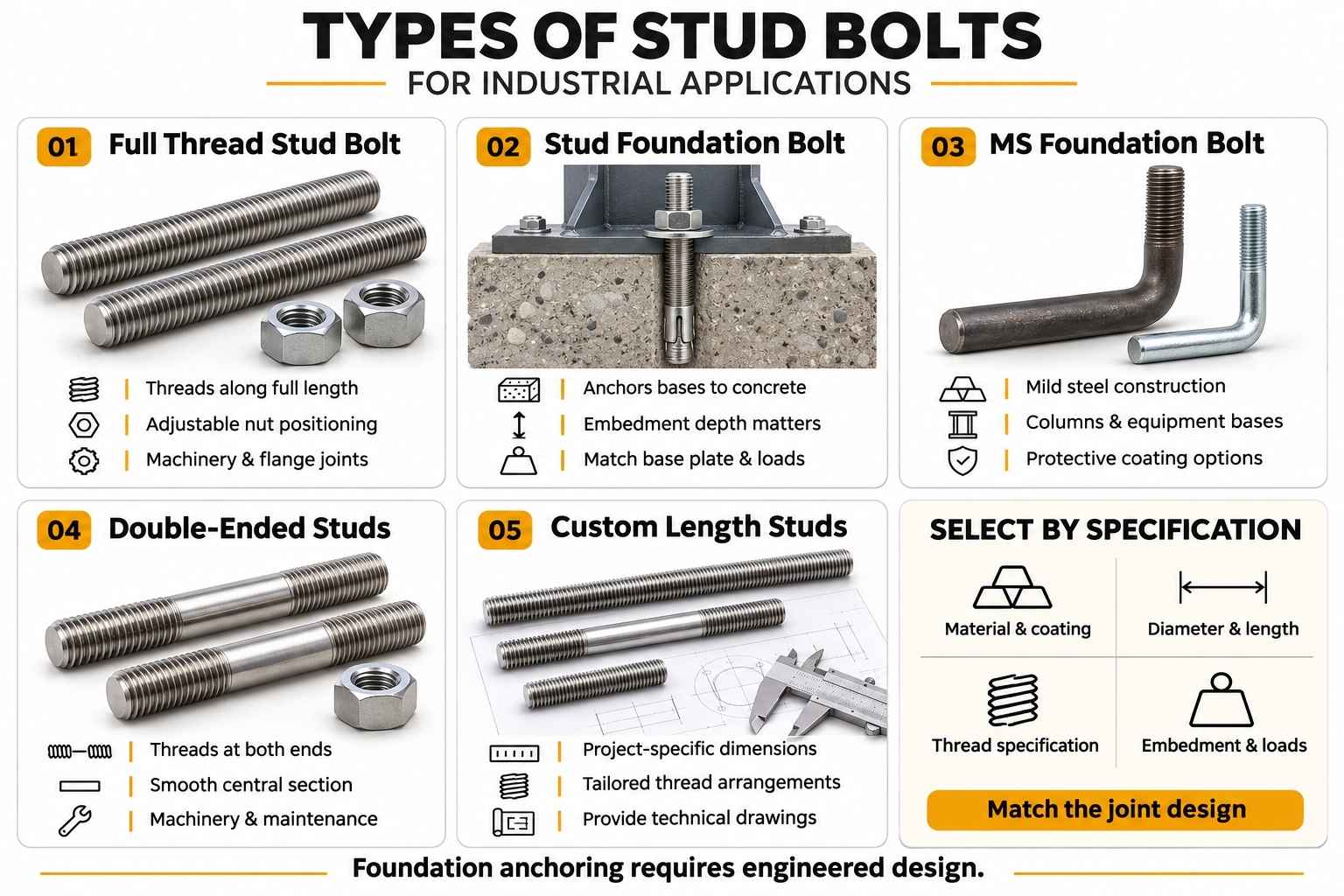
Types of Stud Bolts Used in Industrial Applications - LG Industries

Industrial projects use different stud configurations according to connection requirements. Although these products share a threaded fastening principle, their designs and applications can vary.

01. Full Thread Stud Bolt

A Full Thread Stud Bolt features threads along its entire length. This configuration provides flexibility when installers need adjustable nut positioning or threaded engagement across different sections.

Common applications include:

  • Industrial machinery connections
  • Pipeline and equipment assemblies
  • Flange connections
  • Structural fastening arrangements
  • Maintenance-related installations

Moreover, full-length threading allows installers to adjust the nut position according to the joint design. However, the selected diameter, material, and thread specification must match the intended application.

02. Stud Foundation Bolt

A Stud Foundation Bolt supports the anchoring of machinery, structural supports, and equipment bases to concrete foundations. Its design depends on the required embedment depth, thread arrangement, and foundation configuration.

Engineers may specify these fasteners when an installation requires a threaded connection between a machine base or support plate and a concrete foundation.

Before selecting one, consider:

  • Required anchoring depth
  • Threaded projection above concrete
  • Concrete foundation dimensions
  • Base plate thickness
  • Expected loading conditions

Importantly, a foundation anchoring system needs suitable engineering design. Product selection alone cannot replace proper anchoring calculations.

03. MS Foundation Bolt

An MS Foundation Bolt is made from mild steel and is widely used for general-purpose anchoring of columns, machinery, and equipment bases. MS Foundation Bolts are available in different shapes and lengths, so the right choice depends on the foundation design and load requirements. For outdoor or humid locations, consider a protective coating such as hot-dip galvanizing.

04. Double-Ended Studs

Double-ended studs have threads at both ends, often with an unthreaded section between them. One end engages with a tapped component, while the other accepts a nut.

These fasteners commonly support machinery assembly, equipment maintenance, and industrial flange connections.

05. Custom Length Studs

Some projects require non-standard dimensions or specific thread arrangements. In such situations, custom-length products can help meet the installation requirements.

Buyers should provide accurate technical drawings and specifications before requesting custom manufacturing.

Important Factors to Consider When Selecting a Stud Bolt

Choosing a suitable fastener involves more than comparing dimensions or prices. Material properties, loading conditions, environmental exposure, and installation requirements all influence performance.

01. Select the Appropriate Material

Material selection affects strength, durability, corrosion resistance, and service life.

Common material options include:

  • Mild Steel: Suitable for many general-purpose industrial fastening applications.
  • Alloy Steel: Offers specific mechanical properties for demanding applications when manufactured and heat-treated to the required specification.
  • Stainless Steel: Provides improved corrosion resistance in suitable environmental conditions.

A suitable material should meet the project’s engineering requirements rather than simply the lowest purchase cost.

02. Check Diameter and Length

Incorrect dimensions can create installation problems and affect connection performance. Therefore, confirm the required measurements before placing an order.

Important dimensions include:

  • Nominal diameter
  • Overall length
  • Threaded length
  • Unthreaded shank length
  • Thread pitch
  • Nut engagement length

For foundation applications, also consider embedment depth and the required projection above the concrete surface.

03. Understand Strength Grades

Strength grades indicate important mechanical properties of fastening materials. However, the appropriate grade depends on the applicable product standard and service conditions.

For this reason, buyers should check material certificates, specified grades, and relevant manufacturing requirements before approving a product.

04. Consider Surface Finish and Protection

Industrial fasteners may operate in humid, outdoor, chemical, or high-temperature environments. Consequently, surface protection can influence their service life.

Depending on the application, available options may include:

  • Plain or self-finish
  • Zinc coating
  • Hot-dip galvanizing
  • Other specified protective coatings

Always confirm coating compatibility with the selected material, dimensions, and operating environment.

05. Match the Fastener to the Load Conditions

Every industrial connection experiences different forces. Some joints mainly experience tension, while others may encounter shear, vibration, or combined loading.

Engineers should assess:

  • Tensile loading
  • Shear forces
  • Vibration exposure
  • Temperature conditions
  • Corrosion risks
  • Fatigue requirements

Proper engineering assessment helps prevent unsuitable product selection.

Industrial Applications of Stud Bolts and Foundation Fasteners

Stud-type fasteners support a wide range of industrial activities because they provide practical threaded connections.

01. Heavy Machinery Installation

Manufacturing facilities use threaded fasteners to secure machine components, mounting assemblies, and supporting structures. Correct dimensions and tightening procedures help maintain stable connections during operation.

02. Construction and Structural Engineering

Steel structures, industrial platforms, and supporting assemblies often require reliable fastening arrangements. Suitable threaded products help connect components according to engineering drawings.

03. Oil, Gas, and Pipeline Equipment

Industrial pipeline systems use stud fasteners in suitable flange and equipment connections. Material selection becomes particularly important when installations involve pressure, temperature variations, or corrosive environments.

04. Power Plants and Industrial Facilities

Power generation facilities contain machinery, equipment supports, and structural assemblies that require dependable fastening components. Proper specifications help support maintenance and operational requirements.

05. Manufacturing and Processing Plants

Production facilities use threaded fasteners in machinery installation, equipment assembly, and maintenance activities. Standardized dimensions also help simplify replacement and inventory management.

How to Choose a Reliable Stud Bolt Manufacturer

Selecting a dependable Stud Bolt Manufacturer is an important part of industrial procurement. A suitable supplier should understand technical requirements and provide products that match the approved specifications.

Before finalizing your purchase, evaluate these factors:

  • Manufacturing capability: Check whether the manufacturer can produce the required sizes, materials, and thread configurations.
  • Material quality: Ask for relevant material test certificates and traceability documents.
  • Dimensional accuracy: Confirm that products meet the approved technical drawings.
  • Quality inspection: Review the manufacturer’s inspection and testing procedures.
  • Custom requirements: Check whether the supplier can accommodate project-specific dimensions.
  • Delivery reliability: Evaluate production capacity and expected delivery schedules.
  • Technical communication: Choose a supplier that understands your specifications and responds clearly to technical queries.

Furthermore, request a quotation that clearly mentions material grade, dimensions, coating, applicable standards, and quantity. This approach makes supplier comparisons more accurate.

Stud Bolt Types Compared by Features and Applications

Type Thread Design Common Applications Key Selection Point
Full Thread Stud Bolt Threaded along the entire length Flange connections, pipeline and equipment assemblies, machinery fastening Diameter, thread pitch, and material grade
Double Ended Stud Threads at both ends with an unthreaded section between Machinery assembly, equipment maintenance, industrial flanges Threaded length at each end and nut engagement
Stud Foundation Bolt Threaded projection above concrete, embedded at the other end Anchoring machinery, structural supports, and equipment bases Embedment depth and projection above concrete
MS Foundation Bolt Mild steel, available in different shapes and lengths General-purpose anchoring of columns, machines, and equipment bases Foundation design, load, and protective coating
Custom Length Stud Non-standard length or special thread arrangement Project-specific installations Accurate technical drawings and specifications

Frequently Asked Questions About Stud Bolts

A Stud Bolt is a headless threaded metal rod used to join two components or anchor equipment to a base. It is threaded along its full length or at both ends, and nuts are fitted on the threaded portions to secure the connection.

Was this helpful?

A normal bolt has a head on one end, while a Stud Bolt has no head and carries threads at one or both ends. This allows nuts to be fitted on both sides and makes nut positioning more flexible.

Was this helpful?

A Full Thread Stud Bolt has threads along its entire length. It is commonly used in flange connections, pipeline and equipment assemblies, machinery fastening, and maintenance work where adjustable nut positioning is needed.

Was this helpful?

A Stud Foundation Bolt anchors machinery, structural supports, and equipment bases to concrete foundations. Its design depends on the embedment depth, thread arrangement, and foundation configuration.

Was this helpful?

An MS Foundation Bolt is made from mild steel and widely used for general-purpose anchoring of columns, machines, and equipment bases. MS Foundation Bolts come in different shapes and lengths depending on the foundation design.

Was this helpful?

Common options are mild steel, alloy steel, and stainless steel. Mild steel suits general-purpose use, alloy steel suits demanding applications when heat-treated to specification, and stainless steel offers better corrosion resistance.

Was this helpful?

Check the nominal diameter, overall length, threaded length, thread pitch, and nut engagement length. For foundation applications, also consider the embedment depth and the projection above the concrete surface.

Was this helpful?

It depends on the environment. Plain or self-finish suits dry indoor use, while zinc coating or hot-dip galvanizing is preferred for humid, outdoor, or corrosive locations. Always confirm the coating is compatible with the material and dimensions.

Was this helpful?

The right grade depends on the applicable product standard, load conditions, and service environment. Check the material test certificate and specified grade before approving a product, and consult your engineer for critical applications.

Was this helpful?

Yes, a good Stud Bolt Manufacturer can produce custom lengths and special thread arrangements. Share accurate technical drawings and specifications to avoid errors.

Was this helpful?

Check the manufacturer’s production capability, material test certificates, inspection procedures, dimensional accuracy, and delivery reliability. Also look for clear technical communication and the ability to handle custom requirements.

Was this helpful?

Mention the product type, material grade, dimensions, coating, applicable standards, and quantity. Sharing drawings also helps, as it makes supplier comparisons accurate and avoids delays.

Was this helpful?

Final Thoughts on Choosing the Right Stud Bolt

Choosing the right threaded fastener requires careful attention to material quality, dimensions, thread configuration, strength requirements, and operating conditions. From machinery installation to industrial foundation work, suitable fastening products help create dependable mechanical connections.

Whether your project requires a Full Thread Stud Bolt, a Stud Foundation Bolt, or an MS Foundation Bolt, always match the product specifications with the engineering requirements. Work with a manufacturer that maintains dimensional accuracy, material traceability, and consistent quality inspection.

A well-informed purchasing decision can improve installation efficiency, simplify maintenance, and support long-term structural reliability. To discuss your requirements, contact us with your drawings and specifications for a detailed quotation.
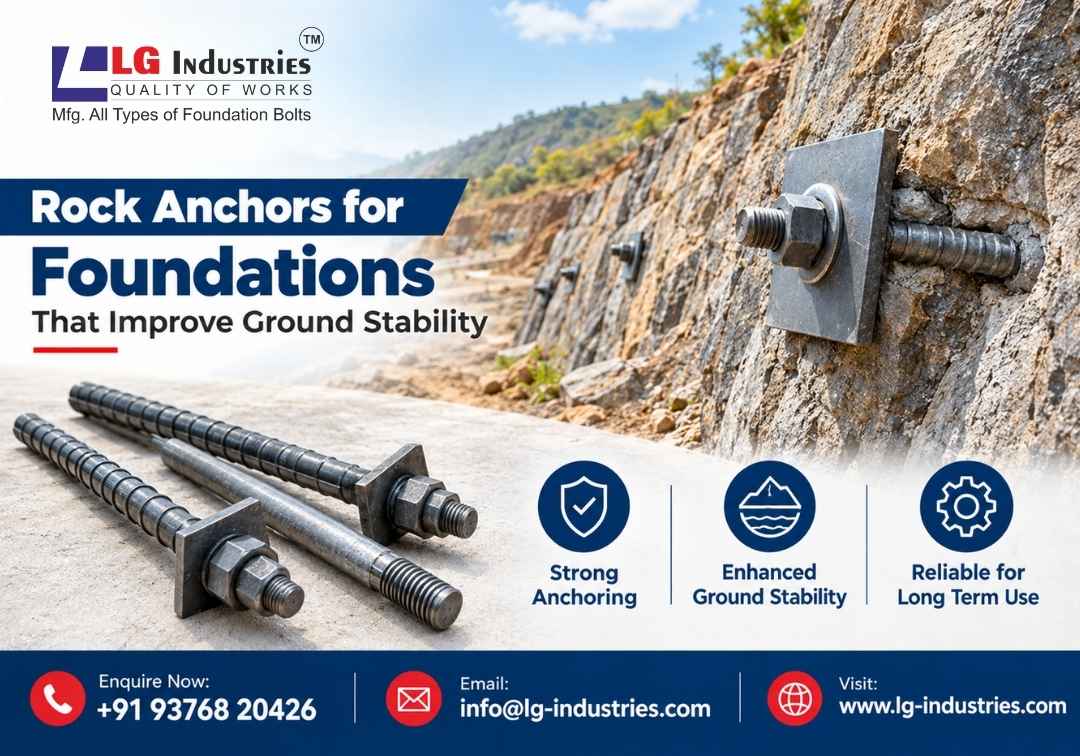
    Rock Anchors for Foundations That Improve Ground Stability - LG Industries

    Rock Anchors for Foundations That Improve Ground Stability

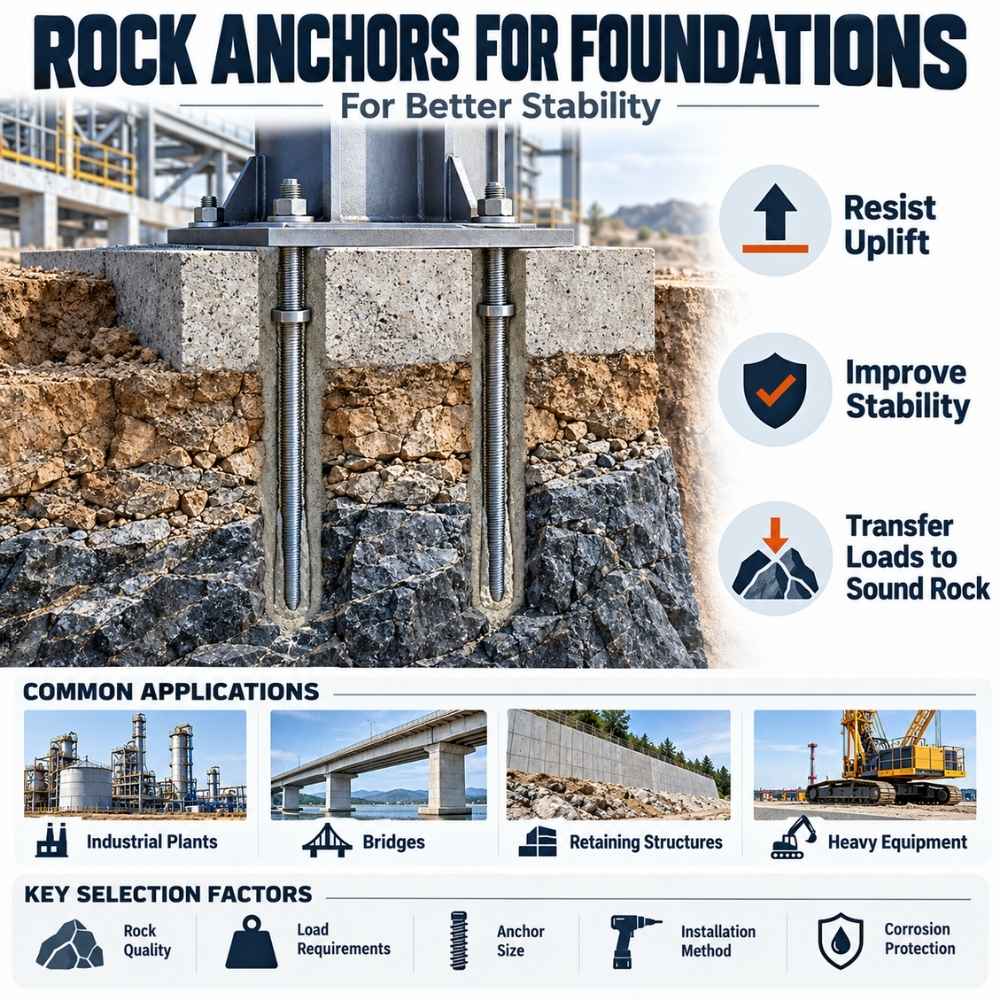
    Rock Anchors For Foundations for Better Stability

    Rock Anchors For Foundations for Better Stability - LG Industries

    Strong foundations determine the safety, durability, and performance of industrial structures. But not every site offers ground suitable for conventional foundations. Rocky terrain, steep slopes, and fractured rock often call for specialized anchoring to achieve dependable support.

    Rock anchors for foundations solve this by connecting a structure to competent rock. They resist uplift, improve stability, and transfer loads into sound rock layers. Engineers use them in industrial plants, bridges, retaining structures, and heavy equipment installations.

    Choosing the right system means weighing rock quality, load requirements, anchor dimensions, installation method, and corrosion protection. Suitable foundation bolts and MS foundation bolts also help create secure connections between base plates and the structure above.

    This guide explains how rock anchoring works, where it is used, and what buyers should check before selecting products.

    What Are Rock Anchors for Foundations, and How Do They Work?

    Rock anchors are specialized structural fastening systems that connect a foundation or structure to a stable rock formation. Depending on the design, they use steel rods, high-strength bars, strands, grout, and anchoring components to transfer loads safely into the surrounding rock.

    Unlike ordinary fastening arrangements, these systems can resist significant tensile and uplift forces. Moreover, engineers select their configuration according to the geological conditions and the structural requirements of each project.

    A typical rock anchoring arrangement includes the following:

    01. Steel Anchor Bar 

    The steel anchor bar provides the primary tensile strength required for load resistance. It carries the force from the structure down into the rock.

    02. Drilled Borehole and Grout 

    Workers drill a borehole to create space for the anchoring assembly. Grout then bonds the anchor with the surrounding rock and transfers the load.

    03. Bearing Plate, Nuts, and Accessories 

    The bearing plate distributes forces around the anchor connection. Nuts and other accessories secure the exposed threaded portion where the design requires them.

    04. Protective Coating 

    A protective coating helps reduce corrosion and improve the service life of the anchor, especially in moist or chemically exposed conditions.

    During installation, workers drill a hole into the selected rock formation. Next, they position the anchor assembly and introduce suitable grout where the design specifies a bonded installation. After the grout develops the required strength, the system can transfer loads through the anchorage.

    Why Rock Anchors For Foundations Improve Ground Stability

    Ground stability directly affects the performance of industrial buildings, machinery foundations, and infrastructure projects. Weak or fractured ground can create movement, settlement, sliding, or uplift problems.

    A properly engineered rock anchoring system helps address these challenges by connecting the structure to a suitable rock mass.

    Here are some important benefits:

    01. Improved Uplift Resistance

    Certain structures experience upward forces because of wind pressure, water pressure, or operating conditions. Properly designed anchors resist these forces and help maintain structural stability.

    02. Better Structural Support

    Anchoring systems transfer tensile loads into suitable rock formations. As a result, engineers can improve the stability of structures installed on challenging sites.

    03. Support for Sloping Ground

    Construction on steep or uneven terrain requires additional attention to sliding and movement. Rock anchors can help stabilize retaining structures and other engineered arrangements.

    04. Reduced Foundation Movement

    When engineers select suitable anchoring points and installation methods, the system can help control unwanted structural movement.

    05. Flexible Engineering Applications

    Different anchor configurations support different load conditions. Therefore, engineers can select passive or prestressed arrangements according to the project design.

    Common Types of Rock Anchors for Foundations

    Common Types of Rock Anchors for Foundations - LG Industries

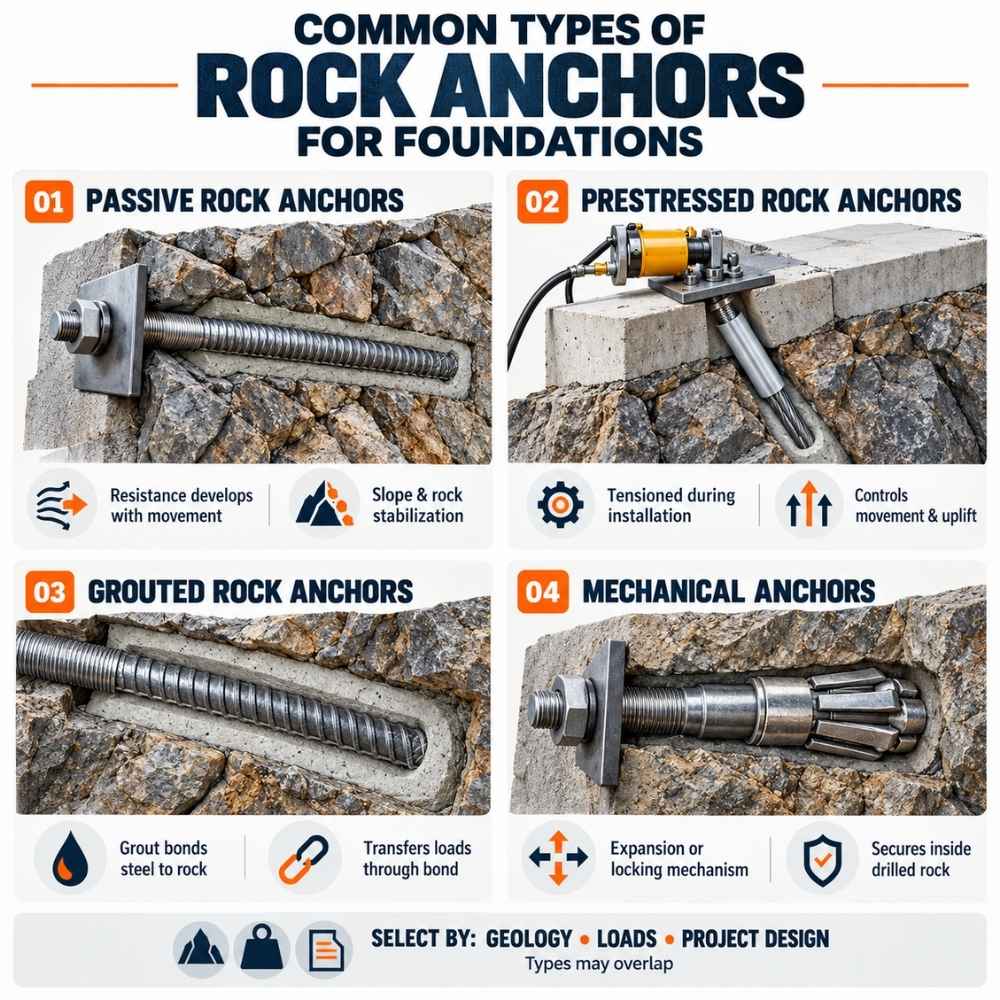
    Engineers select the anchoring method only after evaluating the site and expected loads. Each type works differently, so the right choice depends on geology, load conditions, and the project design.

    The most common types include the following:

    01. Passive Rock Anchors 

    Passive rock anchors develop resistance as the surrounding ground or structure begins to move, relying on the bond between the anchor and the rock. They are common in rock stabilization, slope protection, and retaining applications.

    02. Prestressed Rock Anchors 

    Prestressed rock anchors are tensioned during installation, creating active resistance before full service loads arrive. They suit applications that need controlled resistance to movement or uplift.

    03. Grouted Rock Anchors 

    Grouted rock anchors use cementitious or other specified grout to transfer load between the steel and the rock. Design depends on grout strength, bond length, borehole diameter, and rock quality.

    04. Mechanical Anchors 

    Mechanical anchors use expansion or another locking mechanism inside a drilled hole. Selection depends on the substrate, loads, installation conditions, and approved product specifications.

    Rock Anchors for Foundations Used in Industry and Construction 

    Rock anchoring solutions support several construction and engineering sectors. Their ability to transfer forces into suitable rock formations makes them useful in challenging ground conditions.

    Common applications include the following:

    01. Industrial Foundations 

    Rock anchors support structures that require resistance against uplift and movement.

    02. Bridge Construction

    They help secure selected structural components and foundation arrangements.

    03. Retaining Walls

    Anchors improve stability in engineered retaining systems.

    04. Slope Stabilization

    They control movement in suitable rock slopes and cuttings.

    05. Hydropower Projects

    Anchors support selected structures exposed to water pressure and uplift forces.

    06. Mining Operations

    They secure rock surfaces and underground support systems.

    07. Heavy Machinery Installations

    Anchors provide secure anchoring arrangements for equipment foundations.

    08. Infrastructure Projects

    They support engineered structures in rocky and uneven locations.

    However, every application requires an appropriate engineering assessment. Rock strength, discontinuities, groundwater conditions, and expected loading can significantly influence anchor performance.

    Key Factors When Selecting Rock Anchors for Foundations

    Choosing a suitable anchoring arrangement involves more than selecting a steel bar or matching a diameter. Project engineers and buyers should evaluate the following factors before finalizing specifications.

    01. Rock Quality and Geology 

    Sound, continuous rock behaves very differently from fractured or weathered rock. A geological investigation helps set drilling depth, bond length, and anchor locations.

    02. Load Requirements

    Calculate tensile, shear, and uplift forces, plus additional loads from wind, vibration, water pressure, and equipment operation. The anchor must meet the applicable design and safety requirements.

    03. Material Selection

    Steel grade affects strength and durability. Check mechanical properties and request material certificates where required.

    04. Dimensions and Threads

    Diameter, total length, bonded length, free length, and thread details all influence installation and performance. Make sure nuts, bearing plates, and accessories match the thread specification.

    05. Corrosion Protection

    Moisture, chemicals, and soil conditions attack steel. Depending on the design, engineers may specify galvanizing, coatings, or sheathing.

    06. Installation and Quality Control

    Drilling, hole cleaning, grouting, curing, and stressing all affect results. Follow approved procedures and complete the required inspection and testing.

    Choosing a Reliable Supplier of Rock Anchors for Foundations 

    Selecting the right supplier is an important step in maintaining product quality and project consistency. Industrial buyers should evaluate more than price when comparing anchoring products.

    Consider the following points:

    01. Product Range 

    Choose a supplier that can provide suitable foundation bolt configurations and the required specifications.

    02. Material Information

    Check material grades, dimensional details, and available inspection documentation.

    03. Custom Manufacturing

    Projects may require specific lengths, diameters, thread sizes, and bending configurations.

    04. Quality Inspection

    Review dimensional accuracy, thread quality, surface finish, and relevant testing records.

    05. Technical Communication

    Clear product specifications help buyers coordinate with engineers, contractors, and installation teams.

    06. Delivery Planning

    Confirm manufacturing lead times and supply arrangements before placing bulk orders.

    How Rock Anchors for Foundations Differ from Foundation Bolts

    Although both products help secure structures, rock anchors and foundation bolts perform different functions. Understanding this difference helps buyers choose suitable products for their applications.

    Comparison Factor Rock Anchors Foundation Bolts
    Main Purpose Connect structures to rock formations Secure structures to concrete foundations
    Typical Installation Installed in drilled rock boreholes Cast into concrete or fixed in approved substrates
    Load Resistance Designed for tensile, uplift, and stabilization loads Designed for specified structural connection loads
    Main Components Steel bars or strands, grout, bearing plates Threaded rods, bolts, nuts, washers
    Fixing Method Grouted or mechanically anchored in rock Cast-in, chemical, or mechanical anchoring in concrete
    Corrosion Protection Galvanizing, coatings, sheathing, grout encapsulation Galvanizing or protective coating where required
    Common Applications Slopes, retaining systems, rock foundations Machinery, columns, steel structures
    Design Considerations Rock quality and bond capacity Concrete strength, embedment depth, and connection design

    Frequently Asked Questions About Rock Anchors for Foundations

    Rock anchors for foundations are structural fastening systems that connect a foundation or structure to competent rock. They use steel bars or strands, grout, and accessories to transfer loads into the rock.

    Was this helpful?

    Engineers use them in industrial foundations, bridges, retaining walls, slope stabilization, hydropower projects, mining, and heavy machinery installations.

    Was this helpful?

    They tie the structure to a stable rock mass, which helps resist uplift, sliding, settlement, and unwanted foundation movement.

    Was this helpful?

    Passive anchors develop resistance only after the ground or structure starts to move. Prestressed anchors are tensioned during installation, so they resist load immediately.

    Was this helpful?

    Most use high-strength steel bars or strands, with cement-based or other specified grout. Engineers may specify carbon steel or other approved materials, depending on the design and environment.

    Was this helpful?

    Crews drill a borehole into the rock, insert the anchor assembly, and place grout where the design needs a bonded anchor. After the grout gains strength, the anchor is tested or stressed as the design requires.

    Was this helpful?

    Key factors are rock quality, expected loads, steel grade, anchor dimensions and threads, corrosion protection, and installation and quality control procedures.

    Was this helpful?

    Depending on the design, protection may include galvanizing, protective coatings, sheathing, or grout encapsulation. Moisture, chemicals, and soil conditions determine which method is suitable.

    Was this helpful?

    Rock anchors transfer loads into rock, while foundation bolts connect machinery, columns, and steel structures to concrete foundations. Many projects use both.

    Was this helpful?

    MS (mild steel) foundation bolts secure base plates, columns, and equipment to concrete foundations. They are common in industrial buildings, plants, and machinery installations.

    Was this helpful?

    Use them for modification or strengthening work on existing concrete, such as fixing new equipment or steel members. Engineers should first approve the substrate and anchoring design.

    Was this helpful?

    Check the product range, material grades and test certificates, custom manufacturing ability, quality inspection records, technical support, and delivery lead times.

    Was this helpful?

    Final Thoughts on Rock Anchors for Foundations

    Reliable structural performance starts with sound foundation design and the right fastening components. Rock anchors for foundations help engineers connect structures to competent rock, resist uplift, and improve stability in challenging ground. Success depends on rock quality, anchor dimensions, material strength, corrosion protection, and correct installation.

    Foundation bolts and MS foundation bolts then connect machinery, columns, and steel structures to the concrete above, and retrofit foundation anchor bolts support strengthening projects once the substrate and design are approved. By choosing reliable suppliers, checking specifications, and following approved engineering practice, construction teams can build secure, durable connections.

      U Bolt Guide for Strong and Reliable Foundation Fixing Work - LG Industries

      U Bolt Guide for Strong and Reliable Foundation Fixing Work

      U Bolt Manufacturer and Supplier in Ahmedabad

      U Bolt Manufacturer and Supplier in Ahmedabad - LG Industries

      Choosing the right U Bolt can make a significant difference in how securely pipes, cables, machinery components, structural members, and other parts are held in position. Although the design looks simple, the correct bolt must match the application, load, dimensions, material, thread requirements, and installation conditions.

      For industrial projects, construction work, infrastructure, and foundation-related applications, buyers often compare different types of Foundation Bolts, including specially designed U-shaped fastening solutions. Understanding these differences helps engineers, contractors, fabricators, and procurement teams make better purchasing decisions.

      This guide explains how a U-Bolt works, where it is used, which specifications matter, and how to select a suitable solution for industrial requirements. It also covers important considerations for U Foundation Bolt, MS Foundation Bolt, and related foundation fastening applications.

      What Is a U Bolt and How Does It Work?

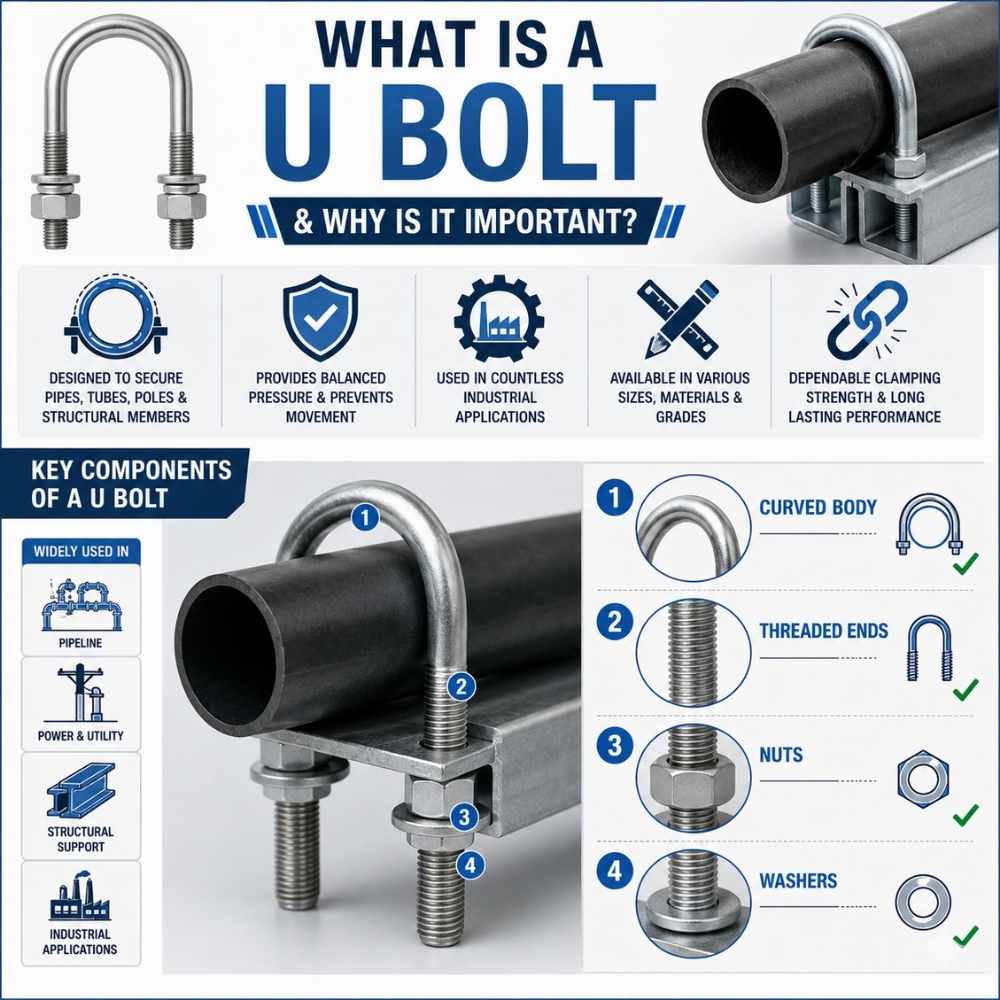
      A U-bolt is a curved fastening component designed to secure pipes, tubes, rods, cables, and other round or cylindrical components to a supporting structure. Its threaded ends work with nuts and washers to create a firm connection. Because of its simple construction, a U-bolt can provide practical support while allowing relatively easy installation and maintenance.

      01. U-Shaped Body

      The U-shaped body surrounds the supported component and helps keep it securely positioned against the mounting surface. Its curved design allows the fastener to hold round components without requiring complicated installation methods.

      • Provides stable component support
      • Helps distribute clamping pressure
      • Suitable for pipes, tubes, rods, and similar components
      • Supports secure positioning during operation

      02. Threaded Ends

      The threaded ends provide the fastening points for nuts and washers. During installation, the nuts are tightened to create the required clamping force. Therefore, correct thread size and sufficient thread length are important for a reliable connection.

      • Provides secure tightening
      • Allows easy installation and removal
      • Supports different thread specifications
      • Helps maintain consistent fastening pressure

      03. Inside Width

      Inside width refers to the distance between the inner sides of the U-shaped body. This dimension should match the outside diameter or overall dimensions of the supported component. A proper fit helps prevent excessive movement and uneven pressure.

      • Should match the component dimensions
      • Helps achieve accurate fitting
      • Reduces unwanted movement
      • Supports proper load distribution

      04. Overall Length

      Overall length determines how much of the threaded section remains available after the U-bolt passes around the component and through the mounting plate. Therefore, selection should consider the component size, mounting thickness, washer thickness, and nut engagement.

      • Consider the supported component thickness
      • Allow sufficient space for washers and nuts
      • Check the required thread engagement
      • Select the length according to the installation arrangement

      How to Select the Right U Bolt

      Choosing the correct product involves more than selecting a diameter. Instead, buyers should evaluate the complete application.

      01. Measure the Supported Component

      Start by measuring the outside diameter or relevant dimensions of the component. Then determine the required internal width of the U-shaped body.

      This simple step helps reduce fitting problems during installation.

      02. Select the Appropriate Material

      Material selection should reflect the working environment and mechanical requirements.

      MS Foundation Bolt and other mild-steel fastening solutions can provide a practical option for many general industrial applications. However, demanding environments may require protective finishes, coatings, or alternative materials.

      03. Check Thread Specifications

      Thread pitch, thread diameter, and threaded length should match the required nut and washer arrangement. Moreover, consistent threading can make installation smoother and reduce assembly difficulties.

      04. Evaluate Surface Protection

      Moisture, chemicals, outdoor exposure, and industrial contaminants can accelerate corrosion. Therefore, buyers should consider an appropriate surface treatment when the operating environment demands additional protection.

      05. Consider Quantity and Custom Requirements

      Large industrial projects often require multiple sizes or customized dimensions. A manufacturer that can understand drawings and project specifications can help simplify procurement.

      U Bolt Applications Across Different Industries

      U Bolt Applications Across Different Industries - LG Industries

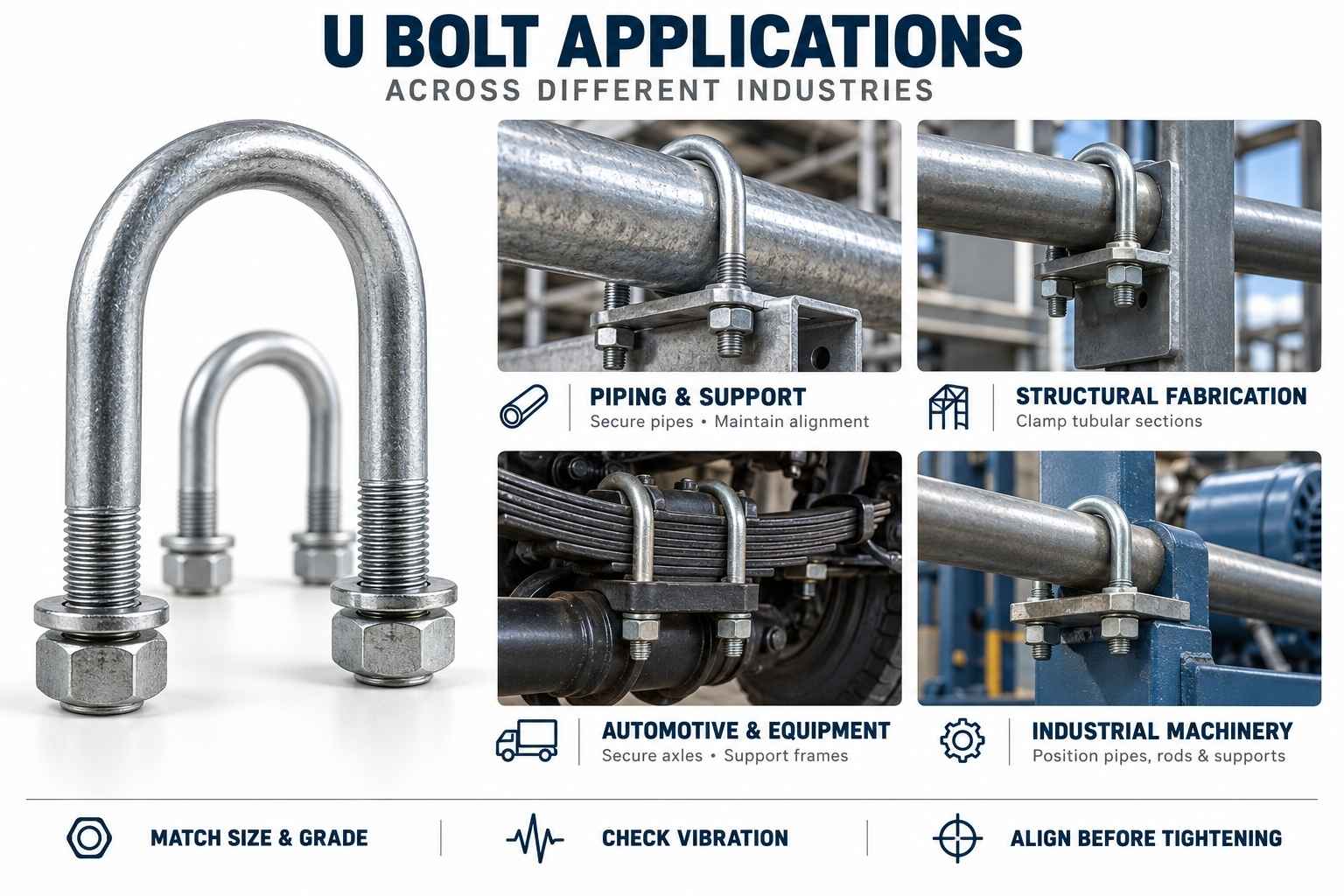
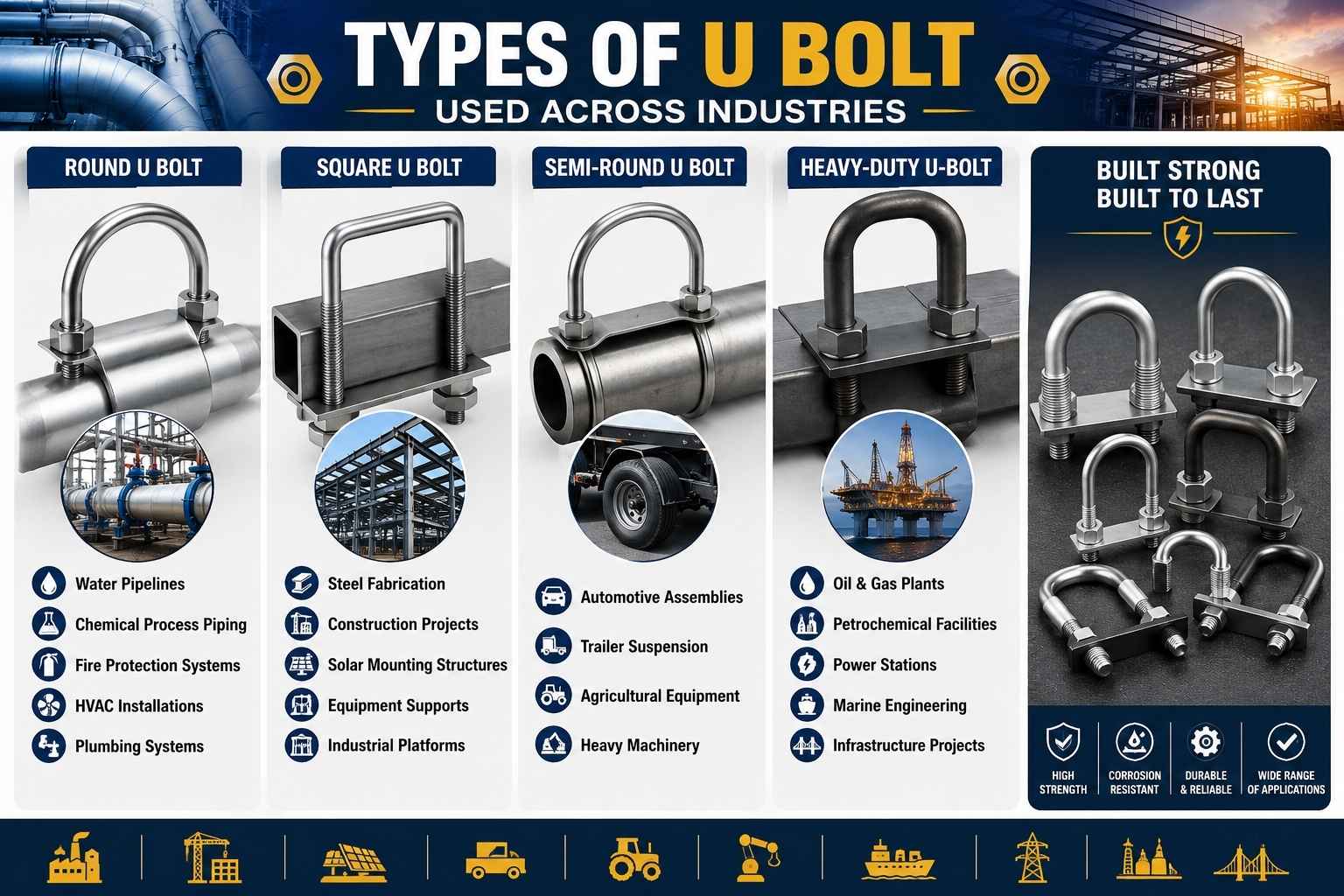
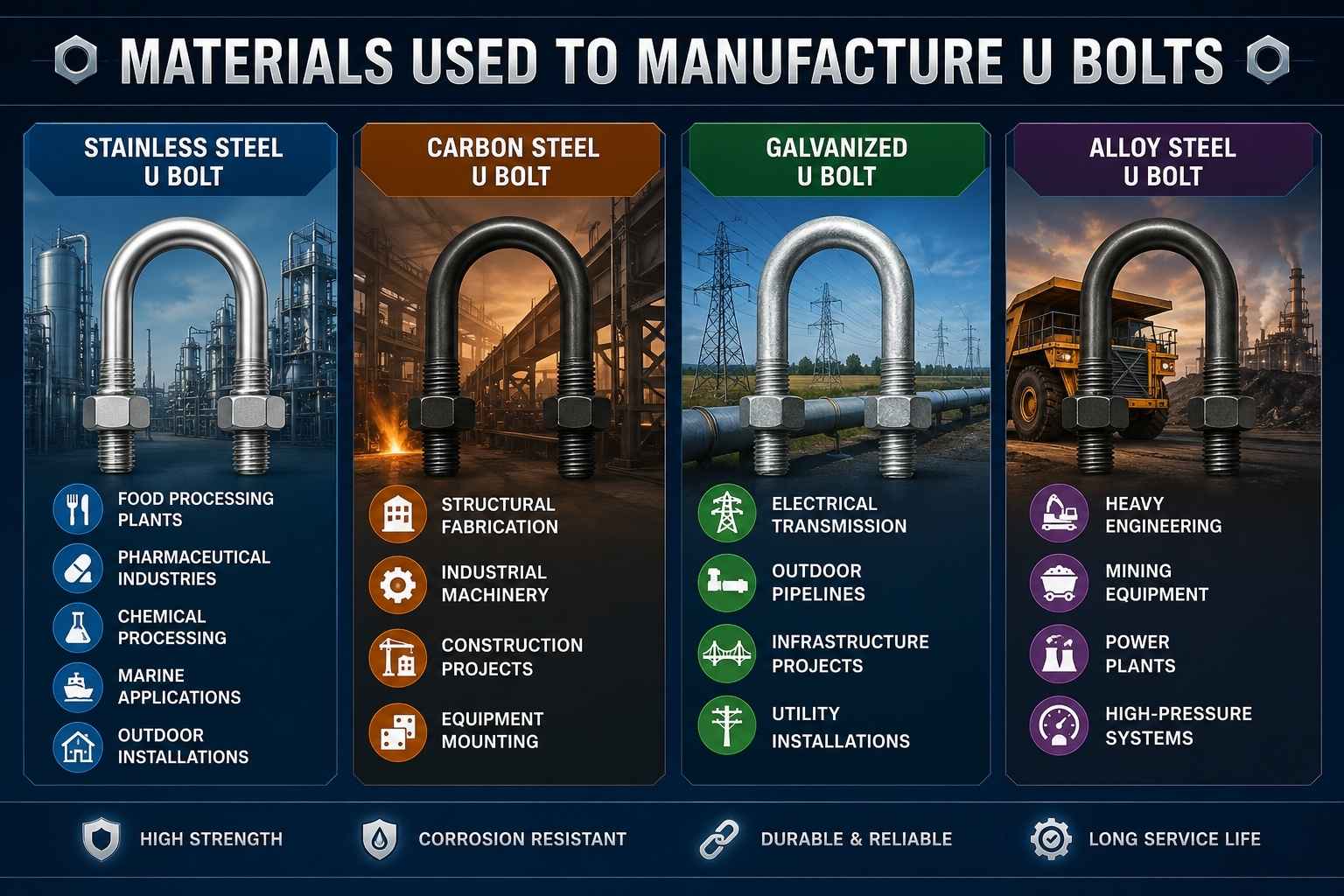
      The versatility of the U Bolt in Ahmedabad makes it a practical fastening solution across several engineering sectors. However, each application requires the right dimensions, material, and specifications. 

      01. Piping and Pipe Support

      Industrial piping systems often require secure support to control movement and maintain alignment. A correctly sized fastener can clamp a pipe against a support channel or structural bracket.

      Furthermore, proper spacing between supports can reduce unnecessary movement and help maintain the intended piping arrangement.

      02. Structural Fabrication

      Fabricators can use U-shaped fastening products to connect or hold tubular sections and other structural components. This application is particularly useful when the geometry of the assembly makes surrounding the component easier than drilling through it.

      03. Automotive and Equipment Applications

      Vehicles, trailers, agricultural equipment, and industrial machinery may require specialized fastening arrangements. Depending on the design, U-shaped fasteners can secure axles, frames, suspension-related components, pipes, or other tubular members.

      04. Industrial Machinery

      Machines often contain pipes, rods, frames, and support assemblies that need controlled positioning. A suitable fastening component can help maintain alignment while allowing future maintenance.

      05. Vibration Considerations

      Machines may generate continuous vibration. Therefore, engineers should select appropriate grades, dimensions, washers, nuts, and tightening practices for the specific operating environment.

      06. Alignment Requirements

      Correct alignment can improve assembly quality and reduce unwanted stress. Consequently, installers should position the fastener correctly before tightening the nuts.

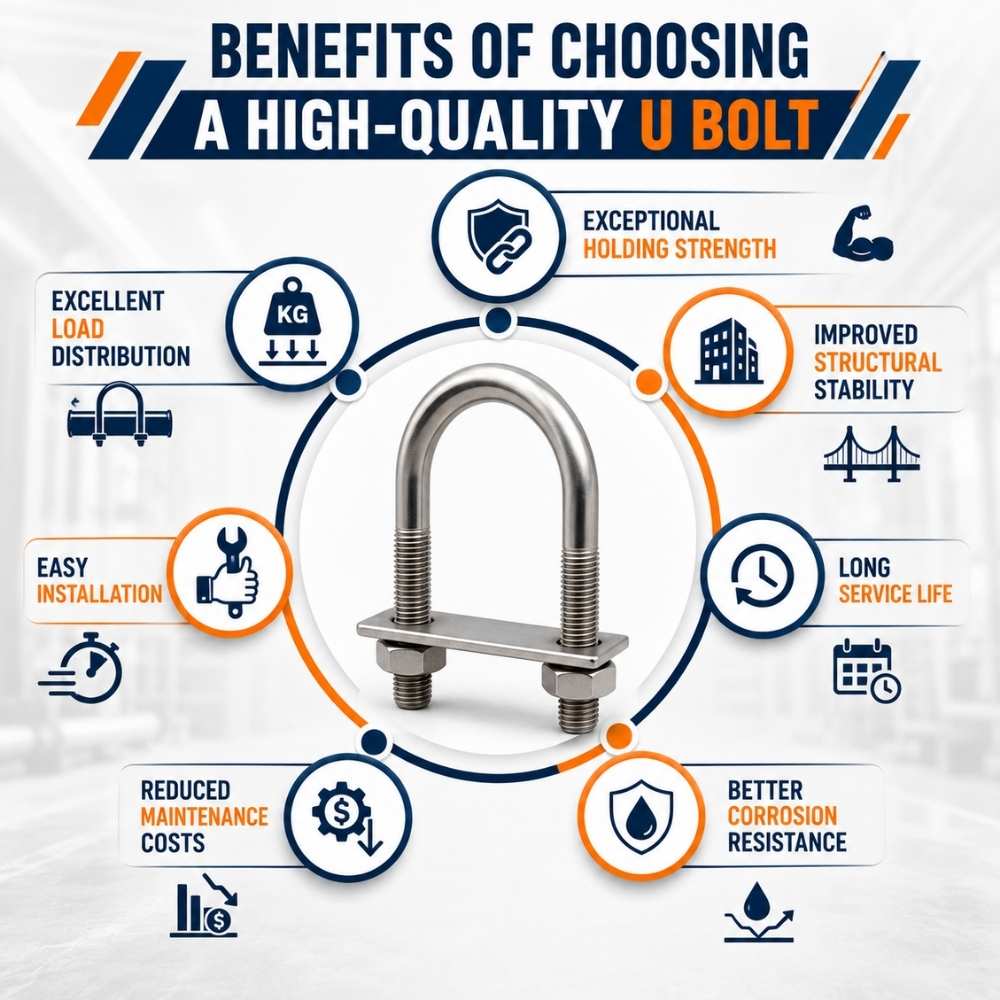
      Key Benefits of Using a U Bolt

      The right fastening solution can simplify assembly while improving the stability of supported components. A properly specified product also helps maintenance teams remove and replace components more efficiently.

      01. Secure Component Clamping

      The curved body surrounds the supported pipe or tubular member. Consequently, tightening the nuts can create a firm mechanical connection between the component and its mounting surface.

      02. Simple Installation

      The design does not normally require complicated assembly procedures. Workers can position the fastener around the component, insert the threaded ends through the mounting arrangement, and tighten the nuts.

      Therefore, the product can provide a practical solution for fabrication shops, maintenance work, equipment installation, and industrial construction.

      03. Flexible Industrial Applications

      Different sizes and materials allow the product to serve a broad range of applications. For instance, manufacturers can produce configurations for piping supports, structural frames, machinery assemblies, agricultural equipment, automotive components, and fabrication projects.

      04. Convenient Maintenance

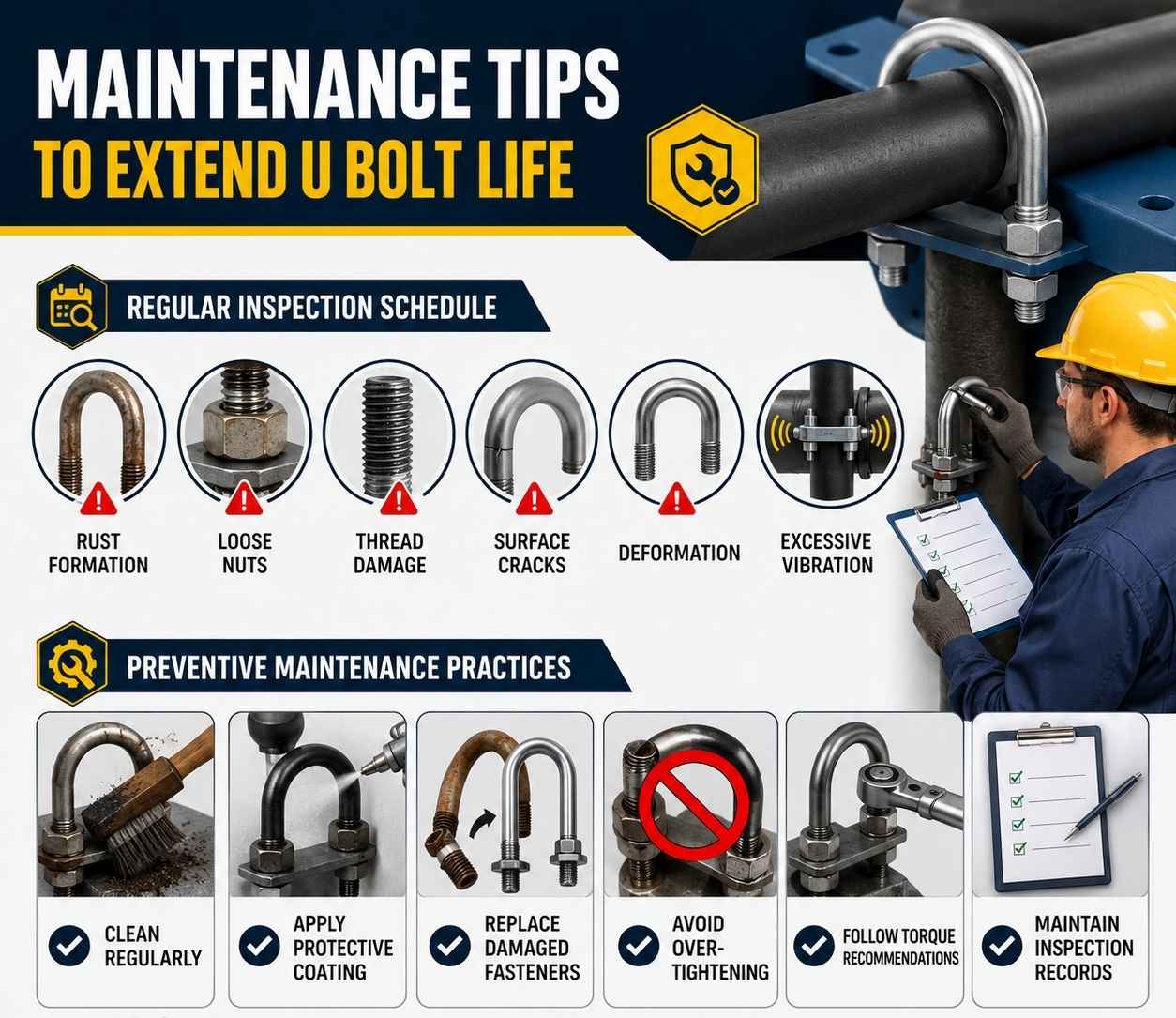
      A bolted connection allows maintenance personnel to loosen and remove the fastening hardware when required. As a result, technicians can inspect or replace supported components without permanently cutting the connection.

      U Bolt Selection Guide

      Specification What to Check Why It Matters
      Bolt Diameter Match the required pipe or component size Provides proper fit and clamping
      Inside Width Measure the outside diameter of the supported component Prevents fitting and alignment issues
      Overall Length Consider component and mounting plate thickness Ensures sufficient threaded projection
      Thread Length Check required nut and washer clearance Supports secure tightening
      Material MS, carbon steel, or other specified material Helps meet strength and environmental requirements
      Surface Finish Select suitable coating or protection Helps improve corrosion resistance
      Bend Radius Match the component shape and application Helps maintain proper contact
      Load Requirement Consider tension, shear, vibration, and operating loads Supports appropriate product selection
      Application Piping, machinery, fabrication, structural support, etc. Determines the suitable configuration
      Quantity & Custom Size Confirm project quantity and special dimensions Helps simplify bulk procurement and production

      Frequently Asked Questions About U Bolt

      A U-bolt is used to secure pipes, tubes, rods, cables, frames, and other round components. Its U-shaped body surrounds the component and holds it firmly against a support.

      Was this helpful?

      A U-bolt surrounds the supported component while its threaded ends pass through a mounting plate or bracket. Nuts and washers then tighten the connection and keep the component securely in position.

      Was this helpful?

      Choose the size according to the component diameter, inside width, bolt diameter, overall length, thread length, and mounting thickness. The expected load should also be considered.

      Was this helpful?

      U Bolts are commonly manufactured from mild steel, carbon steel, stainless steel, and other specified materials. Material selection depends on strength, application, and environmental conditions.

      Was this helpful?

      A U Foundation Bolt is a U-shaped anchoring component used for foundation and structural applications. Its size, length, bend, material, and embedment should match the project requirements.

      Was this helpful?

      MS Foundation Bolts are used for various industrial, construction, machinery, structural, and foundation applications where mild steel meets the required engineering specifications.

      Was this helpful?

      U-bolts are commonly used in piping systems, machinery, structural fabrication, automotive equipment, agricultural equipment, trailers, and industrial support assemblies.

      Was this helpful?

      Yes, U Bolts can be manufactured in customized dimensions depending on production capabilities. Customers can specify diameter, length, thread, material, bend dimensions, and quantity.

      Was this helpful?

      Consider the bolt diameter, overall length, embedment depth, thread length, material grade, bend dimensions, load requirements, base plate thickness, and environmental conditions.

      Was this helpful?

      Look for a supplier that offers suitable materials, accurate dimensions, consistent manufacturing, customization options, and technical support according to your application and project requirements.

      Was this helpful?

      The required surface finish depends on the application and environment. Outdoor, humid, or corrosive conditions may require suitable protective coatings to improve corrosion resistance.

      Was this helpful?

      A U-Bolt provides secure clamping, simple installation, reliable component support, easy maintenance, and flexibility for different industrial and engineering applications.

      Was this helpful?

      Conclusion on U-Bolt Selection for Industrial Applications 

      A well-selected U-Bolt can provide a practical and dependable fastening solution for pipes, tubular components, structural assemblies, machinery, and industrial support systems. Its simple U-shaped design makes installation straightforward while providing effective clamping around supported components.

      At the same time, foundation-related applications require additional attention to engineering design, embedment, material selection, dimensions, and environmental conditions. Therefore, buyers should select U Foundation Bolt, Foundation Bolt, or MS Foundation Bolt products according to the actual project requirements rather than relying only on product names.

      For industrial buyers searching for reliable fastening solutions, LG Industries offers manufacturing and supply support for different engineering requirements. Whether the requirement involves standard dimensions, project quantities, or application-specific specifications, discussing the technical details before ordering can help achieve a better-fitting and more dependable solution.

        Why J Foundation Bolt Matters for Industrial Foundations - LG Industries

        Why J Foundation Bolt Matters for Industrial Foundations

        J Foundation Bolt Uses, Benefits, and Applications

        Key Benefits of J Foundation Bolts - LG Industries

        Industrial structures depend on strong connections between concrete foundations and steel components. Therefore, choosing the right anchoring hardware can directly influence stability, alignment, and long-term structural performance. Among the available anchoring options, the J Foundation Bolt offers a practical solution for projects that require secure embedding and dependable fastening.

        A properly selected Foundation Bolt helps connect base plates, steel columns, machinery supports, and structural frames to concrete foundations. Moreover, the J-shaped configuration provides an effective anchoring profile within the concrete, while the threaded section allows engineers and fabricators to secure the supported component with nuts and washers.

        However, selecting an anchor should involve more than simply choosing a diameter. Project loads, embedment depth, material, thread dimensions, corrosion conditions, installation requirements, and structural design all matter. This guide explains the role of a J Foundation Bolt, its benefits, applications, selection factors, and practical installation considerations.

        Why Choose a J Foundation Bolt for Industrial Projects?

        A J Foundation Bolt uses a curved, hook-like lower section that sits inside the concrete foundation. Meanwhile, the upper threaded portion remains accessible for connecting a base plate or structural component.

        This design creates a mechanical anchoring arrangement within the concrete. As a result, the bolt can help resist unwanted movement when the supported structure experiences operational or environmental forces.

        Industrial projects often encounter several types of loads, including:

        • Static structural loads
        • Equipment vibration
        • Wind forces
        • Operational movement
        • Temperature-related expansion and contraction
        • Impact and dynamic loads

        Consequently, engineers need an anchoring arrangement that suits the project’s actual loading conditions rather than relying only on standard dimensions.

        01. Strong Connection Between Concrete and Steel

        The primary purpose of a foundation anchor is to establish a dependable connection between the concrete base and the supported steel component.

        The hooked end of the J-Type Foundation Bolt provides an embedded anchoring profile. At the same time, the exposed threaded section enables secure fastening through a nut and washer arrangement.

        This connection can support applications such as

        • Steel columns
        • Structural base plates
        • Machinery foundations
        • Industrial equipment
        • Storage and process structures
        • Fabricated steel frames
        • Support brackets

        Furthermore, accurate positioning during foundation preparation helps ensure that the bolt aligns correctly with the holes in the base plate.

        02. Improved Stability for Heavy-Duty Structures

        Heavy equipment and structural frames can generate significant forces during operation. For example, rotating machinery can create vibration, while industrial structures can experience wind or operational loads.

        Therefore, the anchoring system must work together with the concrete foundation and steel structure to maintain stability.

        A correctly designed Foundation Bolt can help:

        • Maintain the position of the supported structure.
        • Transfer applicable forces through the connection.
        • Reduce unwanted movement.
        • Support accurate base-plate installation.
        • Improve the reliability of the overall foundation connection.

        Nevertheless, the bolt should always match the project’s engineering requirements. No single bolt design suits every foundation.

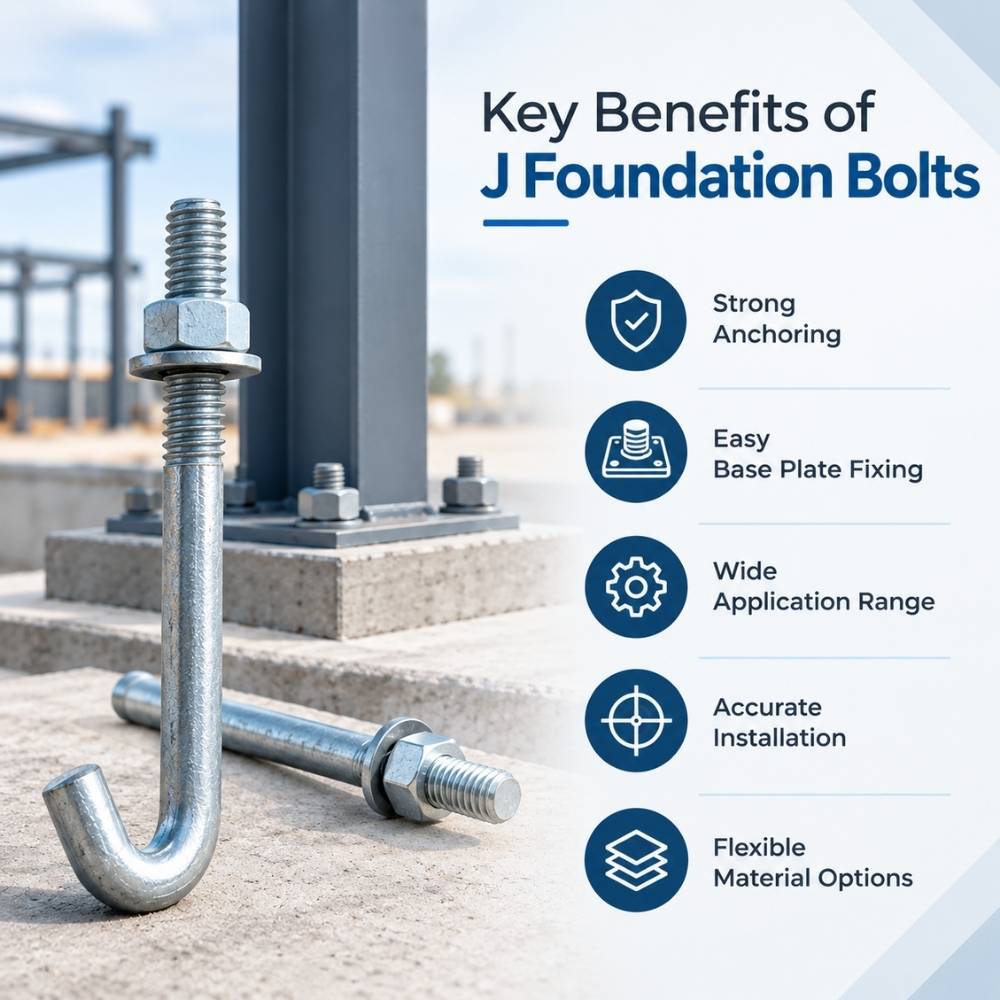
        Key Benefits of J Foundation Bolts

        Key Benefits of J Foundation Bolts - LG Industries

        A well-selected J Foundation Bolt can provide several practical advantages in industrial construction. More importantly, its simple geometry can make it suitable for many cast-in-place anchoring applications.

        01. Secure Embedded Anchoring

        The curved lower portion sits within the concrete and provides mechanical resistance. Therefore, the bolt can create a dependable connection after the concrete achieves the required strength.

        02. Practical Base Plate Connection

        The threaded upper section provides a convenient fastening point. Fabricators can position the base plate over the projecting bolts and secure it with suitable nuts and washers.

        03. Suitable for Industrial Applications

        Manufacturers can produce J-type anchors in different diameters, lengths, thread specifications, and material options. Consequently, buyers can select dimensions according to project requirements.

        04. Supports Accurate Structural Installation

        Properly positioned anchor bolts help contractors install steel members and base plates accurately. As a result, the installation process can become more predictable and efficient.

        05. Flexible Material Options

        An MS Foundation Bolt can provide a practical option for many general industrial applications. However, projects exposed to moisture, chemicals, or corrosive environments may require suitable surface protection or a different material specification.

        J Foundation Bolt Applications Across Industries

        The application of a J Foundation Bolt extends across several industrial and infrastructure projects. Its usefulness comes from its ability to create a cast-in-place threaded connection between concrete and steel components.

        01. Steel Structure Installation

        Steel columns commonly connect to concrete foundations through base plates. In this arrangement, contractors position the anchor bolts according to the approved foundation layout.

        After the concrete cures, workers place the steel base plate over the projecting threads. They then install washers and nuts to secure the assembly.

        02. Machinery and Equipment Foundations

        Industrial machinery requires stable positioning because vibration and movement can affect both equipment performance and surrounding structures.

        For this reason, suitable Foundation Bolts can form an important part of machinery foundation systems. Engineers should determine bolt dimensions according to equipment loads, foundation design, and manufacturer requirements.

        03. Manufacturing Facilities

        Factories often contain steel frames, equipment supports, platforms, and process machinery. Each application can require a different anchoring arrangement.

        Therefore, manufacturers and contractors should select bolt dimensions according to the specific connection rather than treating all applications identically.

        04. Warehouses and Industrial Buildings

        Warehouses use structural steel columns and support frames that require reliable foundation connections. A properly specified anchor can help secure these components to their concrete bases.

        05. Energy and Process Facilities

        Power, energy, and process facilities can experience demanding operating environments. In addition to structural loads, some areas may face heat, moisture, chemicals, or vibration.

        As a result, material selection and surface protection become especially important when specifying MS Foundation Bolts or other anchor materials.

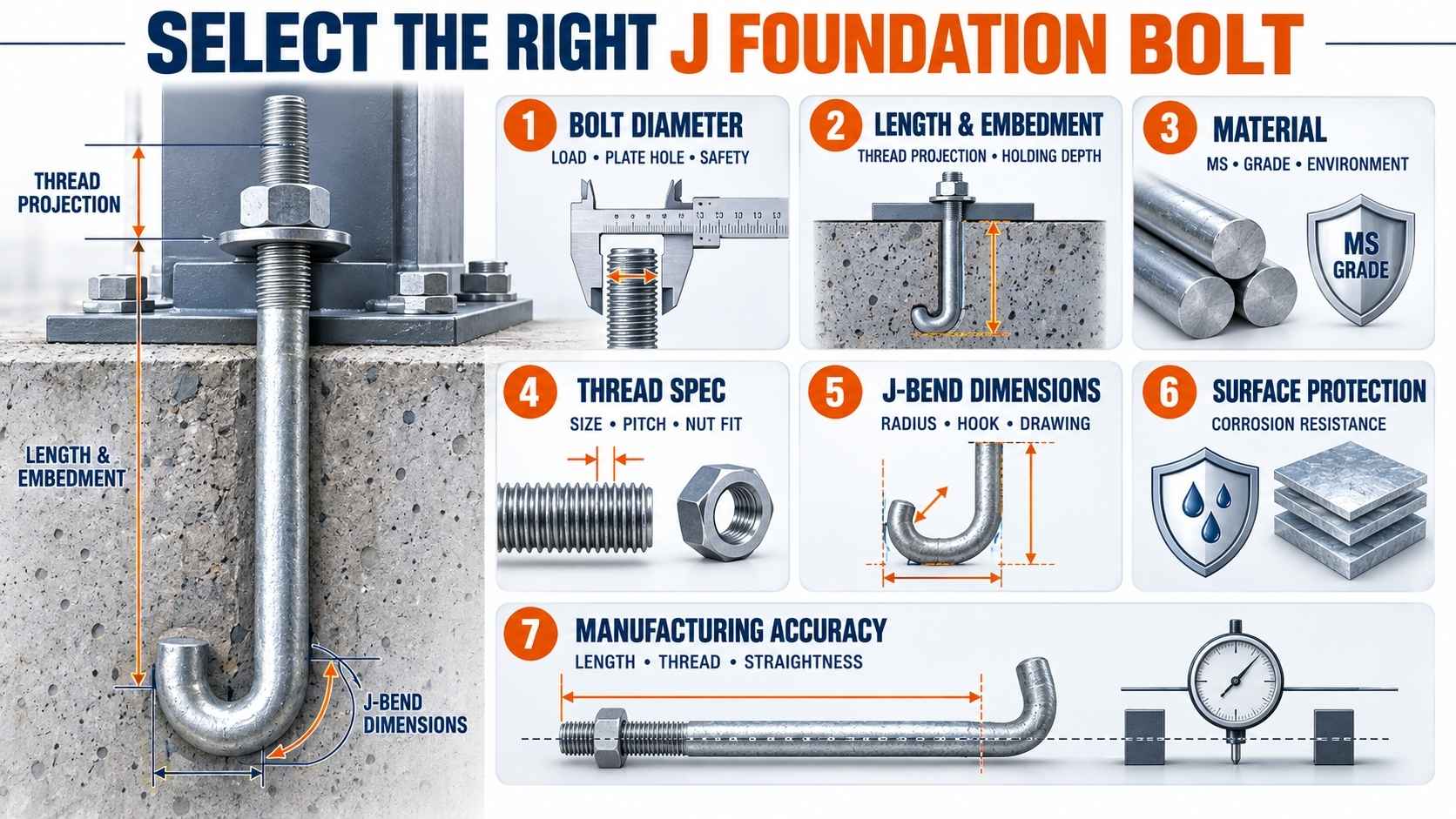
        How to Select the Right J Foundation Bolt

        How to Select the Right J Foundation Bolt - LG Industries

        Selecting the right anchor requires attention to several technical factors. Therefore, buyers should review project drawings and engineering specifications before placing an order.

        01. Bolt Diameter

        Diameter affects the bolt’s capacity and connection compatibility. However, a larger diameter does not automatically make an anchoring system suitable.

        Instead, select the diameter according to:

        • Design loads
        • Base plate hole size
        • Structural calculations
        • Concrete design
        • Required safety factors

        02. Overall Length and Embedment

        The overall bolt length must provide enough threaded projection above the concrete while maintaining the required embedded length.

        An incorrect length can create installation problems. For example, excessive projection may interfere with the nut arrangement, while insufficient projection may prevent proper fastening.

        03. Material Selection

        Material choice should reflect the application environment.

        An MS Foundation Bolt can suit many general-purpose industrial projects. Meanwhile, demanding environments may require additional corrosion protection or a different material grade.

        04. Thread Specification

        Thread size and pitch must match the nuts and connection requirements. Consistent threading also supports smoother installation and proper nut engagement.

        05. J Bend Dimensions

        The curved portion should match the required anchoring arrangement and foundation geometry. Therefore, the bend radius, hook length, and overall dimensions should follow the approved drawing.

        06. Surface Protection

        Corrosion protection can improve service life in environments where moisture or aggressive conditions exist. Depending on the application, buyers may consider suitable protective treatments.

        07. Manufacturing Accuracy

        Dimensional accuracy matters because anchor bolts must align with the base plate and foundation layout.

        A quality-focused manufacturer should maintain consistency in:

        • Diameter
        • Overall length
        • Thread length
        • Bend dimensions
        • Straightness
        • Surface finish

        J Foundation Bolt Installation Guide and Key Considerations 

        Correct installation can influence the performance of the complete anchoring system. Therefore, contractors should follow the approved engineering drawings and installation procedure.

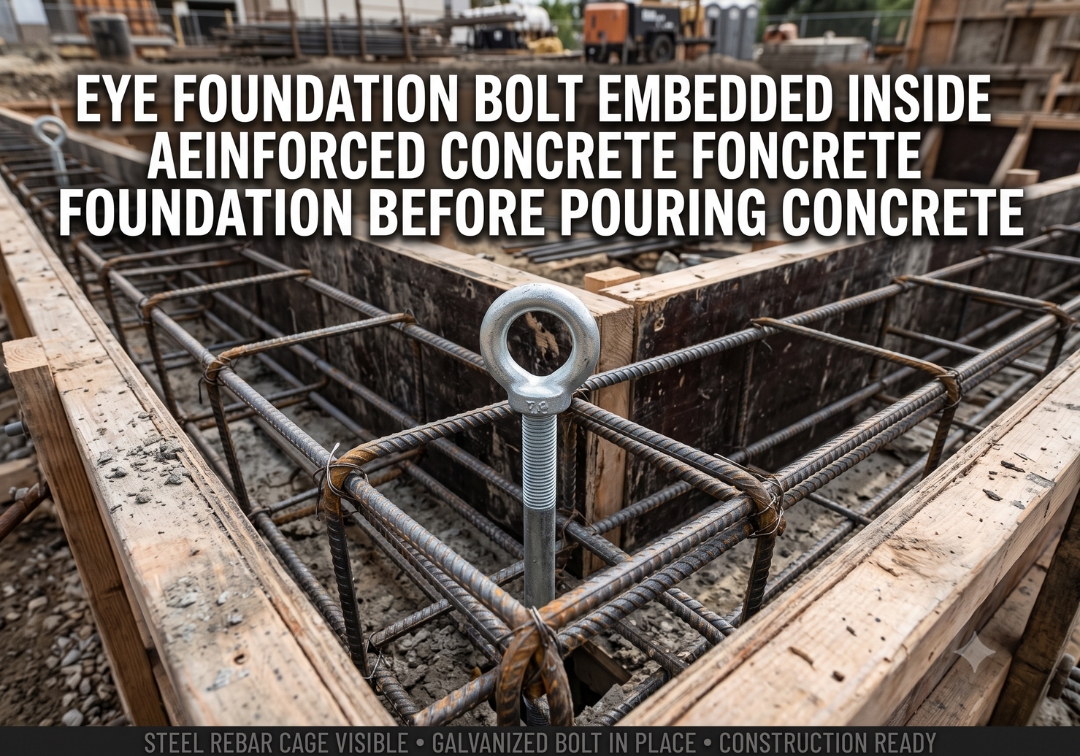
        01. Positioning Before Concrete Pouring

        Workers should accurately position the bolts before pouring concrete. A suitable template can help maintain spacing, alignment, and projection.

        02. Protecting the Threads

        The exposed threads should remain clean during concrete placement. Protective covers can help prevent concrete or debris from damaging the threaded section.

        03. Checking Alignment

        Before the concrete sets, installers should verify bolt location against the foundation drawing. Small positioning errors can create significant problems when workers install the steel base plate.

        04. Final Connection

        After the concrete reaches the specified strength, workers can install the supported component. They should use suitable washers and nuts and follow the specified tightening procedure.

        Importantly, installation requirements vary by project. Therefore, the structural engineer’s drawings and specifications should take priority over generic recommendations.

        J-Foundation Bolt vs Other Types of Foundation Bolts 

        Different projects may require different anchor geometries. Therefore, understanding the basic differences can help buyers choose the most suitable option for their structural and industrial requirements.

        Foundation Bolt Type Typical Application Key Advantage Main Consideration
        J Foundation Bolt Industrial foundations and structural supports Strong hooked anchoring inside concrete Correct embedment depth and alignment
        L Type Foundation Bolt Steel columns, base plates, and support frames Reliable bent anchoring profile Accurate bend and embedment dimensions
        Foundation Bolt General structural and equipment anchoring Versatile solution for multiple applications Specification should match project loads
        MS Foundation Bolt General industrial and construction projects Practical and economical material option Suitable corrosion protection may be required
        MS Foundation Bolts Heavy equipment and fabricated steel structures Available in customized sizes and specifications Material grade and dimensions must suit the application

        This comparison highlights why buyers should evaluate application, load requirements, material, dimensions, and installation conditions instead of selecting a foundation bolt only by its type.

        Frequently Asked Questions About J Foundation Bolt

        A J Foundation Bolt is a foundation anchoring fastener with a J-shaped or hooked lower section and a threaded upper portion. It is commonly embedded into concrete foundations to connect steel structures, base plates, machinery supports, and other components securely.

        Was this helpful?

        A J Foundation Bolt is used to create a strong connection between concrete foundations and structural or industrial components. Common applications include steel columns, base plates, machinery foundations, equipment supports, industrial frames, and fabricated structures.

        Was this helpful?

        The main benefits include secure concrete anchoring, reliable structural connections, practical installation, dimensional flexibility, and suitability for different industrial applications. Properly specified bolts can also help maintain the alignment and stability of supported components.

        Was this helpful?

        The main difference is the shape of the embedded section. A J Foundation Bolt has a hooked J-shaped profile, while an L Type Foundation Bolt uses an L-shaped bend. The appropriate option depends on the foundation design, load requirements, embedment arrangement, and project specifications.

        Was this helpful?

        J Foundation Bolts can be manufactured from materials such as mild steel and other grades specified according to project requirements. MS Foundation Bolt options are commonly considered for general industrial applications, while material selection should also account for environmental and corrosion conditions.

        Was this helpful?

        Yes, they can be suitable for heavy industrial applications when engineers specify the correct diameter, length, material, embedment, and thread dimensions. The complete anchoring system should match the structural loads and foundation design.

        Was this helpful?

        Choose the size according to the engineering requirements of the project. Important factors include bolt diameter, overall length, embedment depth, thread length, base plate hole size, material grade, expected loads, and environmental conditions.

        Was this helpful?

        Proper embedment helps the anchor develop the required connection within the concrete foundation. Insufficient or incorrect embedment can affect anchoring performance. Therefore, installers should follow the approved structural drawings and specified installation requirements.

        Was this helpful?

        Yes. Manufacturers can produce customized Foundation Bolts according to project drawings and specifications. Depending on the manufacturer, customization may include diameter, overall length, threaded length, bend dimensions, material, and surface protection.

        Was this helpful?

        MS Foundation Bolts are commonly used in industrial structures, steel frames, machinery supports, equipment foundations, base plates, warehouses, and general construction applications. The selected material grade and surface protection should suit the project environment.

        Was this helpful?

        Before ordering, check the required diameter, overall length, thread specification, thread length, bend dimensions, material grade, quantity, surface protection, and applicable drawings or technical specifications. Accurate information helps the manufacturer supply bolts that fit the intended application.

        Was this helpful?

        A reliable manufacturer can provide consistent dimensions, accurate threading, controlled bend geometry, suitable materials, and customized specifications. Quality manufacturing also helps reduce installation issues and supports consistent performance across large industrial projects.

        Was this helpful?

        Final Thoughts on J Foundation Bolt Selection

        A J Foundation Bolt provides a practical anchoring option for industrial structures, machinery supports, steel columns, base plates, and other concrete-to-steel connections. Its hooked embedded section and threaded upper portion create a straightforward fastening arrangement for cast-in-place foundations.

        However, the best result comes from correct engineering, accurate manufacturing, and careful installation. Therefore, buyers should consider diameter, length, embedment, material, thread specification, bend dimensions, environmental exposure, and installation requirements before choosing a product.

        Whether a project requires a J-Type Foundation Bolt, MS Foundation Bolt, or another form of Foundation Bolts, the selection should always reflect the actual structural and environmental requirements.

        For industrial projects where dependable anchoring matters, choosing the right specification from the beginning can help support safer installation, better alignment, and long-term connection performance.

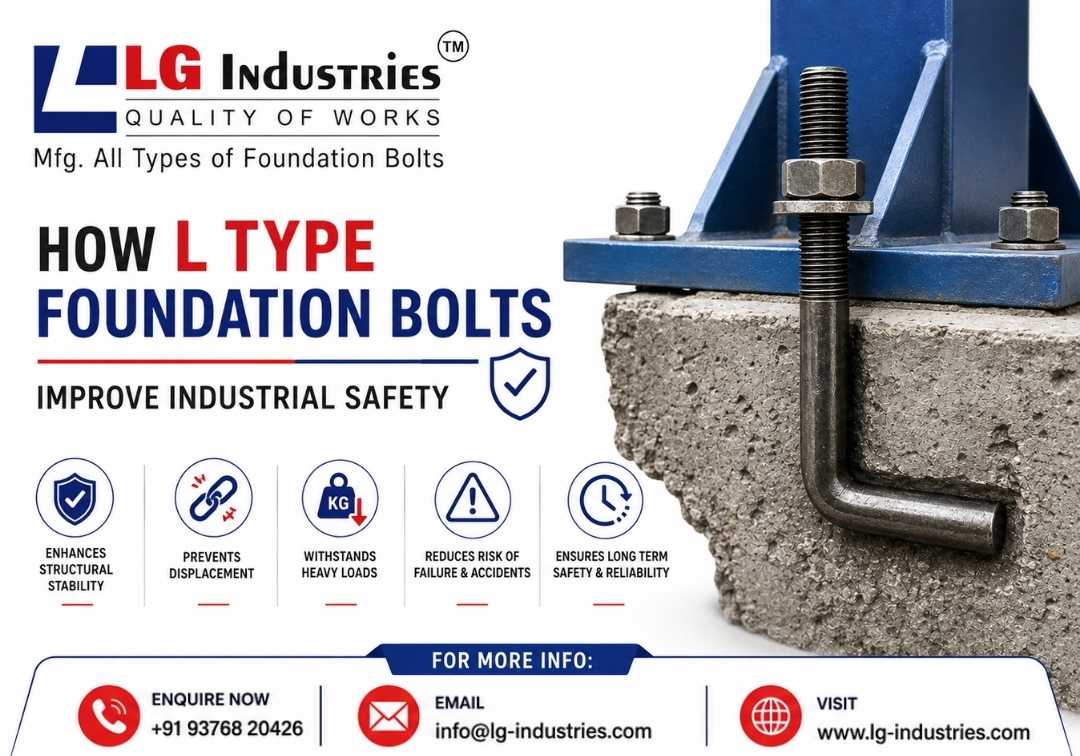
          How L Type Foundation Bolts Improve Industrial Safety

          L Type Foundation Bolts for Safer Industrial Structures

          Why Choose L Type Foundation Bolts? 

          A strong structure begins with a strong connection. When steel columns, machinery, structural frames, or heavy equipment need to be firmly anchored to a concrete base, L Type Foundation Bolts provide a practical and dependable fastening solution.

          Unlike ordinary fasteners, these bolts are designed to become an integral part of the foundation. Their bent L-shaped profile provides a mechanical anchoring effect inside concrete, helping resist movement, vibration, and pulling forces.

          Whether you are sourcing fasteners for a factory project, industrial shed, steel structure, equipment foundation, or infrastructure application, selecting the right Foundation Bolt can directly influence installation quality and long-term stability.

          This guide explains how L-type foundation bolts work, where they are used, why MS foundation bolts remain popular, and what buyers should check before placing an order.

          Why L Type Foundation Bolts Matter in Industrial Construction

          Industrial construction projects require reliable anchoring systems to handle static loads, vibration, wind forces, temperature changes, and operational movement. L-Type Foundation Bolts help create a strong connection between steel structures and concrete foundations, supporting stability, alignment, and long-term performance.

          01. Strong Steel-to-Concrete Connection

          L-shaped foundation bolts provide an embedded section that grips the surrounding concrete and helps resist movement. The threaded upper portion allows base plates and structural components to be securely fastened with suitable nuts and washers.

          Key benefits include:

          • Strong connection between steel and concrete
          • Secure positioning of base plates
          • Improved resistance to structural movement
          • Easy fastening with nuts and washers

          02. Better Stability Under Heavy Loads

          Industrial machinery and structural frames can experience significant loads during operation. A properly installed L Foundation Bolt helps hold the base plate securely in position and reduces unwanted movement.

          When selecting the bolt, important factors include:

          • Bolt diameter and length
          • Material and strength grade
          • Required embedment depth
          • Concrete strength
          • Application-specific load requirements

          Therefore, choosing the correct Foundation Bolt can improve the stability and reliability of industrial structures.

          03. Effective Load Transfer

          Foundation bolts transfer forces from the supported structure into the concrete foundation. Depending on the application, these forces may include tension, shear, compression, or a combination of different loads.

          Engineers should consider:

          • Load direction and magnitude
          • Bolt spacing
          • Edge distance
          • Embedment length
          • Concrete foundation strength
          • Installation and tightening requirements

          Proper consideration of these factors helps ensure that the anchoring system performs effectively under expected operating conditions.

          04. Resistance to Vibration and Movement

          Industrial equipment such as pumps, compressors, motors, conveyors, and heavy machinery can generate continuous vibration. Over time, repeated movement can affect alignment and connection stability if the anchoring system is not properly designed.

          A correctly installed L Type Foundation Bolt can help:

          • Minimize unwanted movement
          • Maintain base plate alignment
          • Improve equipment stability
          • Support reliable long-term operation

          Consequently, L Type Foundation Bolts are an important fastening solution for industrial construction where strength, stability, and dependable anchoring are required.

          Key Benefits of Foundation Bolts for Industrial Structures

          A dependable anchoring system provides several advantages beyond simply holding a structure in place. Foundation Bolts help create secure connections between concrete foundations and steel structures while supporting accurate installation, equipment stability, and long-term structural performance.

          01. Secure Anchoring for Heavy Structures

          Foundation anchoring creates a direct connection between the concrete base and the supported structure. As a result, steel columns, equipment supports, base frames, and other heavy components can remain securely positioned.

          Key advantages include:

          • Secure connection between concrete and steel
          • Better positioning of structural components
          • Improved resistance to unwanted movement
          • Suitable configurations for different load requirements

          Therefore, project designers can select appropriate bolt dimensions and configurations according to the structural requirements.

          02. Flexible Applications Across Industrial Projects

          Industrial construction includes manufacturing plants, warehouses, energy facilities, process plants, infrastructure projects, and equipment foundations. Each application may have different anchoring requirements.

          MS Foundation Bolts can be suitable for many general structural applications when their material, dimensions, and configuration meet the engineering requirements.

          Common applications include:

          • Steel columns and structural frames
          • Equipment support foundations
          • Base plates and machinery frames
          • Industrial buildings and warehouses

          03. Reliable Support for Steel Structures

          Steel structures require accurate and stable foundation connections. During construction, contractors position the anchor bolts according to the approved foundation layout. Afterward, the base plate is placed over the projecting threaded sections and secured using compatible nuts and washers.

          This installation method can provide:

          • Accurate base plate positioning
          • Stable structural connections
          • Proper alignment during erection
          • Easier adjustment during installation

          Consequently, correctly positioned Foundation Bolts can contribute to a strong and dependable steel-to-concrete connection.

          04. Stable Foundations for Heavy Machinery

          Industrial machinery needs stable foundations to maintain proper alignment during operation. Pumps, compressors, motors, generators, and processing equipment can produce vibration and operational forces.

          A suitable MS Foundation Bolt can provide the threaded connection required for securing machinery or support frames.

          Important considerations include:

          • Equipment weight and operating loads
          • Vibration levels
          • Bolt diameter and embedment
          • Foundation design
          • Nut and washer compatibility

          Proper anchoring can help minimize unwanted movement and support reliable equipment operation.

          05. Long-Term Structural Reliability

          Industrial structures often operate for many years under demanding environmental and mechanical conditions. Therefore, material selection, thread quality, corrosion protection, and correct installation are important for maintaining long-term performance.

          When selecting Foundation Bolts, consider:

          • Moisture and outdoor exposure
          • Chemical or corrosive environments
          • Operating temperature
          • Expected structural loading
          • Required corrosion protection
          • Thread and nut compatibility

          For general construction, mild steel can provide a practical balance of performance and cost. However, demanding environments may require corrosion-resistant materials or protective coatings. In addition, clean and properly formed threads should be inspected before installation to ensure compatibility with the selected nuts and washers.

          How to Select the Right L Type Foundation Bolts

          Choosing the right L-Type Foundation Bolt involves more than selecting the correct diameter. The complete fastening arrangement should match the foundation design, load requirements, installation conditions, and environmental exposure. Consider the following important factors before selecting foundation bolts:

          01. Bolt Diameter

          The bolt diameter should be selected according to the expected structural loads and project requirements. A suitable diameter helps provide the required strength and supports secure anchoring of the structure.

          02. Overall Length

          The overall length should provide sufficient embedment inside the concrete foundation while also leaving adequate exposed thread for nut engagement. Proper length ensures secure installation and reliable load transfer.

          03. Material Selection

          The material should be chosen according to the load conditions and surrounding environment. MS Foundation Bolts are commonly used for many structural applications, while suitable material grades can be selected for demanding or corrosive environments.

          04. Thread Specification

          Correct thread dimensions are essential for proper nut engagement and smooth installation. Matching the thread specification with the required nuts helps create a secure and dependable fastening connection.

          05. Bend Dimensions

          The L-shaped bent section should match the required anchoring depth and foundation arrangement. Proper bend dimensions help the bolt achieve effective anchorage within the concrete foundation.

          06. Surface Protection

          Surface protection should be considered when the bolts are exposed to moisture, chemicals, or other corrosive conditions. Galvanizing or another suitable protective finish can help improve corrosion resistance and extend service life.

          07. Manufacturing Accuracy

          Accurate manufacturing ensures consistent bolt dimensions, proper bends, and clean threads. This can make installation easier, reduce assembly problems, and support reliable performance across multiple foundation bolt installations.

          Comparison of Foundation Bolt Types for Industrial Applications

          Foundation Bolt Type Common Industrial Use Main Advantage Important Consideration
          L Foundation Bolt Machinery and structural supports Secure structural connection Select suitable diameter and length
          MS Foundation Bolt General industrial construction Practical and economical Protect against corrosion where required
          MS Foundation Bolts Heavy equipment and steel structures Reliable load support Material grade should match project needs
          Foundation Bolts Industrial foundations and equipment Versatile anchoring solution Proper installation is important

          Frequently Asked Questions About L Type Foundation Bolts

          An L Type Foundation Bolt is primarily used to anchor steel structures, machinery, and fabricated components securely to concrete foundations. Its bent end provides mechanical anchoring within the foundation.

          Was this helpful?

          The bend provides additional mechanical resistance inside concrete. It helps prevent the embedded bolt from pulling straight out when the connected structure experiences an upward or tensile force.

          Was this helpful?

          Yes. L Foundation Bolts can be manufactured in different diameters, lengths, thread lengths, and bend dimensions depending on the project requirement and manufacturing capability.

          Was this helpful?

          MS Foundation Bolts can be used outdoors when their material and protective finish are suitable for the environmental conditions. Corrosive environments may require additional protection or an alternative material.

          Was this helpful?

          Provide the required diameter, total length, threaded length, bend dimensions, material specification, quantity, surface finish, and drawing if available. These details help reduce ordering errors.

          Was this helpful?

          They are commonly positioned using templates, fixtures, or other suitable arrangements that maintain the required spacing, alignment, and projection while concrete is placed.

          Was this helpful?

          Yes, they are commonly used for anchoring machinery and equipment. However, the Foundation Bolt size and material must be selected according to the equipment loads, vibration, foundation design, and engineering requirements.

          Was this helpful?

          Common causes include incorrect spacing, poor alignment, inadequate projection, damaged threads, inaccurate dimensions, or movement during concrete placement.

          Was this helpful?

          In many structural applications, washers and nuts are used with the exposed threaded section. The exact arrangement should follow the approved engineering design and fastening specification.

          Was this helpful?

          Yes. Depending on the application, suitable surface treatments can be considered to improve corrosion resistance and service life. The required finish should be specified before production.

          Was this helpful?

          Neither type is universally better. The correct design depends on the foundation configuration, load conditions, embedment requirements, installation method, and engineering specification.

          Was this helpful?

          A specialized manufacturer can provide better control over dimensions, threading, bending, material selection, customization, and production consistency, which is valuable for project-specific requirements.

          Was this helpful?

          Final Thoughts on L Type Foundation Bolts for Industrial Safety 

          A foundation is only as dependable as the connection between the structure and its supporting base. L Type Foundation Bolts offer a straightforward and effective anchoring solution for steel structures, machinery, industrial equipment, and fabricated assemblies.

          From standard MS Foundation Bolts to customized L Foundation Bolt requirements, the right product should be selected according to load, dimensions, material, environment, and installation conditions.

          If you are looking for dependable Foundation Bolts for an industrial or construction project, work with a manufacturer that understands both the fastening product and the application behind it. The right technical specifications today can help prevent costly installation problems tomorrow.

          Need customized L-type foundation bolts? Contact LG Industries for your project requirements, dimensions, quantities, and manufacturing specifications.

            Why Stud Bolts Are Essential for Heavy-Duty Applications - LG Industries

            Why Stud Bolts Are Essential for Heavy-Duty Applications

            Stud Bolt Uses and Benefits

            Industrial projects need fastening components that deliver strength, accuracy, and dependable support. A Stud Bolt plays an important role in machinery assembly, steel structures, pipe flanges, heavy equipment, and foundation work. It creates a firm connection between two or more parts while allowing easy tightening, removal, and maintenance.

            However, selecting the right fastening component requires more than choosing a size. Material grade, thread type, coating, load requirement, installation environment, and dimensional accuracy all affect performance. Therefore, engineers, fabricators, contractors, and procurement teams should understand how these components work before placing an order.

            This guide explains the uses, advantages, selection process, and quality factors of industrial stud bolts. It also covers Full Thread Stud Bolt options, Stud Foundation Bolt applications, and the value of working with an experienced Stud Bolt Manufacturer.

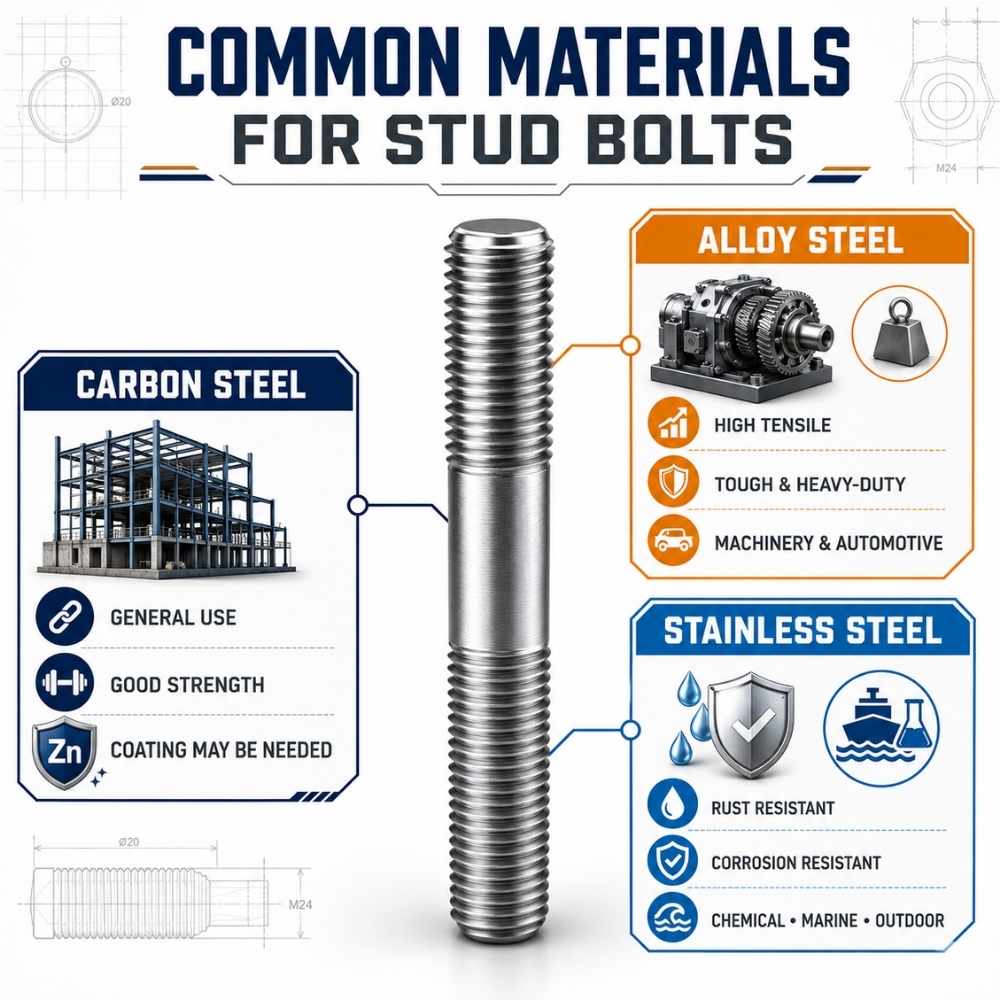
            Common Materials Used for Manufacturing Stud Bolts

            Common Materials Used for Manufacturing Stud Bolts - LG Industries

            Material selection directly affects strength, durability, and corrosion resistance. Therefore, buyers should always discuss the operating environment with the supplier before placing a bulk order.

            01. Carbon Steel

            Carbon steel is widely used for general construction, structural support, and standard machinery applications. It offers good strength at a practical price point. However, it may need zinc plating or another protective coating when used in humid environments.

            02. Alloy Steel

            Alloy steel provides enhanced tensile strength and toughness. As a result, it is ideal for heavy machinery, high-load installations, automotive systems, and industrial equipment.

            03. Stainless Steel

            Stainless steel resists rust and corrosion effectively. Thus, it works well in chemical plants, food processing units, marine areas, pharmaceutical facilities, and outdoor installations.

            Key Benefits of Choosing the Right Stud Bolt

            The right fastening product does much more than connect two parts. It improves stability, simplifies maintenance, and supports safety across the installation.

            01. Strong Load-Bearing Capacity

            High-quality studs can handle substantial tensile loads. When paired with suitable nuts and washers, they distribute clamping force effectively. As a result, the joint remains secure during normal operation.

            02. Easy Installation and Removal

            Studs support convenient maintenance because technicians can remove a nut without taking the entire fastener out of the base component. This feature proves especially useful in pumps, valves, engines, and flanged equipment.

            03. Suitable for Custom Sizes

            Industrial projects often require non-standard lengths, diameters, or thread pitches. A reliable Stud Bolt Manufacturer can produce custom sizes according to drawings, samples, or application details.

            04. Better Performance in Harsh Environments

            Stainless steel and coated bolts can resist moisture, chemicals, heat, and outdoor exposure. Therefore, buyers can choose a material and finish that supports a longer service life.

            How to Select the Correct Stud Bolt

            Selecting an industrial fastener only by diameter can lead to failure. Instead, buyers should evaluate the complete application requirement before finalizing the product.

            01. Check the Load Requirement

            First, understand whether the joint will face tension, shear force, vibration, or dynamic loading. Heavy-duty applications may require high-tensile alloy steel. In contrast, general mounting work may use mild steel or stainless steel.

            02. Choose the Right Material Grade

            Material selection depends on the surrounding environment. For example, stainless steel works well in chemical plants and outdoor installations. Carbon steel may offer a practical choice for dry indoor conditions.

            03. Confirm Thread Type and Pitch

            Metric threads and imperial threads are different. Even similar-looking parts may not fit correctly. Therefore, always confirm the thread standard, diameter, pitch, and required thread length.

            04. Select an Appropriate Finish

            Surface finish protects the fastener and improves appearance. Popular choices include:

            • Zinc plated
            • Yellow zinc plated
            • Hot-dip galvanized
            • Black finish
            • PTFE coated
            • Plain self-finish

            For outdoor foundations and exposed steel structures, hot-dip galvanizing often provides stronger corrosion protection.

            Applications of Stud Bolts Across Industries

            Applications of Stud Bolts Across Industries - LG Industries

            Stud bolts support countless industrial applications because they offer strong and adaptable fastening. Their use extends from simple brackets to high-pressure equipment.

            01. Oil, Gas, and Pipeline Systems

            Flanges in pipelines require high-strength fastening to prevent leakage under pressure. Stud fasteners are often used with flange nuts and washers to create secure joints. Additionally, corrosion-resistant materials help protect the connection in harsh environments.

            02. Power Plants and Process Industries

            Boilers, turbines, heat exchangers, valves, and pressure vessels rely on dependable fastening systems. Here, correct material grade and thread accuracy become extremely important because high temperatures and vibrations can affect performance.

            03. Construction and Steel Fabrication

            Builders use these bolts to secure beams, columns, brackets, platforms, and base plates. A quality Foundation Bolt helps transfer loads safely from a structure or machine into the concrete base.

            04. Automotive and Engineering Equipment

            Engine assemblies, pumps, compressors, gearboxes, and industrial machines often use stud fasteners because they allow repeated dismantling and reassembly. As a result, maintenance teams can service equipment more conveniently.

            05. Chemical and Marine Environments

            Chemical exposure, saltwater, and high humidity can damage ordinary fasteners. Therefore, stainless steel or specially coated stud products are often selected for chemical plants, coastal facilities, and marine installations.

            How to Select the Right Stud Bolt for Your Project

            Choosing the correct fastener is not only about diameter and length. Instead, buyers should consider the complete application requirement.

            01. Check the Required Material Grade

            First, identify whether the environment requires carbon steel, alloy steel, stainless steel, or another special material. For example, outdoor or chemical applications may require corrosion-resistant grades.

            02. Confirm Thread Type and Pitch

            Thread accuracy ensures that nuts fit properly and tighten smoothly. Coarse threads are commonly used for general applications, whereas fine threads can provide better adjustment and holding power in selected assemblies.

            03. Decide the Correct Length and Diameter

            The required length depends on component thickness, washer thickness, nut height, and installation clearance. Similarly, the diameter must match the expected load and design specification.

            Frequently Asked Questions About Stud Bolts

            It is a threaded metal rod used to securely join industrial components, flanges, machinery, and structural parts.

            Was this helpful?

            A normal bolt has a head on one end. However, this fastener has threads on both ends or across its entire length.

            Was this helpful?

            They are used in machinery installation, steel structures, pipelines, flange connections, construction, and equipment foundations.

            Was this helpful?

            It is an anchoring fastener that secures machines, columns, or base plates firmly to a concrete foundation.

            Was this helpful?

            A full-thread design has threads throughout the rod. Therefore, it allows flexible adjustment of nuts during installation.

            Was this helpful?

            Common material options include carbon steel, alloy steel, stainless steel, and galvanized steel.

            Was this helpful?

            Hot-dip galvanized steel and stainless steel are suitable because they offer better resistance against moisture and corrosion.

            Was this helpful?

            Select the size according to the required load capacity, component thickness, thread type, installation space, and engineering drawing.

            Was this helpful?

            Yes, high-strength grades are widely used in flange joints, pipelines, pressure vessels, and heavy industrial equipment.

            Was this helpful?

            Yes. A manufacturer can supply custom length, diameter, thread pattern, material grade, and surface coating as per project requirements.

            Was this helpful?

            Why Choose a Trusted Stud Bolt Manufacturer?

            A professional manufacturer understands that every project has different specifications. They can provide standard and custom products while maintaining consistent quality checks.

            Look for a supplier that offers:

            • Multiple material grades
            • Custom sizes and threads
            • Accurate dimensional control
            • Quality-tested raw materials
            • Bulk order capability
            • Corrosion-resistant coatings
            • Timely dispatch
            • Technical support for product selection

            Additionally, a dependable supplier can guide you toward the right bolt grade for your exact working environment. This support saves time and helps prevent costly fastening failures.

            Final Thoughts on Stud Bolt 

            A high-quality Stud Bolt creates stronger, safer, and more serviceable industrial connections. Its versatile threaded design makes it suitable for machinery, flanges, steel structures, pipe supports, and foundations. Meanwhile, selecting the correct material, thread type, finish, and grade ensures dependable long-term performance.

            For the best results, choose a manufacturer that understands your project requirements and delivers accurately tested fastening solutions. The right bolt may look like a small component, yet it plays a major role in the strength and stability of your entire installation.

              Rag Foundation Bolt

              Rag Foundation Bolts for Industrial Applications and Benefits

              Why Rag Foundation Bolts Are Essential for Industrial Applications

              Industrial structures demand strong and reliable fastening systems that can withstand heavy loads, continuous vibration, and harsh environmental conditions. Among the most trusted anchoring solutions, Rag Foundation Bolt plays a vital role in securing machinery, steel structures, industrial sheds, transmission towers, and heavy equipment to concrete foundations. Their unique design ensures exceptional grip, outstanding stability, and long-term structural performance.

              Whether you are constructing a manufacturing plant, installing heavy machinery, or developing large-scale infrastructure, selecting the right foundation fastening system directly impacts safety and operational efficiency. High-quality rag foundation bolts provide excellent resistance against movement, reduce maintenance costs, and extend the lifespan of industrial installations.

              This guide explains everything you need to know about rag foundation bolts, including their features, applications, benefits, installation process, material options, maintenance tips, and factors to consider before choosing the right solution for your project.

              What Are Rag Foundation Bolts?

              A rigid foundation bolt is a specially engineered anchor bolt designed to create a secure connection between concrete foundations and structural components. Unlike ordinary bolts, rag bolts feature a forged or ragged end that firmly locks into concrete after installation. This unique shape significantly improves pull-out resistance and ensures excellent load-bearing performance.

              These bolts are commonly used in industries where equipment stability is critical. Their rugged construction allows them to perform efficiently under high compression, vibration, and dynamic loads.

              Because of their exceptional holding capacity, RAG foundation bolts have become one of the preferred anchoring solutions across construction, manufacturing, power generation, mining, petrochemical, and infrastructure sectors.

              Why Rag Foundation Bolts Are Essential for Industrial Applications

              Industrial environments require fastening systems that deliver consistent performance under demanding conditions. Rag foundation bolts provide exactly that.

              Their specialized design helps distribute loads evenly throughout the concrete foundation. As a result, machinery remains stable during operation while minimizing unwanted movement and structural stress.

              Furthermore, these bolts improve workplace safety by reducing the possibility of equipment displacement caused by vibration or heavy operational loads.

              Industries rely on RAG foundation bolts because they offer:

              • Excellent anchoring strength
              • Superior resistance to vibration
              • Long service life
              • High tensile performance
              • Reliable structural stability
              • Reduced maintenance requirements
              • Enhanced operational safety

              Key Features of Rag Foundation Bolts

              Superior Grip Inside Concrete

              The forged rag end creates an exceptionally strong mechanical bond within concrete. This feature prevents bolt loosening even after years of continuous service.

              High Load Carrying Capacity

              These bolts are specifically designed to support heavy industrial equipment, structural columns, and steel frameworks.

              Corrosion Resistance

              Manufacturers produce rag foundation bolts using galvanized steel, stainless steel, or protective coatings to resist corrosion in aggressive industrial environments.

              Long Service Life

              High-quality manufacturing processes ensure durability, even under extreme weather and demanding operating conditions.

              Excellent Dimensional Accuracy

              Precision manufacturing guarantees proper alignment during installation while simplifying equipment positioning.

              Major Benefits of Rag Foundation Bolts

              Superior Structural Stability

              Every industrial project requires a strong connection between machinery and its foundation. Rag foundation bolts prevent unwanted movement while improving overall structural stability.

              This stability reduces operational risks and improves equipment performance.

              High Load Capacity

              Heavy industrial equipment places enormous pressure on concrete foundations.

              A properly manufactured foundation bolt transfers these loads efficiently while preventing structural damage.

              Industries trust these bolts because they support:

              • Heavy machinery
              • Industrial presses
              • Compressors
              • Turbines
              • Generators
              • Storage tanks
              Excellent Vibration Resistance

              Industrial machines continuously generate vibration.

              Without proper anchoring, vibration can loosen fasteners and damage equipment.

              Rag foundation bolts minimize these problems by maintaining secure connections over long periods.

              Long Service Life

              High-quality bolts manufactured from premium steel resist wear and deformation.

              Their durability reduces replacement costs while increasing operational reliability.

              Improved Workplace Safety

              Loose machinery creates serious safety hazards.

              A professionally installed Foundation Bolt helps prevent accidents by keeping equipment securely fixed.

              Types of Rag Foundation Bolts

              Different industrial projects require different bolt designs.

              Standard Rag Foundation Bolt

              Suitable for general industrial construction and equipment installation.

              Heavy-Duty Rag Bolt

              Designed for extremely high load applications.

              Hot Dip Galvanized Rag Bolt

              Offers excellent corrosion resistance for outdoor environments.

              Stainless Steel Rag Bolt

              Ideal for chemical plants, marine applications, and food processing industries.

              Materials Used in Manufacturing

              The quality of raw materials directly affects bolt performance.

              Common materials include:

              • Mild Steel
              • Carbon Steel
              • High-Tensile Steel
              • Stainless Steel 304
              • Stainless Steel 316
              • Alloy Steel

              Protective finishes include:

              • Zinc Plating
              • Hot Dip Galvanizing
              • Black Finish
              • PTFE Coating
              • Electrogalvanizing

              Common Industrial Applications of Rag Foundation Bolts

              Rag foundation bolts are widely used across numerous industries due to their versatility and strength.

              Heavy Machinery Installation

              Industrial machines require stable foundations for precise operation. Rag bolts prevent movement and improve operational accuracy.

              Steel Structure Construction

              Structural steel columns depend on secure anchoring systems to transfer loads safely into concrete foundations.

              Industrial Plants

              Manufacturing facilities use foundation bolts to secure production equipment, conveyor systems, compressors, and processing units.

              Power Generation Facilities

              Power plants rely on strong anchoring systems for turbines, generators, transformers, and support structures.

              Oil and Gas Industry

              Heavy processing equipment and storage systems require dependable fastening solutions capable of handling dynamic loads.

              Cement Plants

              Large rotating machinery produces constant vibration. Rag foundation bolts provide reliable stability throughout continuous operations.

              Warehouses

              Industrial warehouses utilize foundation bolts to secure structural columns and heavy storage systems.

              Infrastructure Projects

              Bridges, metro stations, airports, and transportation facilities depend on heavy-duty anchoring systems for long-term durability.

              How to Select the Right Rag Foundation Bolts

              Choosing the correct foundation bolt involves evaluating several important factors.

              Load Requirements

              Determine static and dynamic loads before selecting bolt dimensions.

              Bolt Diameter

              Larger diameters generally provide greater load capacity.

              Bolt Length

              Proper embedment depth ensures maximum holding strength.

              Environmental Conditions

              Outdoor installations require corrosion-resistant finishes.

              Concrete Grade

              Concrete strength directly influences anchoring performance.

              Industry Standards

              Always select bolts manufactured according to recognized engineering standards.

              Frequently Asked Questions Of Rag Foundation Bolts

              It securely anchors machinery, structural columns, and industrial equipment to concrete foundations while providing excellent load-bearing capacity.

              Rag Foundation Bolts feature a specially forged ragged end that creates a stronger mechanical bond with concrete. This design improves anchoring performance, making them ideal for industrial structures that require long-term stability under heavy loads and continuous vibration.

              Yes. Manufacturers can produce Rag Foundation Bolts in custom lengths, diameters, thread sizes, and finishes to match unique engineering drawings and installation requirements. Custom solutions help ensure accurate fitment and reliable structural performance.

              Heavy machinery generates constant movement and operational stress. Rag Foundation Bolts provide a secure connection between equipment and concrete foundations, helping reduce vibration-related movement while improving overall machine stability and operational efficiency.

              Protective finishes such as hot dip galvanizing, zinc plating, black oxide coating, and PTFE coating help shield bolts from moisture, chemicals, and corrosion. Choosing the right finish extends service life in demanding industrial environments.

              We provide complete business solutions including consultation, planning, design, development, implementation, and support tailored to your project requirements.

              Premium Rag Foundation Bolts offer superior manufacturing accuracy, higher tensile strength, and better corrosion resistance. Investing in quality fastening solutions improves structural safety, enhances equipment reliability, and delivers dependable performance for years.

              Correct positioning is essential because even minor alignment errors can affect equipment installation and structural accuracy. Properly installed Rag Foundation Bolts ensure smooth assembly, balanced load transfer, and dependable long-term performance.

              Absolutely. Rag Foundation Bolts are widely used to secure wind turbine bases, solar mounting structures, and other renewable energy installations where reliable anchoring and structural stability are essential for long-term performance.

              The load-bearing performance depends on several factors, including bolt diameter, embedment depth, steel grade, thread quality, and concrete strength. Choosing the correct combination ensures safe and efficient support for industrial applications.

              Rag Foundation Bolts for Heavy-Duty Industrial Construction

              Selecting the right Rag Foundation bolts is essential for achieving safe, durable, and stable industrial foundations. From heavy machinery and steel structures to infrastructure and manufacturing facilities, these bolts deliver the strength, reliability, and long-term performance that modern engineering projects demand.

              By choosing high-quality materials, following proper installation practices, and performing regular inspections, businesses can reduce maintenance costs, improve operational safety, and extend the lifespan of their equipment and structures. Whether your project involves new construction or industrial expansion, investing in premium rag foundation bolts ensures dependable performance and structural integrity for years to come.

              For the best results, consult experienced engineers or trusted Foundation Bolt manufacturers like LG Industries to choose the right Rag Foundation Bolts for your industrial application.

              Looking for reliable Rag Foundation Bolts for industrial applications? Partner with a trusted manufacturer offering high strength foundation bolts, precision engineering, and customized solutions. Ensure maximum safety, durability, and long lasting performance for every construction and heavy machinery installation project.

                U Bolt Guide for Strong Industrial Foundation Support - LG Industries

                U Bolt Guide for Strong Industrial Foundation Support

                Industrial fastening systems demand precision, durability, and long-term reliability. Among the many fastening components used across industries, the U Bolt plays a critical role in securing pipes, structural members, machinery, and heavy equipment. Although it appears simple, selecting the correct U bolt directly affects the safety, stability, and lifespan of an entire installation.

                Whether you are working on construction projects, industrial plants, power generation facilities, water treatment systems, or infrastructure development, choosing the right fastening solution becomes essential. A properly manufactured U bolt provides excellent grip, distributes load evenly, minimizes vibration, and keeps connected components securely in place even under demanding operating conditions.

                Furthermore, industries increasingly prefer high-quality fastening products because they reduce maintenance costs while improving operational safety. Modern manufacturing techniques, premium raw materials, and strict quality inspections ensure that today’s U bolts deliver superior performance in both indoor and outdoor environments.

                This guide explains everything you need to know about U Bolts, including their applications, advantages, materials, selection criteria, installation methods, and maintenance practices. Additionally, you will learn why industries across India trust experienced manufacturers for dependable fastening solutions.

                What Is a U Bolt and Why Is It Important?

                What Is a U Bolt and Why Is It Important - LG Industries

                A U Bolt is a U-shaped threaded fastener specifically designed to secure cylindrical objects such as pipes, tubes, poles, and structural members. The curved portion wraps around the object while threaded ends pass through a support plate and tighten using nuts and washers.

                Because of this simple yet effective design, industries use U bolts in countless applications requiring dependable clamping strength.

                Unlike conventional bolts, U bolts provide balanced pressure around curved surfaces. Consequently, they prevent movement while protecting connected equipment from unnecessary stress.

                Moreover, manufacturers produce U bolts in various diameters, lengths, thread sizes, and material grades to satisfy different industrial requirements.

                Key Components of a U Bolt

                Every industrial U bolt consists of carefully engineered components that work together for maximum performance.

                01. Curved Body

                The curved section surrounds pipes, rods, or structural components securely without damaging their surfaces.

                02. Threaded Ends

                Precision-machined threads allow smooth nut tightening while maintaining excellent holding capacity.

                03. Nuts

                Heavy-duty nuts generate proper clamping force and keep installations stable during operation.

                04. Washers

                Washers distribute tightening pressure evenly, reducing stress on mounting surfaces while improving fastening reliability.

                Types of U Bolt Used Across Industries

                Types of U Bolt Used Across Industries - LG Industries

                Different industries require different fastening solutions. Therefore, manufacturers design multiple types of U-bolts to meet application requirements.

                01. Round U Bolt

                Round U bolts are ideal for securing pipes, conduits, tubes, and cylindrical equipment.

                Common applications include:

                • Water pipelines
                • Chemical process piping
                • Fire protection systems
                • HVAC installations
                • Plumbing systems

                02. Square U Bolt

                Square U bolts securely hold square tubes, beams, channels, and structural frames.

                Industries commonly use them for:

                • Steel fabrication
                • Construction projects
                • Solar mounting structures
                • Equipment supports
                • Industrial platforms

                03. Semi-Round U Bolt

                Semi-round U bolts provide excellent stability where partial pipe support is required.

                Typical applications include the following:

                • Automotive assemblies
                • Trailer suspension
                • Agricultural equipment
                • Heavy machinery

                04. Heavy-Duty U-Bolt

                Heavy-duty U bolts feature larger diameters and stronger material grades for demanding industrial environments.

                They perform exceptionally well in:

                • Oil and gas plants
                • Petrochemical facilities
                • Power stations
                • Marine engineering
                • Infrastructure projects

                Applications of U Bolts in Modern Industries

                Today, almost every industrial sector relies on U-bolts for secure fastening and dependable structural support.

                01. Construction Industry

                Construction professionals use U bolts to secure steel structures, support pipes, install railings, and stabilize heavy frameworks.

                These fasteners improve structural integrity while simplifying installation.

                02. Electrical and Power Projects

                Electrical infrastructure depends on reliable fastening systems for cable trays, transmission equipment, transformers, and support assemblies.

                Proper fastening minimizes vibration while maintaining long-term operational safety.

                03. Oil and Gas Industry

                Oil refineries and gas processing facilities operate under challenging conditions involving high pressure, extreme temperatures, and continuous vibration.

                Therefore, premium-quality U bolts become essential for maintaining safe pipeline support.

                04. Water Treatment Plants

                Water treatment facilities require corrosion-resistant fastening products because equipment frequently operates in wet environments.

                High-quality U bolts maintain dependable performance despite continuous exposure to moisture.

                05. Chemical Processing Plants

                Chemical industries often handle aggressive substances that demand highly durable fastening solutions.

                Selecting suitable material grades significantly improves equipment reliability while reducing maintenance requirements.

                Benefits of Choosing a High-Quality U Bolt

                Benefits of Choosing a High-Quality U Bolt - LG Industries

                Investing in premium fastening components delivers long-term operational advantages.

                01. Exceptional Holding Strength

                High-quality U bolts provide superior gripping force that prevents movement under heavy loads.

                02. Improved Structural Stability

                Proper fastening keeps pipelines, machinery, and structural members securely positioned throughout continuous operation.

                03. Long Service Life

                Premium materials and precision manufacturing significantly increase product lifespan.

                04. Better Corrosion Resistance

                Galvanized, stainless steel, and coated U bolts resist rust effectively, making them suitable for outdoor and corrosive environments.

                05. Reduced Maintenance Costs

                Reliable fastening minimizes unexpected failures, lowering repair expenses and reducing production downtime.

                06. Easy Installation

                Simple installation procedures save labor time while improving project efficiency.

                07. Excellent Load Distribution

                The U-shaped design spreads clamping force evenly, reducing localized stress and protecting connected components.

                How to Choose the Right U Bolt for Your Application

                Selecting the correct U Bolt is just as important as choosing the right machinery or structural component. Every project has different operating conditions, load requirements, and environmental factors. Therefore, understanding these factors helps you choose a fastening solution that delivers maximum safety and long-term performance.

                01. Consider the Load Capacity

                Begin by evaluating the weight and force the U-bolt will support. Heavy industrial machinery, pipelines, and structural frameworks require stronger bolts with higher tensile strength. Choosing the correct load capacity reduces the risk of failure and improves operational reliability.

                02. Measure Pipe or Rod Diameter Accurately

                Always measure the outside diameter of the pipe, tube, or rod before selecting a U bolt. An incorrect size can lead to loose fastening or excessive pressure, both of which reduce system performance.

                03. Select the Appropriate Material

                Different environments demand different materials. Outdoor installations, marine environments, and chemical plants require corrosion-resistant materials, while general industrial applications may use carbon steel for cost-effective performance.

                04. Check Thread Specifications

                Thread size and length should match the mounting plate and nuts used in the assembly. Proper threading ensures secure tightening and prevents installation problems.

                I. Evaluate Environmental Conditions

                Before making a final decision, consider:

                • Temperature range
                • Moisture exposure
                • Chemical contact
                • Outdoor weather conditions
                • Vibration levels
                • Load variations
                II. Choose Quality Over Initial Cost

                Although low-cost fasteners may seem attractive, premium-quality U bolts reduce maintenance expenses, increase equipment life, and improve overall project safety.

                Materials Used to Manufacture U Bolts

                Materials Used to Manufacture U Bolts - LG Industries

                Material selection directly influences strength, corrosion resistance, and service life. Manufacturers produce U bolts using several material grades to suit different industrial applications.

                01. Stainless Steel U-Bolt

                Stainless steel offers outstanding corrosion resistance and excellent durability.

                Best suited for:

                • Food processing plants
                • Pharmaceutical industries
                • Chemical processing
                • Marine applications
                • Outdoor installations

                02. Carbon Steel U-Bolt

                Carbon steel provides excellent strength at an economical price.

                Common applications include:

                • Structural fabrication
                • Industrial machinery
                • Construction projects
                • Equipment mounting

                03. Galvanized U Bolt

                Galvanized U bolts feature a protective zinc coating that improves resistance against rust and weather exposure.

                Ideal for:

                • Electrical transmission
                • Outdoor pipelines
                • Infrastructure projects
                • Utility installations

                04. Alloy Steel U-Bolt

                Alloy steel delivers exceptional mechanical strength and performs well under extreme loads.

                Industries prefer alloy steel for:

                • Heavy engineering
                • Mining equipment
                • Power plants
                • High-pressure systems

                Comparison Between U-Bolt and Foundation Bolt

                Although both fasteners support industrial structures, they serve different purposes. Understanding these differences helps engineers and contractors choose the correct fastening solution.

                Feature U Bolt Foundation Bolt
                Primary Purpose Clamps pipes, tubes, and round structures Anchors machinery and structures to concrete foundations
                Shape U-shaped L-shaped, J-shaped, Straight, Eye, or Anchor
                Installation Around cylindrical objects Embedded inside concrete
                Common Applications Pipelines, poles, structural supports Industrial machinery, heavy equipment, buildings
                Flexibility Easy to remove and replace Permanent installation
                Maintenance Simple Limited after installation
                Best For Pipe support and fastening Structural anchoring

                Choosing the right fastening solution ensures both safety and long-term operational efficiency.

                Why Industries Prefer U Bolts in Ahmedabad

                Ahmedabad has become one of India’s leading manufacturing hubs for industrial fasteners. Businesses across India and international markets source fastening products from experienced manufacturers because they receive consistent quality, competitive pricing, and dependable customer support.

                01. Advanced Manufacturing Technology

                Modern production facilities use advanced machinery for the following:

                • CNC thread cutting
                • Precision bending
                • Heat treatment
                • Surface finishing
                • Quality inspection

                These processes ensure every product meets strict dimensional accuracy.

                02. High-Quality Raw Materials

                Reliable manufacturers use certified raw materials that improve strength, durability, and corrosion resistance.

                03. Custom Manufacturing

                Industrial projects often require non-standard sizes. Leading manufacturers provide customized U bolts according to the following:

                • Drawing specifications
                • Pipe diameter
                • Thread length
                • Material grade
                • Surface coating

                04. Strict Quality Inspection

                Every batch undergoes multiple inspections before dispatch.

                Quality checks generally include:

                • Dimensional verification
                • Thread inspection
                • Load testing
                • Surface finish inspection
                • Material verification

                As a result, customers receive dependable fastening products for demanding industrial applications.

                Maintenance Tips to Extend U Bolt Life

                Maintenance Tips to Extend U Bolt Life - LG Industries

                Routine maintenance helps prevent unexpected failures and keeps industrial systems operating efficiently.

                I. Regular Inspection Schedule

                Inspect U-bolts periodically for:

                • Rust formation
                • Loose nuts
                • Thread damage
                • Surface cracks
                • Deformation
                • Excessive vibration
                II. Preventive Maintenance Practices

                For longer service life:

                • Clean accumulated dirt regularly.
                • Apply suitable protective coatings when necessary.
                • Replace damaged fasteners immediately.
                • Avoid over-tightening.
                • Follow manufacturer torque recommendations.
                • Maintain inspection records for critical installations.

                A preventive maintenance routine reduces downtime and improves workplace safety.

                Frequently Asked Questions About U Bolt

                A U Bolt is primarily used to secure pipes, tubes, poles, and structural components to support frames. Industries commonly use it in construction, electrical systems, water pipelines, machinery installation, and heavy engineering projects because it provides a strong and stable fastening solution.

                Was this helpful?

                Manufacturers produce U Bolts using stainless steel, carbon steel, alloy steel, and galvanized steel. The choice of material depends on the application, load capacity, and environmental conditions such as moisture, chemicals, and temperature.

                Was this helpful?

                Select a U Bolt by measuring the outside diameter of the pipe or rod, determining the required thread size, considering the load capacity, and evaluating the installation environment. Choosing the correct size ensures proper clamping strength and long-term performance.

                Was this helpful?

                A U Bolt is designed to clamp pipes, tubes, and round structures, whereas a Foundation Bolt anchors machinery or structural components directly into concrete foundations. Both serve different purposes but are essential for industrial installations.

                Was this helpful?

                Stainless steel U Bolts provide superior corrosion resistance and are ideal for marine, food processing, pharmaceutical, and chemical industries. Carbon steel U Bolts offer excellent strength and are a cost-effective choice for general industrial and construction applications.

                Was this helpful?

                Yes. Professional manufacturers offer customized U Bolts in different diameters, lengths, thread sizes, bending radii, material grades, and surface finishes to meet specific industrial requirements.

                Was this helpful?

                A trusted U-Bolt manufacturer in Ahmedabad offers precision engineering, high-quality raw materials, advanced manufacturing facilities, competitive pricing, and customized fastening solutions for industries across India and international markets.

                Was this helpful?

                Inspect U Bolts regularly for corrosion, loose nuts, damaged threads, cracks, and deformation. Routine inspections help prevent equipment failure, reduce downtime, and improve workplace safety.

                Was this helpful?

                Why Choose LG Industries for Premium U Bolt Solutions

                When selecting a fastening partner, experience, manufacturing quality, and customer support matter just as much as the product itself. LG Industries delivers precision-engineered U bolts that meet the demanding requirements of construction, infrastructure, electrical, industrial, and engineering projects.

                Our commitment to quality includes:

                • Precision manufacturing
                • High-grade raw materials
                • Customized dimensions
                • Consistent product quality
                • Timely delivery
                • Competitive pricing
                • Reliable technical support

                Whether you require standard products or customized fastening solutions, our team works closely with you to deliver products that match your exact application requirements.

                Final Thoughts on Choosing the Right U Bolt

                A high-quality U Bolt is more than a simple fastening component. It is a critical element that enhances structural stability, improves operational safety, and extends the service life of industrial equipment. By selecting the correct size, material, and manufacturing quality, businesses can reduce maintenance costs, minimize downtime, and achieve dependable performance in demanding environments.

                If you are searching for a premium U Foundation Bolt, Foundation Bolt, Foundation Bolts, or U-Bolt in Ahmedabad, choose a trusted manufacturer that combines engineering expertise, strict quality control, and customized manufacturing solutions. Investing in reliable fastening products today ensures stronger, safer, and more efficient industrial operations for years to come.

                  Eye Foundation Bolt Benefits for Heavy-Duty Construction

                  Eye Foundation Bolt Solutions for Secure Heavy Anchoring

                  Every successful construction project begins with a strong foundation. Whether building an industrial plant, warehouse, bridge, power station, or manufacturing facility, every structural component must remain securely anchored under extreme loads. One of the most reliable fastening solutions used in these demanding applications is the Eye Foundation Bolt.

                  Unlike conventional anchor bolts, an Eye Foundation Bolt features a forged circular eye at one end that provides exceptional holding strength, secure lifting capability, and dependable anchoring. Its unique design makes it suitable for projects where safety, durability, and structural stability are essential.

                  In this guide, you’ll discover the major benefits of an Eye Foundation Bolt, its applications, material options, installation practices, and why engineers and contractors rely on it for heavy-duty construction projects worldwide.

                  Why Heavy-Duty Construction Requires Reliable Anchoring

                  Heavy-duty construction projects experience constant pressure from:

                  • Dynamic machinery loads
                  • Wind forces
                  • Earthquake movement
                  • Heavy equipment vibration
                  • Structural weight
                  • Temperature fluctuations

                  Without reliable anchoring, these forces may compromise structural integrity over time.

                  An Eye Foundation Bolt provides dependable performance by maintaining a secure connection between the foundation and the supported structure, helping reduce movement and improve overall stability.

                  Eye Foundation Bolt embedded inside a reinforced concrete foundation before pouring concrete.

                  Top Benefits of Eye Foundation Bolt for Heavy-Duty Construction

                  1: Superior Load-Bearing Capacity

                  One of the biggest advantages of an Eye Foundation Bolt is its impressive load-bearing capability.

                  Its eye-shaped end distributes forces effectively throughout the concrete foundation, helping reduce stress concentration and improve long-term structural performance.

                  This makes it suitable for:

                  • Industrial plants
                  • Steel fabrication units
                  • Power generation facilities
                  • Large warehouses
                  • Heavy engineering projects

                  2: Excellent Structural Stability

                  Construction professionals choose an Eye Foundation Bolt because it creates a strong and dependable anchorage.

                  The embedded eye provides better resistance against pull-out forces while helping maintain the alignment of structural components during years of operation.


                  3: Long-Term Durability

                  Heavy-duty construction often exposes fastening systems to:

                  • Moisture
                  • Chemicals
                  • Dust
                  • Heat
                  • Corrosion
                  • Continuous vibration

                  Eye Foundation Bolts manufactured from premium-grade steel with protective finishes such as hot-dip galvanization or zinc coating offer enhanced resistance to corrosion and wear, extending their service life.


                  4: Improved Safety

                  Safety remains one of the highest priorities on every construction site.

                  A properly designed and installed Eye Foundation Bolt helps:

                  • Prevent structural displacement
                  • Reduce equipment movement
                  • Improve lifting security
                  • Enhance foundation reliability
                  • Minimize maintenance risks

                  Reliable anchoring contributes to safer working conditions and increased confidence in structural performance.

                  Common Applications of Eye Foundation Bolts

                  Because of their strength and versatility, Eye Foundation Bolts are widely used across multiple industries.

                  1: Industrial Manufacturing Plants

                  Heavy machinery generates constant vibration.

                  Eye Foundation Bolts securely anchor production equipment, compressors, presses, and fabrication machines, helping maintain operational stability.


                  2: Steel Structure Construction

                  Large steel columns depend on dependable foundation anchoring.

                  Eye Foundation Bolts help maintain alignment and structural integrity while supporting significant vertical and lateral loads.


                  3: Power Plants

                  Thermal, hydroelectric, and renewable energy facilities require robust fastening systems for turbines, generators, and structural frames.

                  Eye Foundation Bolts provide dependable support in demanding operating environments.


                  4: Bridge Construction

                  Bridge foundations experience continuous stress from:

                  • Traffic loads
                  • Wind
                  • Weather conditions
                  • Expansion and contraction

                  Eye Foundation Bolts help maintain secure structural connections over extended service periods.


                  5: Infrastructure Projects

                  Engineers frequently specify Eye Foundation Bolts for:

                  • Metro stations
                  • Railway infrastructure
                  • Airports
                  • Ports
                  • Water treatment facilities
                  • Industrial warehouses

                  Their proven strength makes them suitable for critical infrastructure applications.

                  Material Options for Eye Foundation Bolt

                  Selecting the correct material significantly affects performance and longevity.

                  Common materials include:

                  1: Mild Steel

                  Suitable for standard construction projects where environmental conditions are moderate.

                  Benefits include:

                  • Cost-effective
                  • Easy fabrication
                  • Reliable mechanical strength

                  2: High Tensile Steel

                  Designed for demanding structural applications requiring greater load capacity.

                  Advantages include:

                  • Higher tensile strength
                  • Better fatigue resistance
                  • Excellent structural performance

                  3: Stainless Steel

                  Ideal for corrosive environments such as coastal, chemical, and marine installations.

                  Key benefits:

                  • Outstanding corrosion resistance
                  • Attractive finish
                  • Long service life
                  • Low maintenance requirements

                  Protective Surface Finishes

                  Surface treatment enhances the durability of an Eye Foundation Bolt.

                  Popular finishes include:

                  • Hot-dip galvanized
                  • Zinc plated
                  • Black oxide
                  • Self-color finish
                  • Epoxy-coated
                  • Custom protective coatings

                  Selecting the right finish depends on the project’s environmental conditions and expected service life.

                  Installation Process of Eye Foundation Bolts

                  Correct installation is just as important as selecting the right bolt.

                  Follow these best practices:

                  • Verify engineering drawings before installation.
                  • Confirm bolt dimensions and specifications.
                  • Position bolts accurately using templates.
                  • Maintain proper alignment throughout concrete pouring.
                  • Protect exposed threads from damage.
                  • Tighten nuts according to specified torque values.
                  • Conduct final inspection before commissioning.

                  Proper installation helps maximize the performance and lifespan of the fastening system.

                  How to Choose the Right Eye Foundation Bolt in India?

                  Selecting the correct Eye Foundation Bolt involves evaluating several project requirements.

                  Consider:

                  • Required load capacity
                  • Foundation depth
                  • Bolt diameter
                  • Thread length
                  • Eye diameter
                  • Steel grade
                  • Protective coating
                  • Environmental exposure
                  • Industry standards
                  • Installation method

                  Consulting experienced engineers or trusted Foundation Bolt manufacturers, such as LG Industries in India, helps ensure that the selected bolt meets project specifications and performance expectations.

                  Frequently Asked Questions Of Foundation Bolts Types in Indian Market

                  An Eye Foundation Bolt is designed to provide a strong and dependable anchoring point for heavy equipment, structural steel, and industrial installations. Its eye-shaped end helps create secure lifting or fastening connections while maintaining excellent load-bearing performance.

                  Was this helpful?

                  Yes. High-quality Eye Foundation Bolts are commonly used in environments where machinery produces continuous vibration. When installed correctly with proper embedment depth, they help maintain structural stability and reduce the risk of loosening over time.

                  Was this helpful?

                  Many industries depend on Eye Foundation Bolts, including:

                  Power generation
                  Oil and gas
                  Manufacturing plants
                  Mining operations
                  Chemical processing
                  Infrastructure projects

                  Their versatility makes them suitable for both industrial and commercial construction.

                  Was this helpful?

                  Foundation bolts are often exposed to moisture, chemicals, and changing weather conditions. Corrosion-resistant coatings or stainless steel materials help extend service life, reduce maintenance costs, and preserve structural safety for many years.

                  Was this helpful?

                  Choosing the correct diameter, length, and thread size ensures the bolt can safely transfer design loads into the concrete foundation. An undersized bolt may reduce structural reliability, while an oversized bolt can increase installation costs unnecessarily.

                  Was this helpful?

                  Yes. Manufacturers can produce Eye Foundation Bolts in customized dimensions, materials, finishes, and thread specifications to meet unique engineering requirements. Custom fabrication ensures compatibility with specialized equipment and foundation designs.

                  Was this helpful?

                  Proper installation includes:

                  Accurate positioning before concrete pouring
                  Correct alignment
                  Recommended embedment depth
                  Secure concrete curing
                  Final torque verification

                  These practices help maximize long-term structural performance.

                  Was this helpful?

                  In most permanent foundation applications, reuse is generally not recommended. Engineers usually inspect bolts for thread damage, deformation, corrosion, and fatigue before considering any reuse to maintain structural safety.

                  Was this helpful?

                  The eye-shaped loop provides a secure attachment point for lifting accessories such as hooks, shackles, or lifting slings. This design allows safer handling during equipment installation, maintenance, and relocation when used within rated load capacities.

                  Was this helpful?

                  LG Industries is a leading Eye Foundation Bolt manufacturer, supplier, and exporter from Ahmedabad, delivering premium-quality foundation bolts for heavy-duty construction and industrial projects across India. Our precision-engineered Eye Foundation Bolts are manufactured using high-grade raw materials and advanced production techniques to ensure superior strength, durability, and long-lasting performance.

                  Was this helpful?

                  A high-quality Eye Foundation Bolt improves equipment stability, minimizes maintenance, reduces unexpected downtime, and enhances the service life of heavy-duty structures. Choosing a trusted manufacturer is equally important for long-term reliability.

                  Was this helpful?

                  If you are looking for reliable Eye Foundation Bolt manufacturers, suppliers, or exporters in India, LG Industries is a dependable choice. Based in Ahmedabad, we manufacture high-strength Eye Foundation Bolts for infrastructure, steel structures, power plants, petrochemical facilities, manufacturing units, and heavy engineering projects.

                  We supply our products across major Indian cities, including Mumbai, Pune, Delhi, Noida, Gurugram, Jaipur, Ahmedabad, Surat, Vadodara, Rajkot, Bengaluru, Hyderabad, Chennai, Coimbatore, Kochi, Kolkata, Bhubaneswar, Visakhapatnam, Nagpur, Nashik, Indore, Bhopal, Chandigarh, Ludhiana, Faridabad, Ghaziabad, Lucknow, Kanpur, and many more locations across India.

                  Was this helpful?

                  Conclusion: Choose the Right Eye Foundation Bolt with Confidence

                  An Eye Foundation Bolt plays a vital role in creating safe, durable, and reliable foundations for heavy-duty construction projects. From industrial facilities and bridges to power plants and steel structures, its unique eye-shaped design provides strong anchoring, excellent load distribution, and dependable structural support.

                  By selecting the appropriate material, protective finish, and installation method, project teams can improve long-term performance while supporting safer and more resilient construction. Whether your project involves new infrastructure or equipment installation, choosing a high-quality Eye Foundation Bolt is an important step toward achieving dependable structural stability and a long service life.

                  Looking for premium-quality Eye Foundation Bolts for your next heavy-duty construction project? Choose a trusted manufacturer that offers certified materials, precision engineering, and customized fastening solutions to meet your project requirements. Investing in quality today helps build stronger, safer, and longer-lasting structures for the future.

                    Foundation Bolts Types Best Guide for Stronger Structures India

                    Foundation Bolts Types: Best Guide for Stronger Structures

                    Foundation Bolts Types: Complete Guide for Modern Projects

                    Every strong structure begins with a solid foundation, but the foundation alone is not enough. The connection between the foundation and the structure is equally important. That is where Foundation Bolts Types play a critical role. Whether you are constructing factories, bridges, warehouses, power plants, transmission towers, or commercial buildings, selecting the correct foundation bolt directly affects safety, durability, and structural performance.

                    Understanding various Foundation Bolts Types helps engineers, contractors, architects, and project managers choose the right fastening solution for every application. Each bolt type is designed for specific load conditions, environmental factors, and installation methods.

                    What Are Foundation Bolts?

                    Foundation bolts are heavy-duty fasteners embedded into concrete foundations before or during construction. Their primary purpose is to securely connect steel structures, machinery, equipment, and support columns to concrete foundations.

                    A properly selected foundation bolt provides:

                    • High tensile strength
                    • Excellent load-bearing capacity
                    • Long-term structural stability
                    • Resistance against vibration
                    • Reliable performance under heavy loads
                    Different shapes of foundation bolts including L, J, U, Eye, and Straight bolts

                    Why Choosing the Right Foundation Bolts Types Matters in India

                    Selecting the proper Foundation Bolts Types offers several important benefits.

                    1: Enhanced Structural Safety

                    Proper bolts minimize movement and improve building stability during operational loads.

                    2: Better Load Distribution

                    Foundation bolts transfer structural loads evenly into concrete.

                    3: Longer Service Life

                    Quality bolts reduce maintenance costs and improve durability.

                    4: Increased Installation Accuracy

                    Correct bolt selection ensures easier alignment of structural components.

                    Different Foundation Bolts Types in India

                    1. L Type Foundation Bolt

                    The L Type Foundation Bolt is one of the most commonly used foundation bolts in construction. Its 90-degree bent end provides excellent anchorage within concrete, making it ideal for permanent installations.

                    Applications:

                    • Industrial buildings
                    • Steel columns
                    • Warehouses
                    • Manufacturing plants

                    Advantages:

                    • Strong anchoring performance
                    • Easy to manufacture and install
                    • Cost-effective solution
                    • Excellent load-bearing capacity

                    2. J Type Foundation Bolt

                    The J Type Foundation Bolt features a hook-shaped end that increases pull-out resistance. It is widely used where high-strength anchoring is required.

                    Applications:

                    • Heavy machinery foundations
                    • Industrial sheds
                    • Power plants
                    • Commercial buildings

                    Advantages:

                    • Superior grip inside concrete
                    • High tensile strength
                    • Reliable under vibration
                    • Long service life

                    3. U Type Foundation Bolt

                    The U Type Foundation Bolt is designed in a U-shaped configuration with threaded ends. It is commonly used to secure pipes, poles, and structural components.

                    Applications:

                    • Pipe support systems
                    • Utility poles
                    • Steel structures
                    • Industrial equipment

                    Advantages:

                    • Even load distribution
                    • Easy installation
                    • High durability
                    • Excellent clamping strength

                    4. Anchor Foundation Bolt

                    The Anchor Foundation Bolt is specially designed to create a secure connection between structural steel and concrete foundations. These bolts are available in several configurations, including cast-in-place and mechanical anchor designs.

                    Applications:

                    • Steel frame buildings
                    • Bridges
                    • Industrial plants
                    • Heavy equipment installation
                    • Infrastructure projects

                    Advantages:

                    • Exceptional holding power
                    • High resistance to uplift forces
                    • Suitable for heavy structural loads
                    • Long-term structural stability

                    5. Stud Bolt

                    A Stud Bolt is a fully threaded fastener with no head, secured using nuts on both ends. While commonly used in piping and flange connections, heavy-duty stud bolts are also used in foundation and structural applications.

                    Applications:

                    • Industrial machinery
                    • Flanged joints
                    • Structural steel assemblies
                    • Petrochemical plants
                    • Power stations

                    Advantages:

                    • Uniform load distribution
                    • Easy replacement
                    • High-strength fastening
                    • Suitable for high-pressure applications

                    6. Plate Type Foundation Bolt

                    The Plate Type Foundation Bolt incorporates a welded anchor plate at the embedded end, providing superior resistance against pull-out forces.

                    Applications:

                    • High-rise buildings
                    • Bridges
                    • Large industrial structures
                    • Infrastructure developments

                    Advantages:

                    • Maximum anchoring strength
                    • Excellent load transfer
                    • Increased concrete bonding
                    • Reliable performance under heavy loads

                    7. Pipe Foundation Bolt

                    A Pipe Foundation Bolt is specially manufactured to secure pipelines, pipe racks, pipe supports, and process piping systems to concrete foundations. These bolts help maintain alignment and reduce movement caused by vibration or thermal expansion.

                    Applications:

                    • Oil and gas pipelines
                    • Chemical plants
                    • Water treatment facilities
                    • Power plants
                    • Industrial piping systems

                    Advantages:

                    • Strong pipe support
                    • Excellent vibration resistance
                    • Improved pipeline stability
                    • Long-lasting performance

                    8. Sleeve Foundation Bolt

                    The Sleeve Foundation Bolt is an expansion-type fastener designed for fixing structural components into existing concrete. As the bolt is tightened, the sleeve expands to create a secure grip.

                    Applications:

                    • Retrofitting projects
                    • Equipment installation
                    • Existing concrete structures
                    • Industrial renovations

                    Advantages:

                    • Quick installation
                    • Strong expansion grip
                    • Suitable for existing concrete
                    • Reliable holding strength

                    9. MS Stiffener Foundation Bolt

                    The MS Stiffener Foundation Bolt uses mechanical expansion to lock securely inside drilled concrete holes. It is widely used when cast-in-place bolts cannot be installed.

                    Applications:

                    • Machinery foundations
                    • Steel structures
                    • Industrial platforms
                    • Commercial buildings

                    Advantages:

                    • High pull-out resistance
                    • Fast installation
                    • Excellent load capacity
                    • Suitable for retrofit applications

                    10. Galvanized Sag Rod Foundation Bolt

                    The Galvanized Sag Rod Foundation Bolt features a rough or forged embedded end that creates a strong mechanical bond with concrete. It is commonly used for heavy-duty industrial installations.

                    Applications:

                    • Heavy engineering projects
                    • Industrial machinery
                    • Factory foundations
                    • Large equipment bases

                    Advantages:

                    • Superior anchoring
                    • High tensile strength
                    • Excellent durability
                    • Reliable long-term performance

                    Materials Used for Foundation Bolts

                    Manufacturers produce foundation bolts using various materials depending on project requirements.

                    Common materials include:

                    • Mild Steel
                    • Carbon Steel
                    • Stainless Steel
                    • High Tensile Steel
                    • Alloy Steel
                    • Galvanized Steel

                    Each material offers different levels of corrosion resistance, mechanical strength, and durability.

                    Applications of Foundation Bolts Types

                    Foundation bolts are used in numerous industries.

                    Major applications include:

                    • Steel structures
                    • Commercial buildings
                    • Industrial plants
                    • Transmission towers
                    • Wind turbines
                    • Railway infrastructure
                    • Petrochemical facilities
                    • Power generation plants
                    • Warehouses
                    • Heavy machinery installation

                    Key Factors When Selecting Foundation Bolts Types

                    Before purchasing foundation bolts, consider the following.

                    1: Load Capacity

                    Understand tensile, shear, and compression loads.

                    2: Bolt Diameter

                    Larger diameters generally provide greater strength.

                    3: Embedment Depth

                    Proper embedment ensures secure anchorage.

                    4: Corrosion Protection

                    Use galvanized or stainless steel in corrosive environments.

                    5: Concrete Strength

                    Concrete grade directly influences bolt performance.

                    6: Environmental Conditions

                    Consider moisture, chemicals, and temperature exposure.

                    Frequently Asked Questions Of Foundation Bolts Types in Indian Market

                    The best Foundation Bolts Types depend on your project requirements. L Type, J Type, Anchor Foundation Bolts, Plate Foundation Bolts, Pipe Foundation Bolts, Stud Bolts, and U Bolts are widely used for securing heavy machinery, steel structures, transmission towers, and industrial foundations. Selecting the correct type ensures long-term structural safety and performance.

                    Was this helpful?

                    Consider the structure's load capacity, concrete grade, bolt diameter, embedment depth, environmental conditions, and corrosion resistance. Consulting an experienced manufacturer helps ensure the selected bolt meets engineering specifications and project safety standards.

                    Was this helpful?

                    Foundation bolts are extensively used in construction, oil & gas, petrochemical plants, power generation, renewable energy, railway infrastructure, telecommunications, heavy engineering, cement plants, and manufacturing industries where strong anchoring is essential.

                    Was this helpful?

                    Yes. Foundation bolts can be manufactured in custom diameters, lengths, thread sizes, materials, grades, and surface finishes to match project drawings. Custom fabrication is ideal for infrastructure, industrial, and commercial construction projects requiring precise dimensions.

                    Was this helpful?

                    LG Industries is a trusted manufacturer, supplier, and exporter of Foundation Bolts based in Ahmedabad, Gujarat. The company manufactures L Type, J Type, Anchor, Plate, Pipe, Stud, and other customized foundation bolts for customers across India and international markets, with products available in multiple grades and finishes.

                    Was this helpful?

                    LG Industries supplies high-quality foundation bolts from Ahmedabad to major industrial cities including Mumbai, Pune, Delhi, Noida, Gurugram, Jaipur, Ahmedabad, Surat, Vadodara, Rajkot, Indore, Bhopal, Hyderabad, Chennai, Bengaluru, Coimbatore, Kochi, Kolkata, Bhubaneswar, Visakhapatnam, Nagpur, Lucknow, Kanpur, Chandigarh, and Ludhiana, along with customers across India.

                    Was this helpful?

                    Foundation bolts are commonly produced using Mild Steel, Carbon Steel, Alloy Steel, Stainless Steel, and High Tensile Steel. Depending on the application, they may also be supplied with hot-dip galvanizing, zinc plating, primer coating, or black finishes for improved corrosion resistance.

                    Was this helpful?

                    Certified foundation bolts provide confidence in strength, dimensional accuracy, and material quality. For critical applications, many manufacturers offer quality documentation, including third-party inspection (TPI) and NABL-approved laboratory test reports, helping meet project quality requirements.

                    Was this helpful?

                    Yes. Many Indian manufacturers export foundation bolts worldwide for infrastructure, engineering, and industrial projects. LG Industries also serves international customers while supplying projects throughout India, supported by manufacturing and logistics capabilities from Ahmedabad.

                    Was this helpful?

                    LG Industries combines modern manufacturing, customization, strict quality control, and timely delivery to provide reliable fastening solutions. Whether you need Anchor Foundation Bolts, L Type, J Type, Plate Type, Pipe Foundation Bolts, U Bolts, or Stud Bolts, the company delivers precision-engineered products for projects ranging from small commercial buildings to large industrial facilities across India and export markets.

                    Was this helpful?

                    Conclusion: Foundation Bolts Types That Improve Structural Safety Today

                    Choosing the LG Industries’ Foundation Bolts is one of the most important decisions in any construction or industrial project. The right bolt improves structural integrity, enhances safety, minimizes maintenance, and increases the lifespan of buildings and heavy machinery installations.

                    Whether your project requires L Type, J Type, U Type, Eye, Straight, or Plate Foundation Bolts, selecting high-quality products and following proper installation practices ensure dependable long-term performance.

                    Looking for premium-quality Foundation Bolts? Contact a trusted manufacturer like LG Industries that delivers certified, precision-engineered fastening solutions designed for maximum strength, reliability, and long-lasting structural performance.

                      ×

                      Buy MS Foundation Bolt at Best Prices Across India