U Bolt Manufacturer and Supplier in Ahmedabad
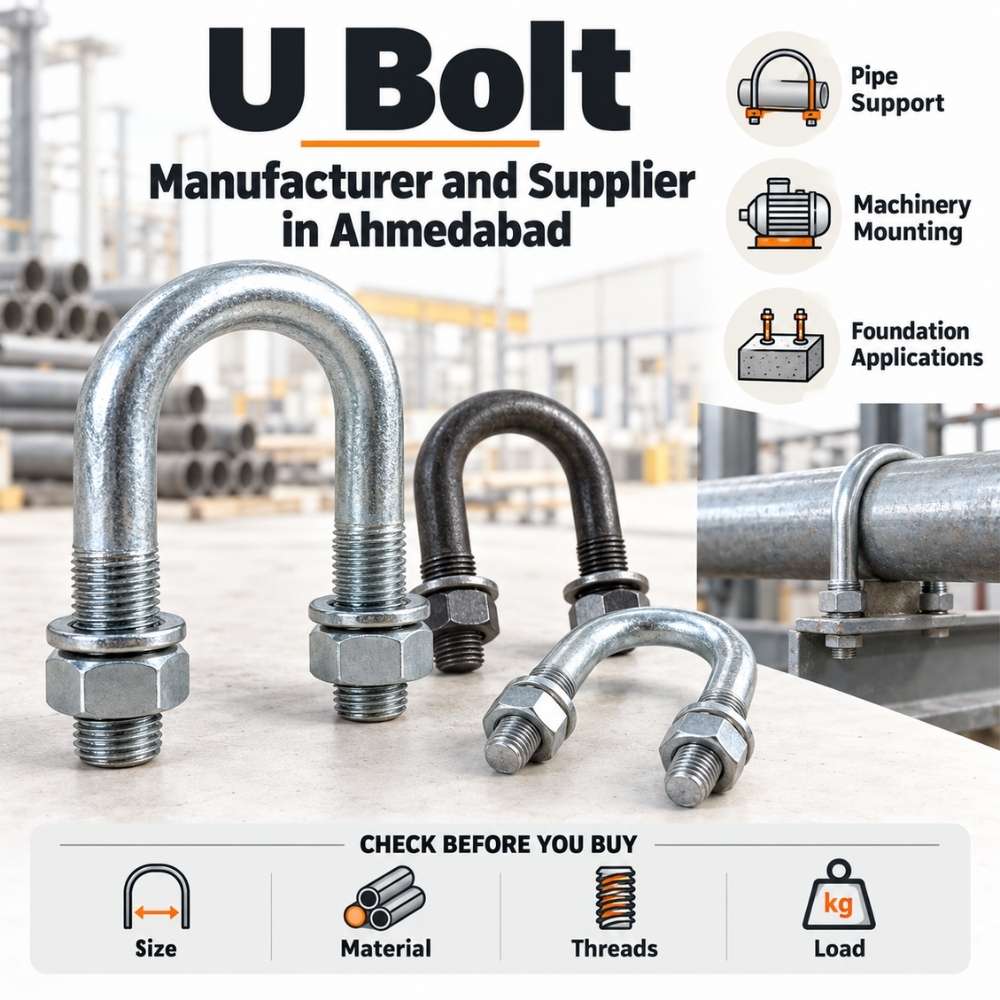
Choosing the right U Bolt can make a significant difference in how securely pipes, cables, machinery components, structural members, and other parts are held in position. Although the design looks simple, the correct bolt must match the application, load, dimensions, material, thread requirements, and installation conditions.
For industrial projects, construction work, infrastructure, and foundation-related applications, buyers often compare different types of Foundation Bolts, including specially designed U-shaped fastening solutions. Understanding these differences helps engineers, contractors, fabricators, and procurement teams make better purchasing decisions.
This guide explains how a U-Bolt works, where it is used, which specifications matter, and how to select a suitable solution for industrial requirements. It also covers important considerations for U Foundation Bolt, MS Foundation Bolt, and related foundation fastening applications.
What Is a U Bolt and How Does It Work?
A U-bolt is a curved fastening component designed to secure pipes, tubes, rods, cables, and other round or cylindrical components to a supporting structure. Its threaded ends work with nuts and washers to create a firm connection. Because of its simple construction, a U-bolt can provide practical support while allowing relatively easy installation and maintenance.
01. U-Shaped Body
The U-shaped body surrounds the supported component and helps keep it securely positioned against the mounting surface. Its curved design allows the fastener to hold round components without requiring complicated installation methods.
- Provides stable component support
- Helps distribute clamping pressure
- Suitable for pipes, tubes, rods, and similar components
- Supports secure positioning during operation
02. Threaded Ends
The threaded ends provide the fastening points for nuts and washers. During installation, the nuts are tightened to create the required clamping force. Therefore, correct thread size and sufficient thread length are important for a reliable connection.
- Provides secure tightening
- Allows easy installation and removal
- Supports different thread specifications
- Helps maintain consistent fastening pressure
03. Inside Width
Inside width refers to the distance between the inner sides of the U-shaped body. This dimension should match the outside diameter or overall dimensions of the supported component. A proper fit helps prevent excessive movement and uneven pressure.
- Should match the component dimensions
- Helps achieve accurate fitting
- Reduces unwanted movement
- Supports proper load distribution
04. Overall Length
Overall length determines how much of the threaded section remains available after the U-bolt passes around the component and through the mounting plate. Therefore, selection should consider the component size, mounting thickness, washer thickness, and nut engagement.
- Consider the supported component thickness
- Allow sufficient space for washers and nuts
- Check the required thread engagement
- Select the length according to the installation arrangement
How to Select the Right U Bolt
Choosing the correct product involves more than selecting a diameter. Instead, buyers should evaluate the complete application.
01. Measure the Supported Component
Start by measuring the outside diameter or relevant dimensions of the component. Then determine the required internal width of the U-shaped body.
This simple step helps reduce fitting problems during installation.
02. Select the Appropriate Material
Material selection should reflect the working environment and mechanical requirements.
MS Foundation Bolt and other mild-steel fastening solutions can provide a practical option for many general industrial applications. However, demanding environments may require protective finishes, coatings, or alternative materials.
03. Check Thread Specifications
Thread pitch, thread diameter, and threaded length should match the required nut and washer arrangement. Moreover, consistent threading can make installation smoother and reduce assembly difficulties.
04. Evaluate Surface Protection
Moisture, chemicals, outdoor exposure, and industrial contaminants can accelerate corrosion. Therefore, buyers should consider an appropriate surface treatment when the operating environment demands additional protection.
05. Consider Quantity and Custom Requirements
Large industrial projects often require multiple sizes or customized dimensions. A manufacturer that can understand drawings and project specifications can help simplify procurement.
U Bolt Applications Across Different Industries
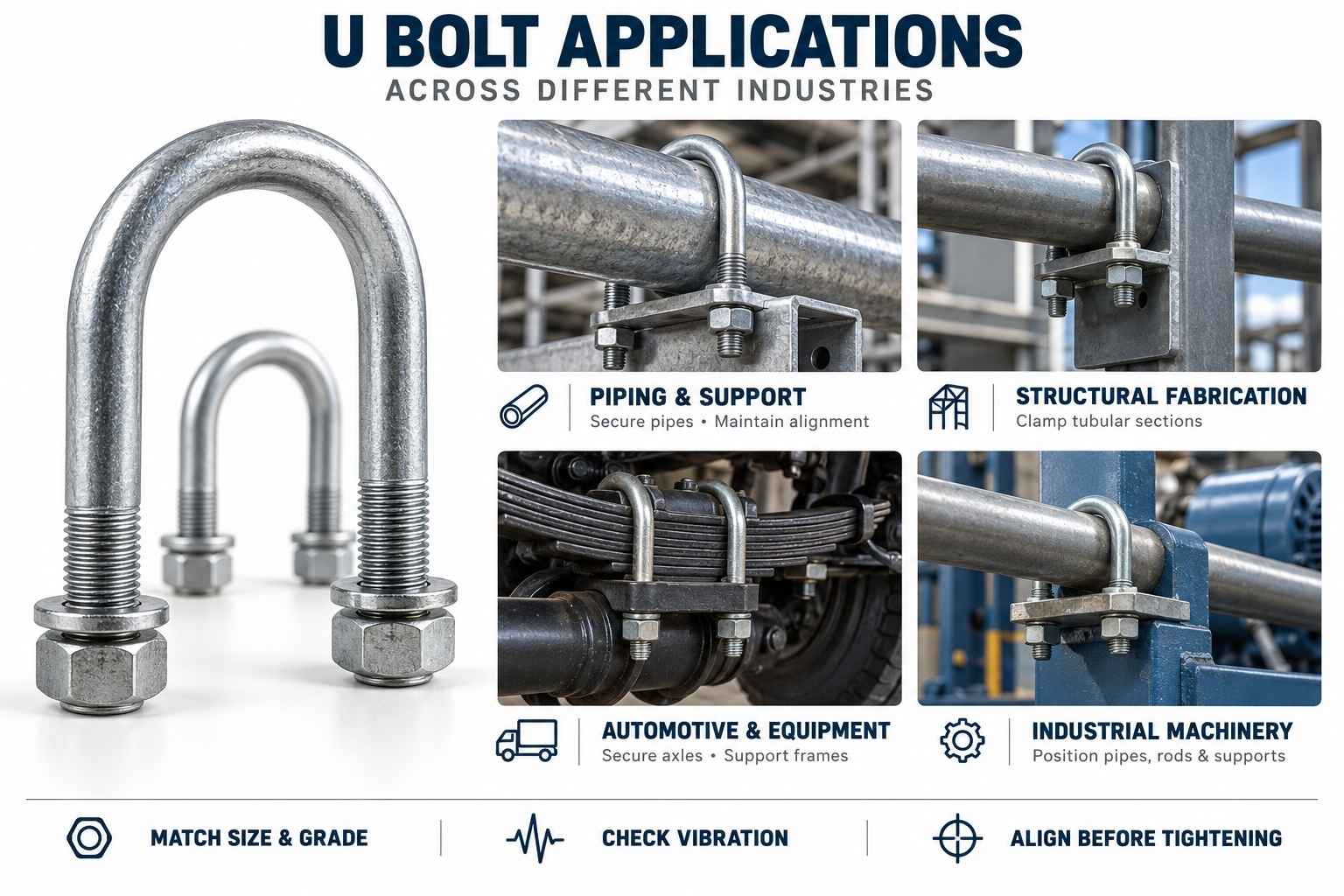
The versatility of the U Bolt in Ahmedabad makes it a practical fastening solution across several engineering sectors. However, each application requires the right dimensions, material, and specifications.
01. Piping and Pipe Support
Industrial piping systems often require secure support to control movement and maintain alignment. A correctly sized fastener can clamp a pipe against a support channel or structural bracket.
Furthermore, proper spacing between supports can reduce unnecessary movement and help maintain the intended piping arrangement.
02. Structural Fabrication
Fabricators can use U-shaped fastening products to connect or hold tubular sections and other structural components. This application is particularly useful when the geometry of the assembly makes surrounding the component easier than drilling through it.
03. Automotive and Equipment Applications
Vehicles, trailers, agricultural equipment, and industrial machinery may require specialized fastening arrangements. Depending on the design, U-shaped fasteners can secure axles, frames, suspension-related components, pipes, or other tubular members.
04. Industrial Machinery
Machines often contain pipes, rods, frames, and support assemblies that need controlled positioning. A suitable fastening component can help maintain alignment while allowing future maintenance.
05. Vibration Considerations
Machines may generate continuous vibration. Therefore, engineers should select appropriate grades, dimensions, washers, nuts, and tightening practices for the specific operating environment.
06. Alignment Requirements
Correct alignment can improve assembly quality and reduce unwanted stress. Consequently, installers should position the fastener correctly before tightening the nuts.
Key Benefits of Using a U Bolt
The right fastening solution can simplify assembly while improving the stability of supported components. A properly specified product also helps maintenance teams remove and replace components more efficiently.
01. Secure Component Clamping
The curved body surrounds the supported pipe or tubular member. Consequently, tightening the nuts can create a firm mechanical connection between the component and its mounting surface.
02. Simple Installation
The design does not normally require complicated assembly procedures. Workers can position the fastener around the component, insert the threaded ends through the mounting arrangement, and tighten the nuts.
Therefore, the product can provide a practical solution for fabrication shops, maintenance work, equipment installation, and industrial construction.
03. Flexible Industrial Applications
Different sizes and materials allow the product to serve a broad range of applications. For instance, manufacturers can produce configurations for piping supports, structural frames, machinery assemblies, agricultural equipment, automotive components, and fabrication projects.
04. Convenient Maintenance
A bolted connection allows maintenance personnel to loosen and remove the fastening hardware when required. As a result, technicians can inspect or replace supported components without permanently cutting the connection.
U Bolt Selection Guide
Frequently Asked Questions About U Bolt
A U-bolt is used to secure pipes, tubes, rods, cables, frames, and other round components. Its U-shaped body surrounds the component and holds it firmly against a support.
A U-bolt surrounds the supported component while its threaded ends pass through a mounting plate or bracket. Nuts and washers then tighten the connection and keep the component securely in position.
Choose the size according to the component diameter, inside width, bolt diameter, overall length, thread length, and mounting thickness. The expected load should also be considered.
U Bolts are commonly manufactured from mild steel, carbon steel, stainless steel, and other specified materials. Material selection depends on strength, application, and environmental conditions.
A U Foundation Bolt is a U-shaped anchoring component used for foundation and structural applications. Its size, length, bend, material, and embedment should match the project requirements.
MS Foundation Bolts are used for various industrial, construction, machinery, structural, and foundation applications where mild steel meets the required engineering specifications.
No FAQ found.
U-bolts are commonly used in piping systems, machinery, structural fabrication, automotive equipment, agricultural equipment, trailers, and industrial support assemblies.
Yes, U Bolts can be manufactured in customized dimensions depending on production capabilities. Customers can specify diameter, length, thread, material, bend dimensions, and quantity.
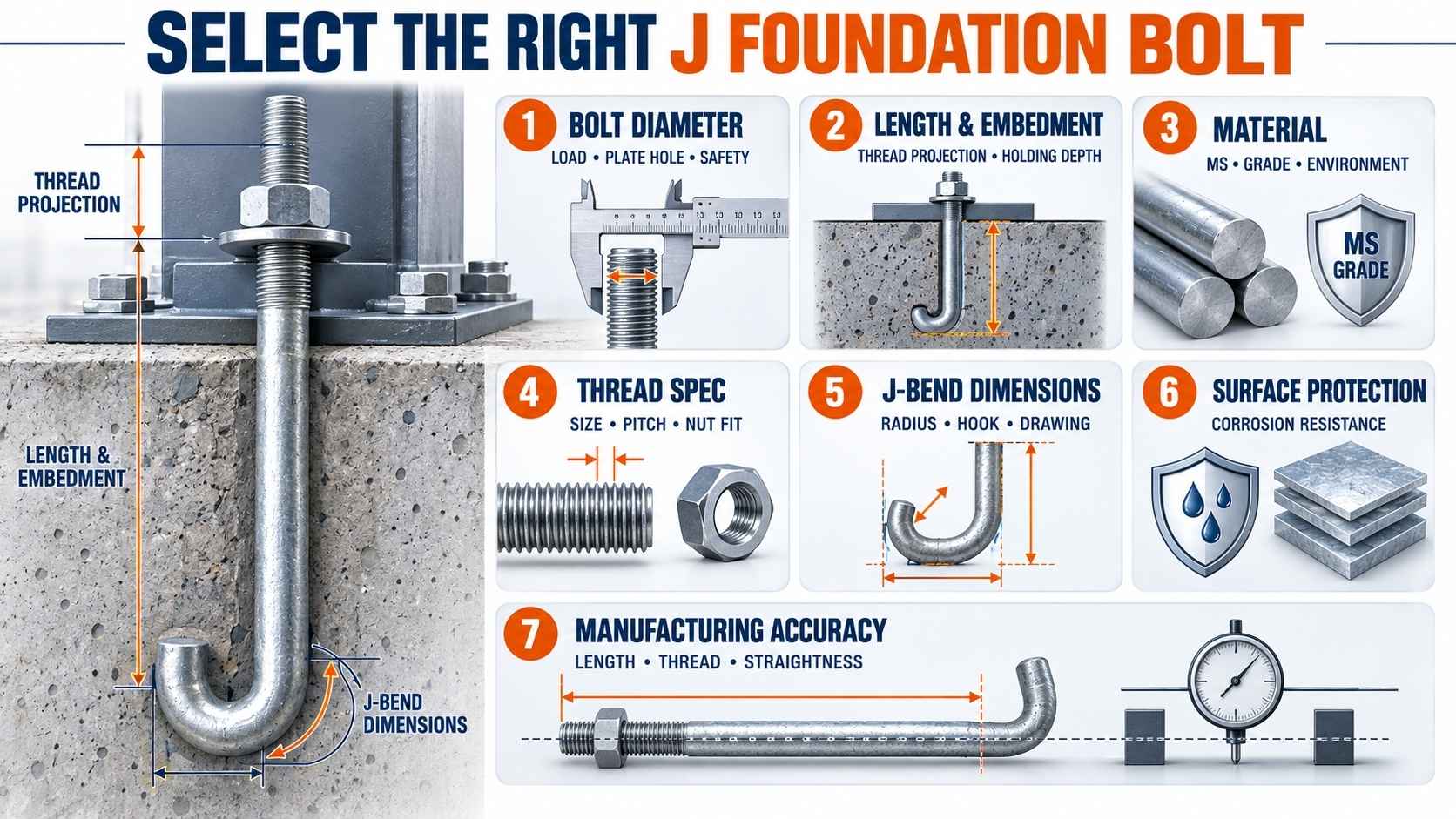
Consider the bolt diameter, overall length, embedment depth, thread length, material grade, bend dimensions, load requirements, base plate thickness, and environmental conditions.
Look for a supplier that offers suitable materials, accurate dimensions, consistent manufacturing, customization options, and technical support according to your application and project requirements.
The required surface finish depends on the application and environment. Outdoor, humid, or corrosive conditions may require suitable protective coatings to improve corrosion resistance.
A U-Bolt provides secure clamping, simple installation, reliable component support, easy maintenance, and flexibility for different industrial and engineering applications.
No FAQ found.
Conclusion on U-Bolt Selection for Industrial Applications
A well-selected U-Bolt can provide a practical and dependable fastening solution for pipes, tubular components, structural assemblies, machinery, and industrial support systems. Its simple U-shaped design makes installation straightforward while providing effective clamping around supported components.
At the same time, foundation-related applications require additional attention to engineering design, embedment, material selection, dimensions, and environmental conditions. Therefore, buyers should select U Foundation Bolt, Foundation Bolt, or MS Foundation Bolt products according to the actual project requirements rather than relying only on product names.
For industrial buyers searching for reliable fastening solutions, LG Industries offers manufacturing and supply support for different engineering requirements. Whether the requirement involves standard dimensions, project quantities, or application-specific specifications, discussing the technical details before ordering can help achieve a better-fitting and more dependable solution.