Why Stud Bolts Are Essential for Heavy-Duty Applications - LG Industries

Why Stud Bolts Are Essential for Heavy-Duty Applications

Stud Bolt Uses and Benefits

Industrial projects need fastening components that deliver strength, accuracy, and dependable support. A Stud Bolt plays an important role in machinery assembly, steel structures, pipe flanges, heavy equipment, and foundation work. It creates a firm connection between two or more parts while allowing easy tightening, removal, and maintenance.

However, selecting the right fastening component requires more than choosing a size. Material grade, thread type, coating, load requirement, installation environment, and dimensional accuracy all affect performance. Therefore, engineers, fabricators, contractors, and procurement teams should understand how these components work before placing an order.

This guide explains the uses, advantages, selection process, and quality factors of industrial stud bolts. It also covers Full Thread Stud Bolt options, Stud Foundation Bolt applications, and the value of working with an experienced Stud Bolt Manufacturer.

Common Materials Used for Manufacturing Stud Bolts
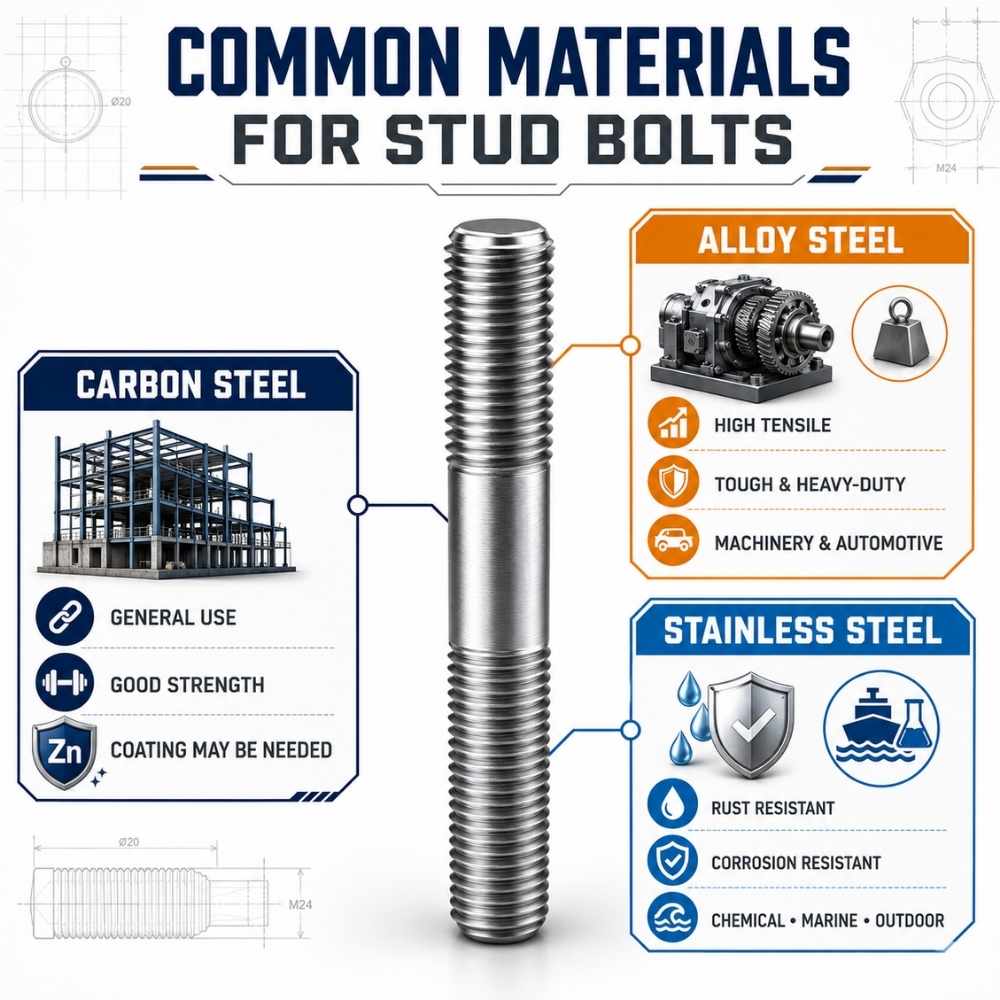
Common Materials Used for Manufacturing Stud Bolts - LG Industries

Material selection directly affects strength, durability, and corrosion resistance. Therefore, buyers should always discuss the operating environment with the supplier before placing a bulk order.

01. Carbon Steel

Carbon steel is widely used for general construction, structural support, and standard machinery applications. It offers good strength at a practical price point. However, it may need zinc plating or another protective coating when used in humid environments.

02. Alloy Steel

Alloy steel provides enhanced tensile strength and toughness. As a result, it is ideal for heavy machinery, high-load installations, automotive systems, and industrial equipment.

03. Stainless Steel

Stainless steel resists rust and corrosion effectively. Thus, it works well in chemical plants, food processing units, marine areas, pharmaceutical facilities, and outdoor installations.

Key Benefits of Choosing the Right Stud Bolt

The right fastening product does much more than connect two parts. It improves stability, simplifies maintenance, and supports safety across the installation.

01. Strong Load-Bearing Capacity

High-quality studs can handle substantial tensile loads. When paired with suitable nuts and washers, they distribute clamping force effectively. As a result, the joint remains secure during normal operation.

02. Easy Installation and Removal

Studs support convenient maintenance because technicians can remove a nut without taking the entire fastener out of the base component. This feature proves especially useful in pumps, valves, engines, and flanged equipment.

03. Suitable for Custom Sizes

Industrial projects often require non-standard lengths, diameters, or thread pitches. A reliable Stud Bolt Manufacturer can produce custom sizes according to drawings, samples, or application details.

04. Better Performance in Harsh Environments

Stainless steel and coated bolts can resist moisture, chemicals, heat, and outdoor exposure. Therefore, buyers can choose a material and finish that supports a longer service life.

How to Select the Correct Stud Bolt

Selecting an industrial fastener only by diameter can lead to failure. Instead, buyers should evaluate the complete application requirement before finalizing the product.

01. Check the Load Requirement

First, understand whether the joint will face tension, shear force, vibration, or dynamic loading. Heavy-duty applications may require high-tensile alloy steel. In contrast, general mounting work may use mild steel or stainless steel.

02. Choose the Right Material Grade

Material selection depends on the surrounding environment. For example, stainless steel works well in chemical plants and outdoor installations. Carbon steel may offer a practical choice for dry indoor conditions.

03. Confirm Thread Type and Pitch

Metric threads and imperial threads are different. Even similar-looking parts may not fit correctly. Therefore, always confirm the thread standard, diameter, pitch, and required thread length.

04. Select an Appropriate Finish

Surface finish protects the fastener and improves appearance. Popular choices include:

  • Zinc plated
  • Yellow zinc plated
  • Hot-dip galvanized
  • Black finish
  • PTFE coated
  • Plain self-finish

For outdoor foundations and exposed steel structures, hot-dip galvanizing often provides stronger corrosion protection.

Applications of Stud Bolts Across Industries
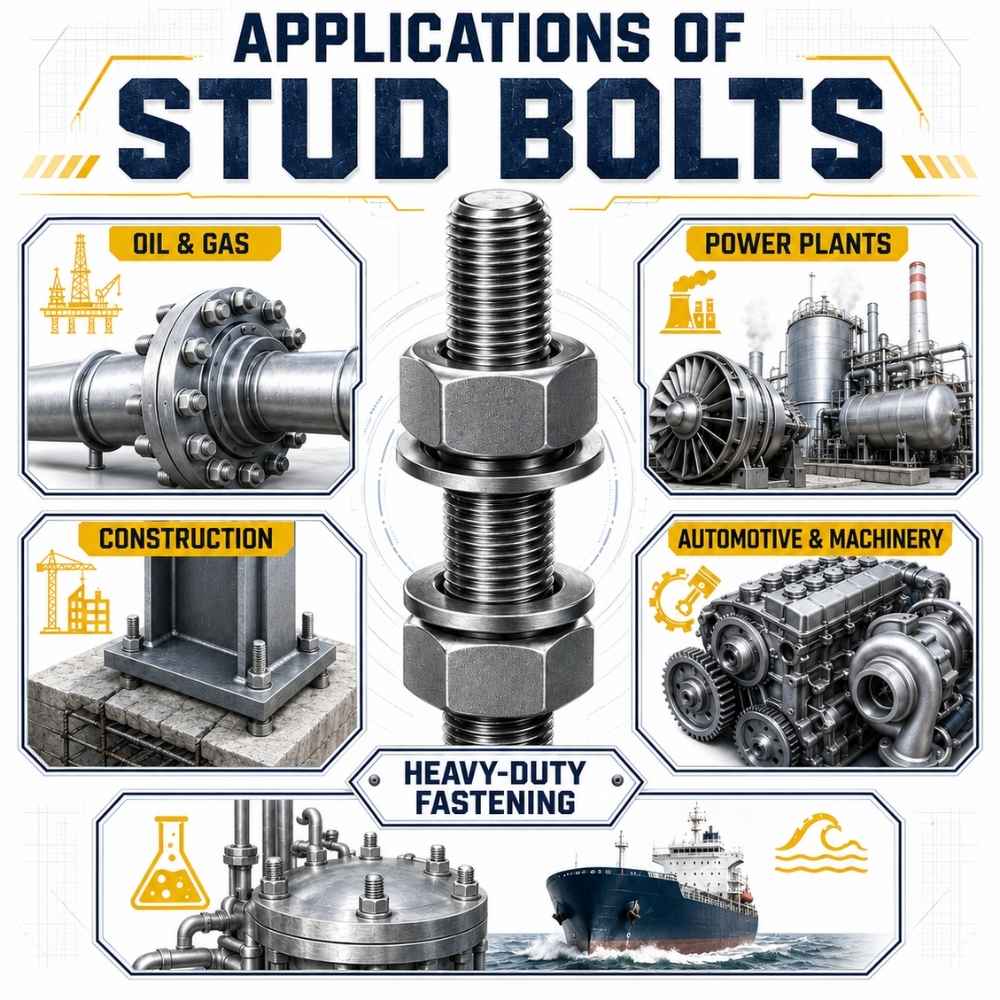
Applications of Stud Bolts Across Industries - LG Industries

Stud bolts support countless industrial applications because they offer strong and adaptable fastening. Their use extends from simple brackets to high-pressure equipment.

01. Oil, Gas, and Pipeline Systems

Flanges in pipelines require high-strength fastening to prevent leakage under pressure. Stud fasteners are often used with flange nuts and washers to create secure joints. Additionally, corrosion-resistant materials help protect the connection in harsh environments.

02. Power Plants and Process Industries

Boilers, turbines, heat exchangers, valves, and pressure vessels rely on dependable fastening systems. Here, correct material grade and thread accuracy become extremely important because high temperatures and vibrations can affect performance.

03. Construction and Steel Fabrication

Builders use these bolts to secure beams, columns, brackets, platforms, and base plates. A quality Foundation Bolt helps transfer loads safely from a structure or machine into the concrete base.

04. Automotive and Engineering Equipment

Engine assemblies, pumps, compressors, gearboxes, and industrial machines often use stud fasteners because they allow repeated dismantling and reassembly. As a result, maintenance teams can service equipment more conveniently.

05. Chemical and Marine Environments

Chemical exposure, saltwater, and high humidity can damage ordinary fasteners. Therefore, stainless steel or specially coated stud products are often selected for chemical plants, coastal facilities, and marine installations.

How to Select the Right Stud Bolt for Your Project

Choosing the correct fastener is not only about diameter and length. Instead, buyers should consider the complete application requirement.

01. Check the Required Material Grade

First, identify whether the environment requires carbon steel, alloy steel, stainless steel, or another special material. For example, outdoor or chemical applications may require corrosion-resistant grades.

02. Confirm Thread Type and Pitch

Thread accuracy ensures that nuts fit properly and tighten smoothly. Coarse threads are commonly used for general applications, whereas fine threads can provide better adjustment and holding power in selected assemblies.

03. Decide the Correct Length and Diameter

The required length depends on component thickness, washer thickness, nut height, and installation clearance. Similarly, the diameter must match the expected load and design specification.

Frequently Asked Questions About Stud Bolts

It is a threaded metal rod used to securely join industrial components, flanges, machinery, and structural parts.

Was this helpful?

A normal bolt has a head on one end. However, this fastener has threads on both ends or across its entire length.

Was this helpful?

They are used in machinery installation, steel structures, pipelines, flange connections, construction, and equipment foundations.

Was this helpful?

It is an anchoring fastener that secures machines, columns, or base plates firmly to a concrete foundation.

Was this helpful?

A full-thread design has threads throughout the rod. Therefore, it allows flexible adjustment of nuts during installation.

Was this helpful?

Common material options include carbon steel, alloy steel, stainless steel, and galvanized steel.

Was this helpful?

Hot-dip galvanized steel and stainless steel are suitable because they offer better resistance against moisture and corrosion.

Was this helpful?

Select the size according to the required load capacity, component thickness, thread type, installation space, and engineering drawing.

Was this helpful?

Yes, high-strength grades are widely used in flange joints, pipelines, pressure vessels, and heavy industrial equipment.

Was this helpful?

Yes. A manufacturer can supply custom length, diameter, thread pattern, material grade, and surface coating as per project requirements.

Was this helpful?

Why Choose a Trusted Stud Bolt Manufacturer?

A professional manufacturer understands that every project has different specifications. They can provide standard and custom products while maintaining consistent quality checks.

Look for a supplier that offers:

  • Multiple material grades
  • Custom sizes and threads
  • Accurate dimensional control
  • Quality-tested raw materials
  • Bulk order capability
  • Corrosion-resistant coatings
  • Timely dispatch
  • Technical support for product selection

Additionally, a dependable supplier can guide you toward the right bolt grade for your exact working environment. This support saves time and helps prevent costly fastening failures.

Final Thoughts on Stud Bolt 

A high-quality Stud Bolt creates stronger, safer, and more serviceable industrial connections. Its versatile threaded design makes it suitable for machinery, flanges, steel structures, pipe supports, and foundations. Meanwhile, selecting the correct material, thread type, finish, and grade ensures dependable long-term performance.

For the best results, choose a manufacturer that understands your project requirements and delivers accurately tested fastening solutions. The right bolt may look like a small component, yet it plays a major role in the strength and stability of your entire installation.
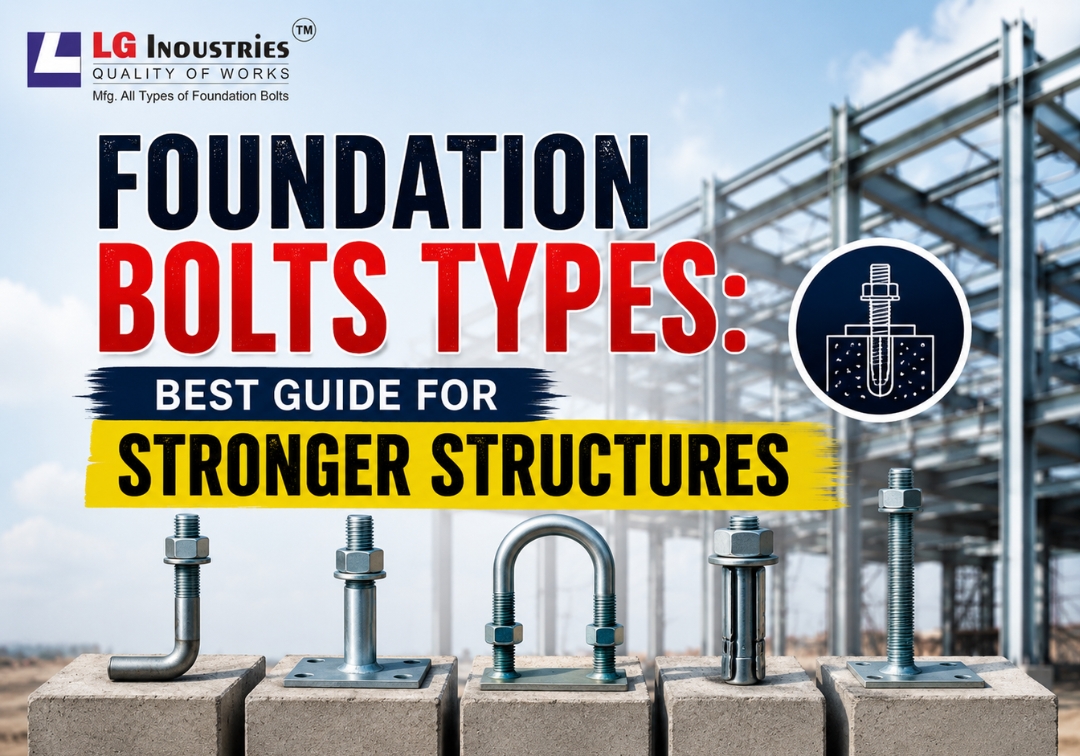
    Foundation Bolts Types Best Guide for Stronger Structures India

    Foundation Bolts Types: Best Guide for Stronger Structures

    Foundation Bolts Types: Complete Guide for Modern Projects

    Every strong structure begins with a solid foundation, but the foundation alone is not enough. The connection between the foundation and the structure is equally important. That is where Foundation Bolts Types play a critical role. Whether you are constructing factories, bridges, warehouses, power plants, transmission towers, or commercial buildings, selecting the correct foundation bolt directly affects safety, durability, and structural performance.

    Understanding various Foundation Bolts Types helps engineers, contractors, architects, and project managers choose the right fastening solution for every application. Each bolt type is designed for specific load conditions, environmental factors, and installation methods.

    What Are Foundation Bolts?

    Foundation bolts are heavy-duty fasteners embedded into concrete foundations before or during construction. Their primary purpose is to securely connect steel structures, machinery, equipment, and support columns to concrete foundations.

    A properly selected foundation bolt provides:

    • High tensile strength
    • Excellent load-bearing capacity
    • Long-term structural stability
    • Resistance against vibration
    • Reliable performance under heavy loads
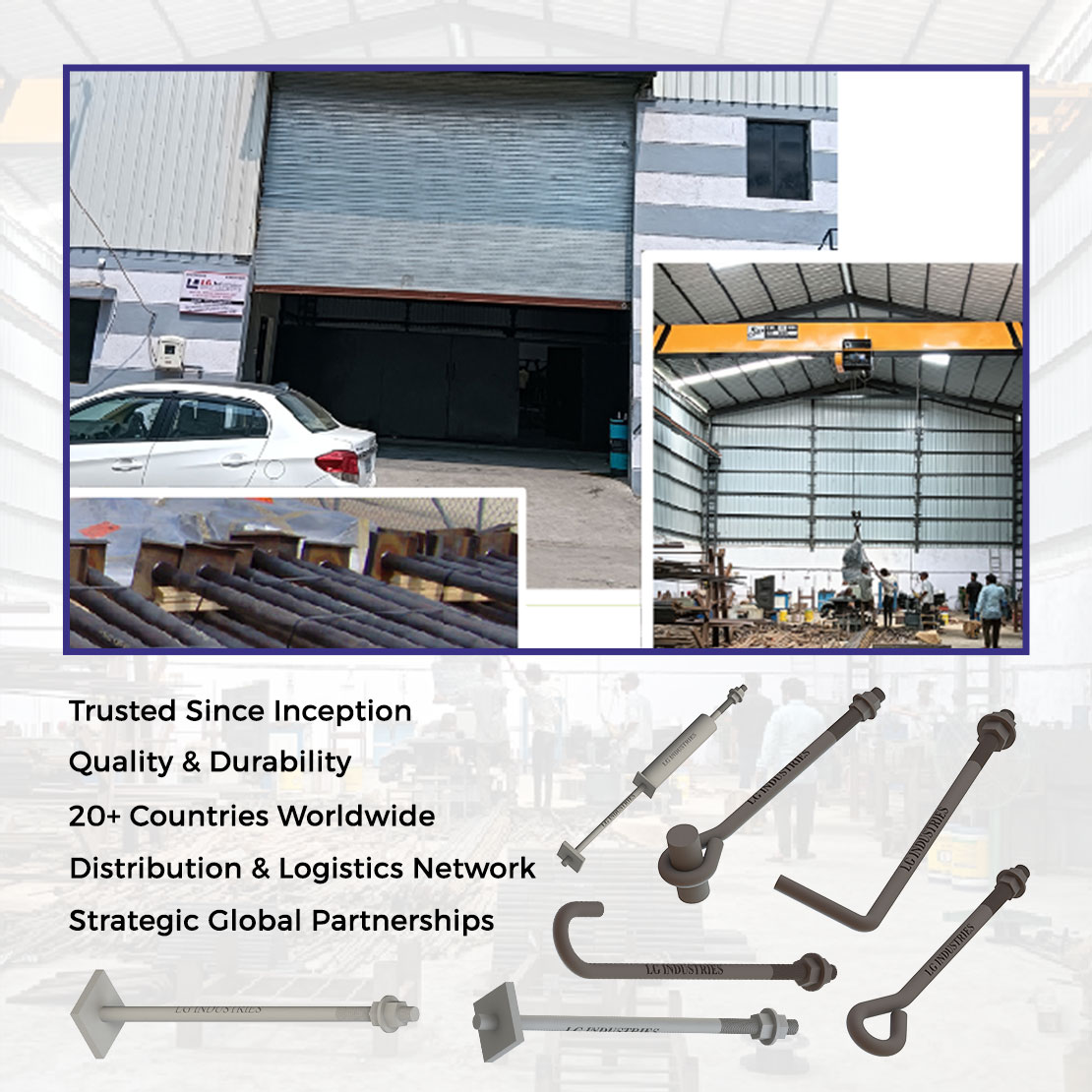
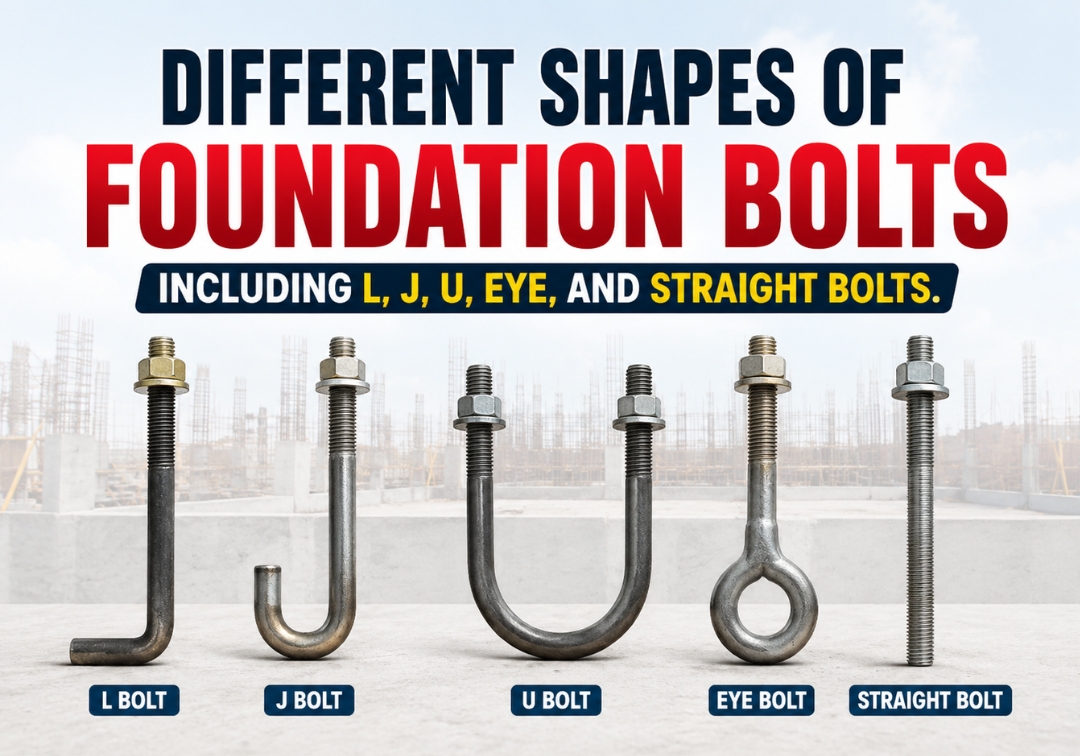
    Different shapes of foundation bolts including L, J, U, Eye, and Straight bolts

    Why Choosing the Right Foundation Bolts Types Matters in India

    Selecting the proper Foundation Bolts Types offers several important benefits.

    1: Enhanced Structural Safety

    Proper bolts minimize movement and improve building stability during operational loads.

    2: Better Load Distribution

    Foundation bolts transfer structural loads evenly into concrete.

    3: Longer Service Life

    Quality bolts reduce maintenance costs and improve durability.

    4: Increased Installation Accuracy

    Correct bolt selection ensures easier alignment of structural components.

    Different Foundation Bolts Types in India

    1. L Type Foundation Bolt

    The L Type Foundation Bolt is one of the most commonly used foundation bolts in construction. Its 90-degree bent end provides excellent anchorage within concrete, making it ideal for permanent installations.

    Applications:

    • Industrial buildings
    • Steel columns
    • Warehouses
    • Manufacturing plants

    Advantages:

    • Strong anchoring performance
    • Easy to manufacture and install
    • Cost-effective solution
    • Excellent load-bearing capacity

    2. J Type Foundation Bolt

    The J Type Foundation Bolt features a hook-shaped end that increases pull-out resistance. It is widely used where high-strength anchoring is required.

    Applications:

    • Heavy machinery foundations
    • Industrial sheds
    • Power plants
    • Commercial buildings

    Advantages:

    • Superior grip inside concrete
    • High tensile strength
    • Reliable under vibration
    • Long service life

    3. U Type Foundation Bolt

    The U Type Foundation Bolt is designed in a U-shaped configuration with threaded ends. It is commonly used to secure pipes, poles, and structural components.

    Applications:

    • Pipe support systems
    • Utility poles
    • Steel structures
    • Industrial equipment

    Advantages:

    • Even load distribution
    • Easy installation
    • High durability
    • Excellent clamping strength

    4. Anchor Foundation Bolt

    The Anchor Foundation Bolt is specially designed to create a secure connection between structural steel and concrete foundations. These bolts are available in several configurations, including cast-in-place and mechanical anchor designs.

    Applications:

    • Steel frame buildings
    • Bridges
    • Industrial plants
    • Heavy equipment installation
    • Infrastructure projects

    Advantages:

    • Exceptional holding power
    • High resistance to uplift forces
    • Suitable for heavy structural loads
    • Long-term structural stability

    5. Stud Bolt

    A Stud Bolt is a fully threaded fastener with no head, secured using nuts on both ends. While commonly used in piping and flange connections, heavy-duty stud bolts are also used in foundation and structural applications.

    Applications:

    • Industrial machinery
    • Flanged joints
    • Structural steel assemblies
    • Petrochemical plants
    • Power stations

    Advantages:

    • Uniform load distribution
    • Easy replacement
    • High-strength fastening
    • Suitable for high-pressure applications

    6. Plate Type Foundation Bolt

    The Plate Type Foundation Bolt incorporates a welded anchor plate at the embedded end, providing superior resistance against pull-out forces.

    Applications:

    • High-rise buildings
    • Bridges
    • Large industrial structures
    • Infrastructure developments

    Advantages:

    • Maximum anchoring strength
    • Excellent load transfer
    • Increased concrete bonding
    • Reliable performance under heavy loads

    7. Pipe Foundation Bolt

    A Pipe Foundation Bolt is specially manufactured to secure pipelines, pipe racks, pipe supports, and process piping systems to concrete foundations. These bolts help maintain alignment and reduce movement caused by vibration or thermal expansion.

    Applications:

    • Oil and gas pipelines
    • Chemical plants
    • Water treatment facilities
    • Power plants
    • Industrial piping systems

    Advantages:

    • Strong pipe support
    • Excellent vibration resistance
    • Improved pipeline stability
    • Long-lasting performance

    8. Sleeve Foundation Bolt

    The Sleeve Foundation Bolt is an expansion-type fastener designed for fixing structural components into existing concrete. As the bolt is tightened, the sleeve expands to create a secure grip.

    Applications:

    • Retrofitting projects
    • Equipment installation
    • Existing concrete structures
    • Industrial renovations

    Advantages:

    • Quick installation
    • Strong expansion grip
    • Suitable for existing concrete
    • Reliable holding strength

    9. MS Stiffener Foundation Bolt

    The MS Stiffener Foundation Bolt uses mechanical expansion to lock securely inside drilled concrete holes. It is widely used when cast-in-place bolts cannot be installed.

    Applications:

    • Machinery foundations
    • Steel structures
    • Industrial platforms
    • Commercial buildings

    Advantages:

    • High pull-out resistance
    • Fast installation
    • Excellent load capacity
    • Suitable for retrofit applications

    10. Galvanized Sag Rod Foundation Bolt

    The Galvanized Sag Rod Foundation Bolt features a rough or forged embedded end that creates a strong mechanical bond with concrete. It is commonly used for heavy-duty industrial installations.

    Applications:

    • Heavy engineering projects
    • Industrial machinery
    • Factory foundations
    • Large equipment bases

    Advantages:

    • Superior anchoring
    • High tensile strength
    • Excellent durability
    • Reliable long-term performance

    Materials Used for Foundation Bolts

    Manufacturers produce foundation bolts using various materials depending on project requirements.

    Common materials include:

    • Mild Steel
    • Carbon Steel
    • Stainless Steel
    • High Tensile Steel
    • Alloy Steel
    • Galvanized Steel

    Each material offers different levels of corrosion resistance, mechanical strength, and durability.

    Applications of Foundation Bolts Types

    Foundation bolts are used in numerous industries.

    Major applications include:

    • Steel structures
    • Commercial buildings
    • Industrial plants
    • Transmission towers
    • Wind turbines
    • Railway infrastructure
    • Petrochemical facilities
    • Power generation plants
    • Warehouses
    • Heavy machinery installation

    Key Factors When Selecting Foundation Bolts Types

    Before purchasing foundation bolts, consider the following.

    1: Load Capacity

    Understand tensile, shear, and compression loads.

    2: Bolt Diameter

    Larger diameters generally provide greater strength.

    3: Embedment Depth

    Proper embedment ensures secure anchorage.

    4: Corrosion Protection

    Use galvanized or stainless steel in corrosive environments.

    5: Concrete Strength

    Concrete grade directly influences bolt performance.

    6: Environmental Conditions

    Consider moisture, chemicals, and temperature exposure.

    Frequently Asked Questions Of Foundation Bolts Types in Indian Market

    The best Foundation Bolts Types depend on your project requirements. L Type, J Type, Anchor Foundation Bolts, Plate Foundation Bolts, Pipe Foundation Bolts, Stud Bolts, and U Bolts are widely used for securing heavy machinery, steel structures, transmission towers, and industrial foundations. Selecting the correct type ensures long-term structural safety and performance.

    Was this helpful?

    Consider the structure's load capacity, concrete grade, bolt diameter, embedment depth, environmental conditions, and corrosion resistance. Consulting an experienced manufacturer helps ensure the selected bolt meets engineering specifications and project safety standards.

    Was this helpful?

    Foundation bolts are extensively used in construction, oil & gas, petrochemical plants, power generation, renewable energy, railway infrastructure, telecommunications, heavy engineering, cement plants, and manufacturing industries where strong anchoring is essential.

    Was this helpful?

    Yes. Foundation bolts can be manufactured in custom diameters, lengths, thread sizes, materials, grades, and surface finishes to match project drawings. Custom fabrication is ideal for infrastructure, industrial, and commercial construction projects requiring precise dimensions.

    Was this helpful?

    LG Industries is a trusted manufacturer, supplier, and exporter of Foundation Bolts based in Ahmedabad, Gujarat. The company manufactures L Type, J Type, Anchor, Plate, Pipe, Stud, and other customized foundation bolts for customers across India and international markets, with products available in multiple grades and finishes.

    Was this helpful?

    LG Industries supplies high-quality foundation bolts from Ahmedabad to major industrial cities including Mumbai, Pune, Delhi, Noida, Gurugram, Jaipur, Ahmedabad, Surat, Vadodara, Rajkot, Indore, Bhopal, Hyderabad, Chennai, Bengaluru, Coimbatore, Kochi, Kolkata, Bhubaneswar, Visakhapatnam, Nagpur, Lucknow, Kanpur, Chandigarh, and Ludhiana, along with customers across India.

    Was this helpful?

    Foundation bolts are commonly produced using Mild Steel, Carbon Steel, Alloy Steel, Stainless Steel, and High Tensile Steel. Depending on the application, they may also be supplied with hot-dip galvanizing, zinc plating, primer coating, or black finishes for improved corrosion resistance.

    Was this helpful?

    Certified foundation bolts provide confidence in strength, dimensional accuracy, and material quality. For critical applications, many manufacturers offer quality documentation, including third-party inspection (TPI) and NABL-approved laboratory test reports, helping meet project quality requirements.

    Was this helpful?

    Yes. Many Indian manufacturers export foundation bolts worldwide for infrastructure, engineering, and industrial projects. LG Industries also serves international customers while supplying projects throughout India, supported by manufacturing and logistics capabilities from Ahmedabad.

    Was this helpful?

    LG Industries combines modern manufacturing, customization, strict quality control, and timely delivery to provide reliable fastening solutions. Whether you need Anchor Foundation Bolts, L Type, J Type, Plate Type, Pipe Foundation Bolts, U Bolts, or Stud Bolts, the company delivers precision-engineered products for projects ranging from small commercial buildings to large industrial facilities across India and export markets.

    Was this helpful?

    Conclusion: Foundation Bolts Types That Improve Structural Safety Today

    Choosing the LG Industries’ Foundation Bolts is one of the most important decisions in any construction or industrial project. The right bolt improves structural integrity, enhances safety, minimizes maintenance, and increases the lifespan of buildings and heavy machinery installations.

    Whether your project requires L Type, J Type, U Type, Eye, Straight, or Plate Foundation Bolts, selecting high-quality products and following proper installation practices ensure dependable long-term performance.

    Looking for premium-quality Foundation Bolts? Contact a trusted manufacturer like LG Industries that delivers certified, precision-engineered fastening solutions designed for maximum strength, reliability, and long-lasting structural performance.

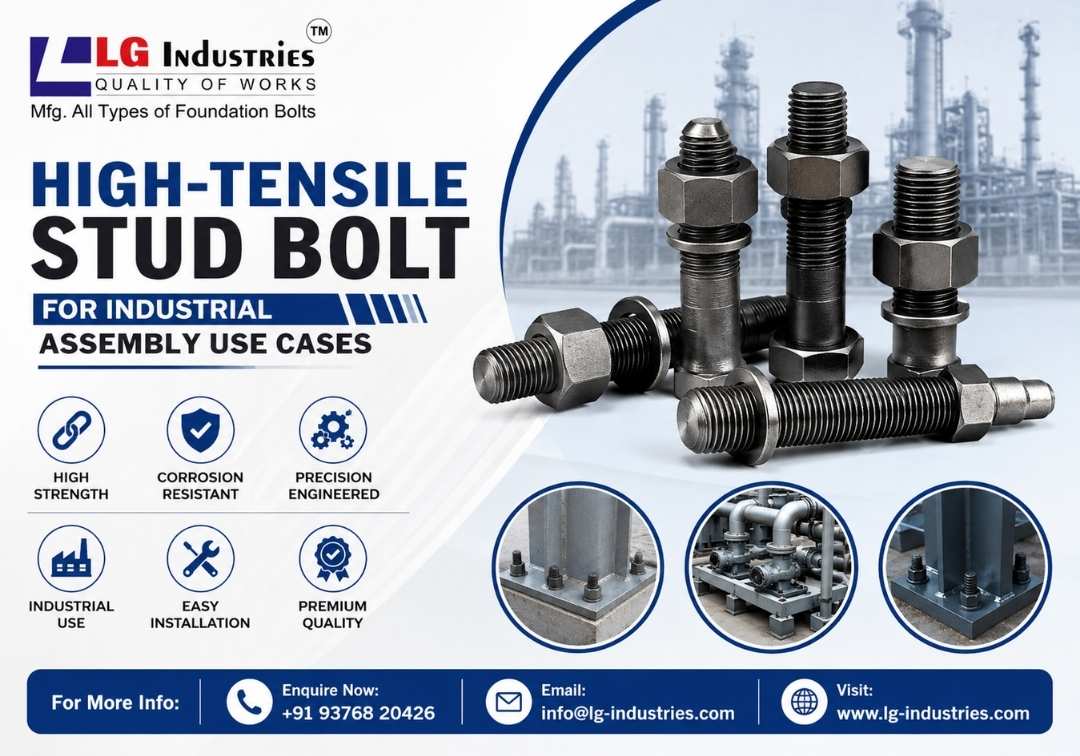
      High-Tensile Stud Bolt for Industrial Assembly Use Cases - LG Industries

      High-Tensile Stud Bolt for Industrial Assembly Use Cases

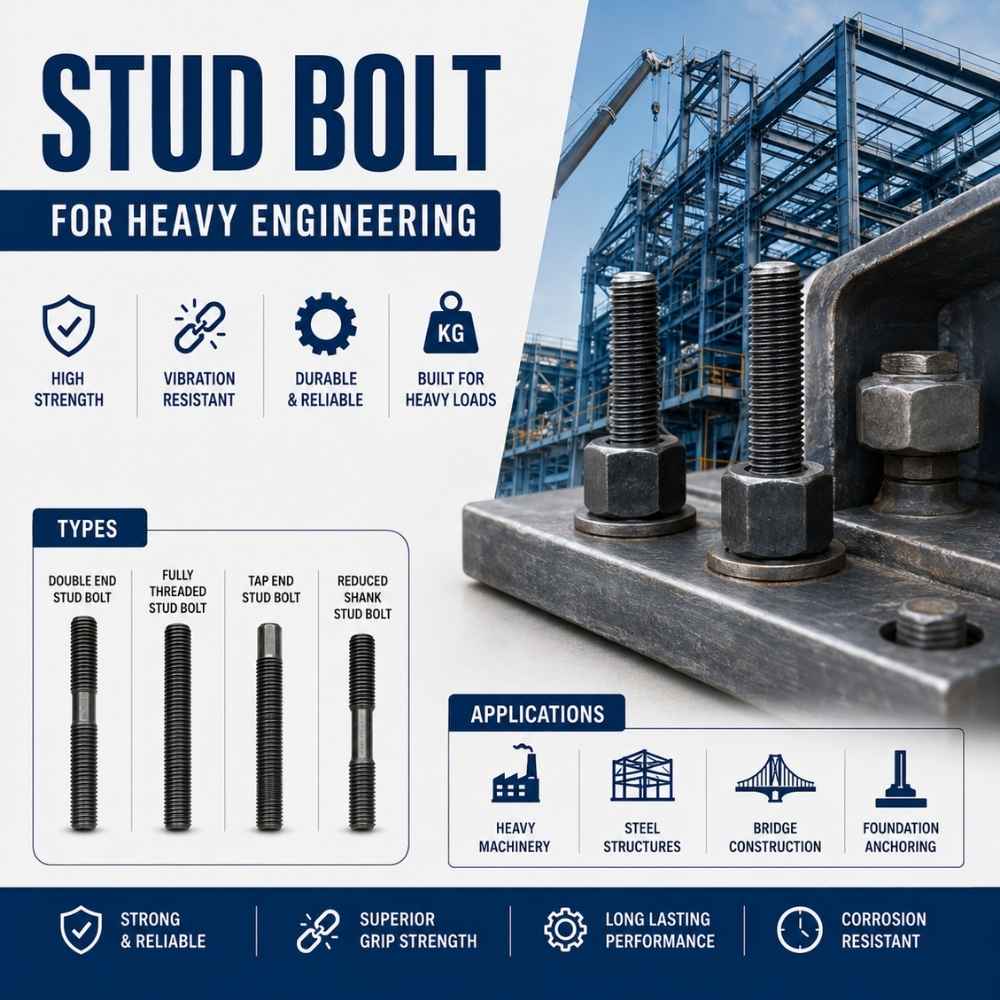
      Stud Bolt for Heavy Engineering 

      Stud Bolt for Heavy Engineering - LG Industries

      In modern engineering and construction industries, strong and reliable fastening systems play a crucial role in ensuring safety, durability, and structural stability. Among these essential components, the Stud Bolt stands out as one of the most trusted and widely used fastening solutions.

      From heavy machinery assembly to steel structure installation and foundation anchoring, a Threaded Stud Rod delivers exceptional performance under extreme pressure, vibration, and load conditions. Moreover, industries prefer it because it provides superior grip strength and long-term reliability compared to conventional bolts.

      In this comprehensive guide, we will explore everything about Stud Bolts, including their types, applications, advantages, installation processes, and why they are widely used in modern industrial projects.

      What is a Stud Bolt, and why is it Widely Used in Engineering?

      A Stud Bolt is a threaded fastener that does not have a head like a standard bolt. Instead, it is a straight rod with threads on both ends or throughout its length. It is typically used with two nuts on either side to secure heavy-duty connections.

      Because of its unique design, an Industrial Fastener distributes load evenly, ensuring strong clamping force and stability. As a result, it is widely used in industries where safety and strength are critical.

      Key Characteristics of Stud Bolt

      A Stud Bolt is designed with precision to handle industrial-grade applications. Some of its core features include:

      • High tensile strength for heavy loads
      • Full thread or double-end threading options
      • Excellent resistance to vibration and loosening
      • Suitable for high-pressure and high-temperature environments
      • Long service life with minimal maintenance

      Furthermore, its design allows easy installation in confined spaces where traditional bolts cannot be used effectively.

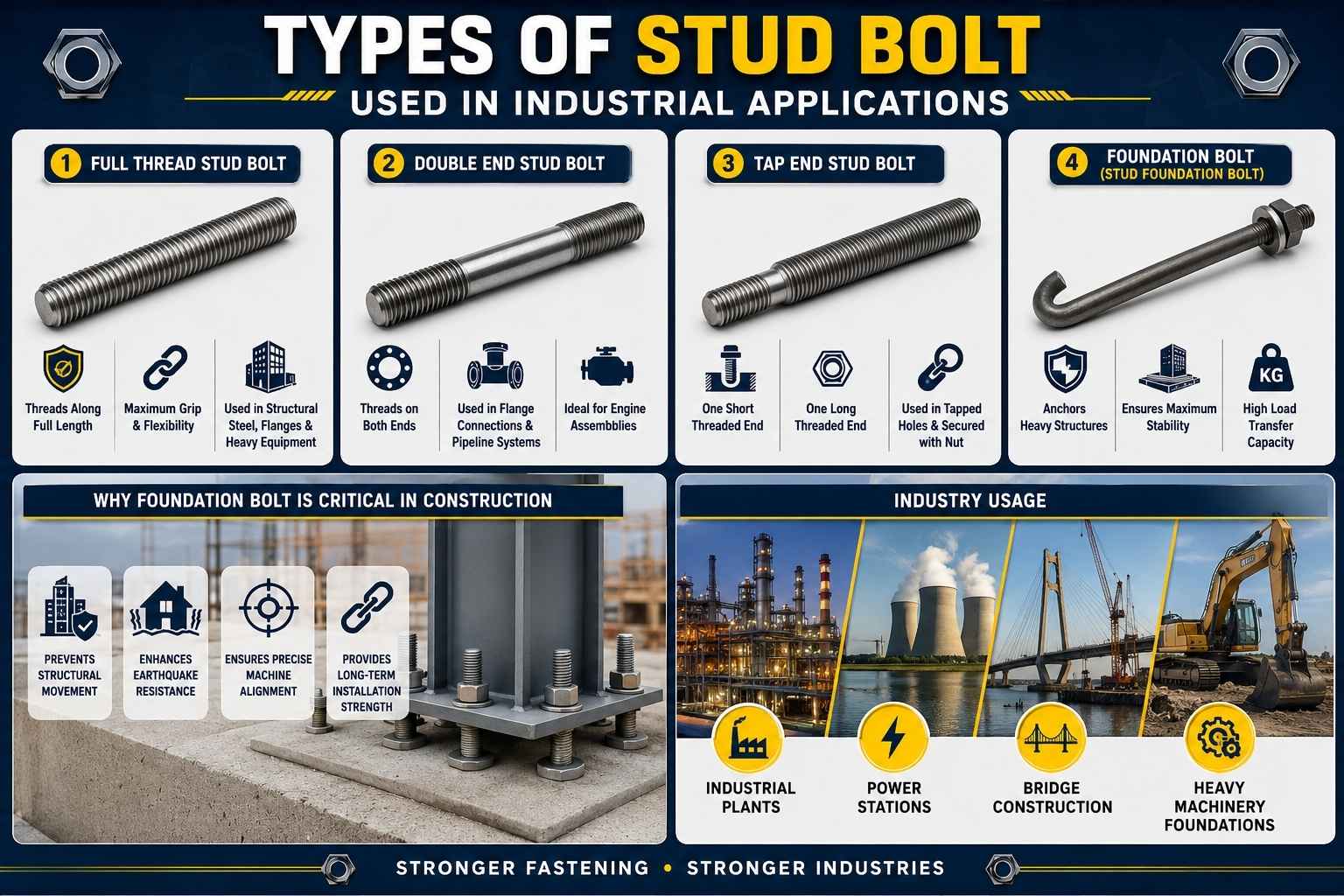
      Types of Stud Bolt Used in Industrial Applications

      Types of Stud Bolt Used in Industrial Applications - LG Industries

      Different industries require different fastening solutions. Therefore, several variations of Stud Bolt are manufactured to meet specific engineering needs.

      01. Full Thread Stud Bolt

      A Full Thread Stud Bolt is threaded along its entire length, offering maximum grip and flexibility in load distribution. It is commonly used in structural steel joints, flanges, and heavy equipment assembly.

      02. Double-End Stud Bolt

      This type of Stud Bolt has threads on both ends with an unthreaded middle section. It is widely used in flange connections, pipeline systems, and engine assemblies.

      03. Tap End Stud Bolt

      A Tap End Threaded Stud Rod has one short threaded end and one long threaded end. It is often used where one side is permanently fixed into a tapped hole, while the other side is secured with a nut.

      04. Foundation Bolt (Stud Foundation Bolt)

      A Stud Foundation Bolt is specifically designed for anchoring heavy structures to concrete foundations. It ensures maximum stability and load transfer between machinery and base structures.

      I. Why Foundation Bolt is Critical in Construction

      • Prevents structural movement
      • Enhances earthquake resistance
      • Ensures precise machine alignment
      • Provides long-term installation strength
      II. Industry Usage

      Foundation bolts are widely used in:

      • Industrial plants
      • Power stations
      • Bridge construction
      • Heavy machinery foundations

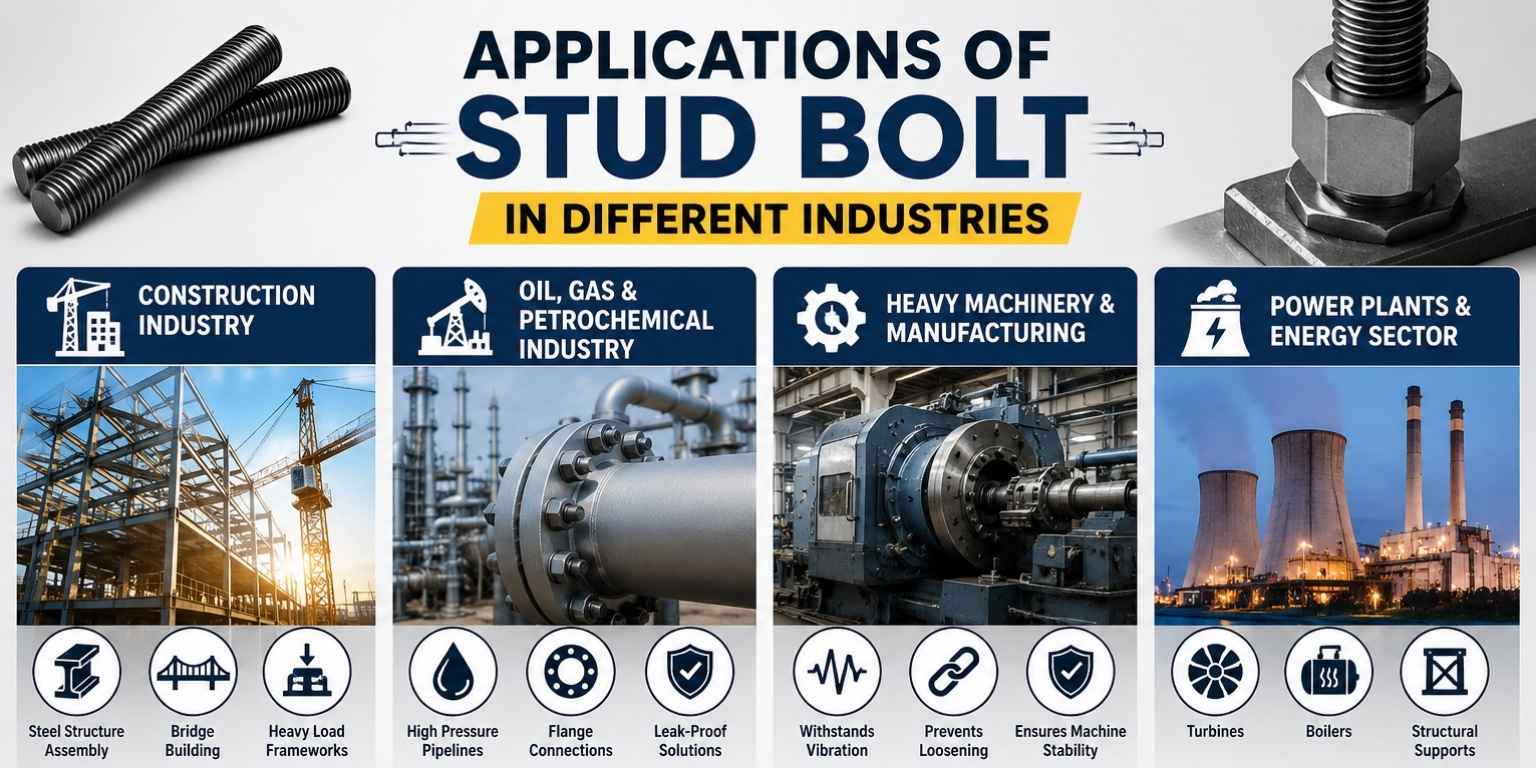
      Applications of Stud Bolts in Different Industries

      Applications of Stud Bolt in Different Industries - LG Industries

      The Stud Bolt is a versatile fastener used across multiple industries due to its strength and reliability. Its applications extend far beyond basic construction work.

      01. Construction Industry

      In construction projects, Foundation Bolts are used for steel structure assembly, bridge building, and heavy load-bearing frameworks. Their ability to withstand safe stress makes them essential for infrastructure development.

      02. Oil, Gas & Petrochemical Industry

      In high-pressure environments like pipelines and refineries, Stud Bolts ensure leak-proof flange connections. Because safety is critical in this sector, only high-quality bolts are used.

      03. Heavy Machinery & Manufacturing

      Machines that operate under vibration and continuous load require strong fastening systems. Threaded stud rods prevent loosening and ensure machine stability during operation.

      04. Power Plants & Energy Sector

      Power plants use industrial fasteners in turbines, boilers, and structural supports. Since these systems operate under extreme conditions, reliability becomes essential.

      Advantages of Using Stud Bolts in Industrial Projects

      Choosing the right fastening solution directly impacts the performance and safety of any structure. The Stud Bolt offers several advantages that make it a preferred choice.

      01. Superior Load Distribution

      Unlike conventional bolts, Foundation Bolts distribute stress evenly across the joint, reducing the risk of failure.

      02. High Strength & Durability

      Threaded Stud Rods are manufactured using high-grade materials such as carbon steel, alloy steel, and stainless steel, ensuring long-lasting performance.

      03. Easy Installation and Maintenance

      Because Foundation Bolts do not have a head, they can be installed in tight spaces. Additionally, maintenance becomes easier since only nuts need replacement.

      04. Resistance to Corrosion and Temperature

      In harsh environments, Stud Bolts maintain their structural integrity, especially when coated or made from stainless steel.

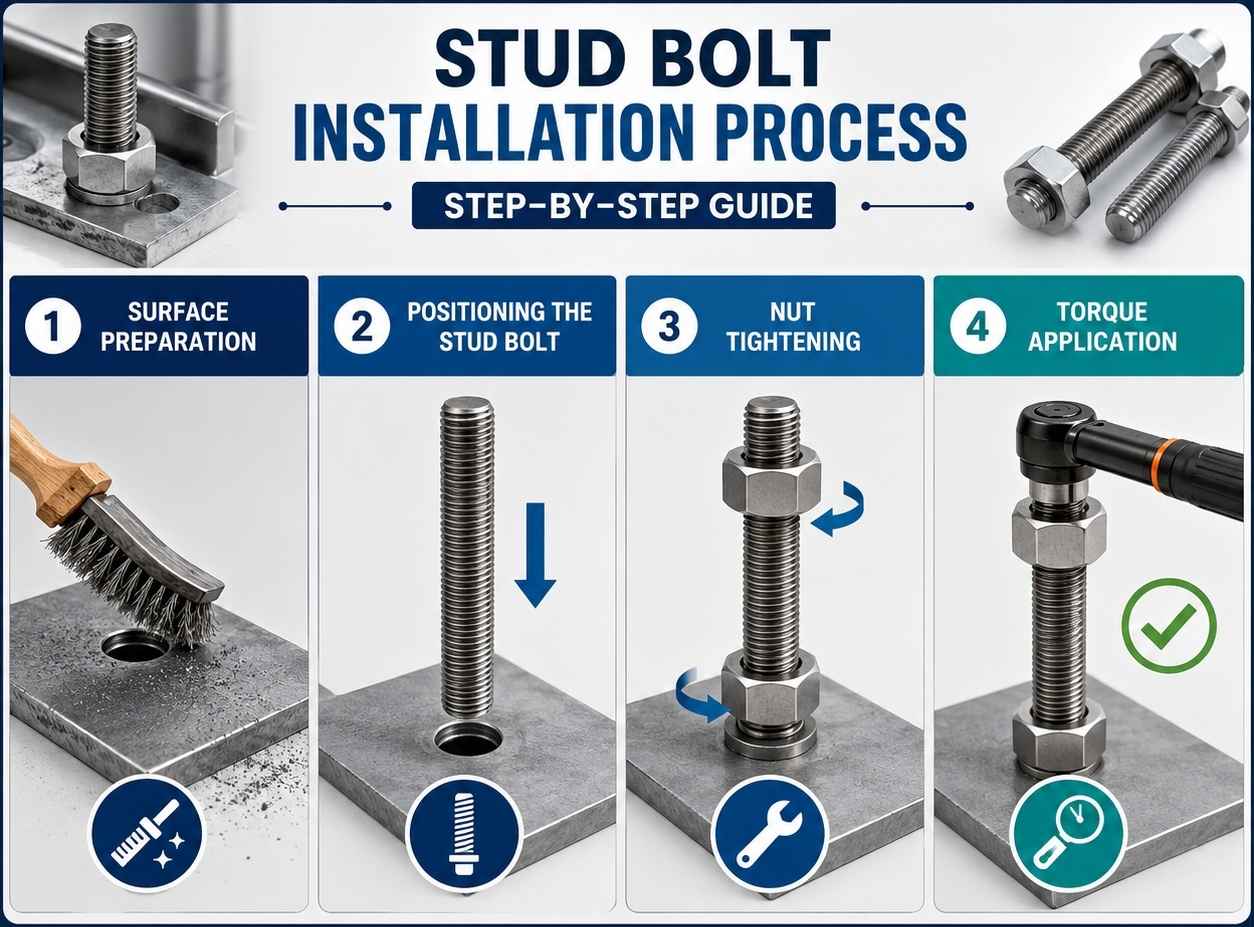
      Stud Bolt Installation Process – Step-by-Step Guide

      Stud Bolt Installation Process – Step-by-Step Guide - LG Industries

      Proper installation ensures maximum performance and safety. The Stud Bolt installation process must be carried out carefully to avoid structural issues.

      Step 1 – Surface Preparation

      Before installation, ensure that all surfaces are clean, aligned, and free from dust or rust.

      Step 2 – Positioning the Stud Bolt

      Insert the Foundation Bolt into the designated hole or structure carefully without damaging the threads.

      Step 3 – Nut Tightening

      Place nuts on both ends and tighten them evenly to ensure balanced load distribution.

      Step 4 – Torque Application

      Apply the correct torque value using industrial tools to achieve proper fastening strength.

      Important Installation Tips
      • Always use calibrated tools
      • Avoid over-tightening
      • Inspect threads before installation
      • Follow manufacturer guidelines

      Stud Foundation Bolt in Heavy Structural Applications

      A Stud Foundation Bolt plays a critical role in securing heavy equipment and structures to concrete foundations. It ensures that machines remain stable even under high vibration and dynamic loads.

      01. Importance in Industrial Stability

      Without proper foundation bolts, machinery alignment can shift over time, leading to performance issues and safety risks.

      02. Where Stud Foundation Bolts Are Used

      • Wind turbine installations
      • Industrial machinery foundations
      • Steel column anchoring
      • Bridge support systems

      03. Material Selection for Foundation Bolts

      Different materials are selected based on load requirements:

      • Mild steel for general construction
      • Alloy steel for heavy-duty applications
      • Stainless steel for corrosion resistance

      FAQs About Stud Bolt

      What is a Stud Bolt?

      A Stud Bolt is a headless threaded fastener with threads on both ends or along its full length, used with nuts to create strong and secure joints in industrial and construction applications.

      Where is Stud Bolt commonly used?

      Stud Bolts are widely used in construction, oil & gas pipelines, petrochemical plants, power plants, heavy machinery, and structural steel work due to their high strength and durability.

      What is the difference between a Stud Bolt and a normal bolt?

      A normal bolt has a head on one side, while a Stud Bolt has no head and is fully or partially threaded. Stud Bolts provide better load distribution and are preferred for heavy-duty applications.

      What is a Full Thread Stud Bolt?

      A Full Thread Stud Bolt is threaded throughout its entire length, allowing flexible fastening and better grip in high-load applications such as flanges and structural joints.

      What is a Stud Foundation Bolt used for?

      A Stud Foundation Bolt is used to anchor heavy machinery and structures to concrete foundations, ensuring stability, alignment, and resistance to vibration and movement.

      Which material is used for Stud Bolt manufacturing?

      Stud Bolts are commonly made from carbon steel, alloy steel, stainless steel, and high-tensile steel, depending on the application and environmental conditions.

      How does Stud Bolt improve safety in structures?

      Stud Bolts distribute load evenly, reduce joint failure risk, resist vibration loosening, and ensure long-term structural stability, making them ideal for critical industrial applications.

      Can Stud Bolts be reused?

      Yes, in some cases, Stud Bolts can be reused if the threads are not damaged and the bolt has not been overstressed. However, in critical applications, replacement is recommended for safety.

      What sizes are available in Stud Bolts?

      Stud Bolts are available in a wide range of sizes, from small diameters for machinery to large heavy-duty sizes for industrial and structural applications, depending on project requirements.

      Why choose Stud Bolts over other fasteners?

      Stud Bolts are preferred because they offer higher strength, better load distribution, corrosion resistance (if coated), and reliable performance in extreme conditions.

      How Stud Bolts Improve Structural Safety and Performance

      Structural safety is one of the top priorities in engineering. The Stud Bolt significantly contributes to improving safety standards.

      Firstly, it minimizes joint failure risks by providing uniform tension. Secondly, it enhances vibration resistance, which is essential for rotating machinery. Finally, it ensures long-term reliability, reducing maintenance costs.

      Moreover, in critical industries such as oil refineries and power plants, Stud Bolts are often mandatory due to their proven safety performance.

      Why Choose a High-Quality Stud Bolt for Your Project?

      Selecting the right Stud Bolt is not just a technical decision—it is a long-term investment in safety and performance.

      High-quality Stud Bolts:

      • Reduce maintenance downtime
      • Improve operational efficiency
      • Increase structural lifespan
      • Ensure compliance with engineering standards

      In addition, certified manufacturing ensures that each Threaded Stud Rod meets international quality requirements, making it suitable for both domestic and export use.

      Conclusion – Stud Bolt as a Backbone of Modern Engineering

      In conclusion, the Stud Bolt is an essential component in modern engineering and construction industries. Its strength, durability, and versatility make it a preferred fastening solution across multiple sectors.

      Whether it is a Full Thread Stud Bolt, a Stud Foundation Bolt, or a standard industrial fastening application, each type plays a crucial role in ensuring safety and performance.

      As industries continue to evolve, the demand for reliable fastening systems like Industrial Fastener will continue to grow. Therefore, choosing the right quality and specification becomes extremely important for long-term success.

      Get in Touch with LG Industries Today

        ×

        Buy MS Foundation Bolt at Best Prices Across India